

Top Highlights
-
Novel Technique Development: The paper introduces the SADDBN-AMOA technique for resilient attack detection in smart city IoHT networks, enhancing security against threats through a structured model integrating data pre-processing, feature optimization, deep learning, and model tuning.
-
Effective Data Normalization: It utilizes Z-score normalization for data pre-processing to standardize varying feature scales, ensuring effective input for machine learning algorithms, ultimately boosting the stability, accuracy, and performance of the intrusion detection model.
-
Feature Optimization through SMO: The feature subset selection employs the SMO method, chosen for its adaptability and global search efficiency, which enhances model accuracy while minimizing computational costs by retaining critical data during dimensionality reduction.
- Model Tuning with IHHO: The IHHO approach optimizes the DBN model’s hyperparameters, improving classification performance and reducing false positives, thus ensuring robust detection capabilities in high-dimensional and noisy IoHT environments.
A Deep Dive into AI for Smart Cities
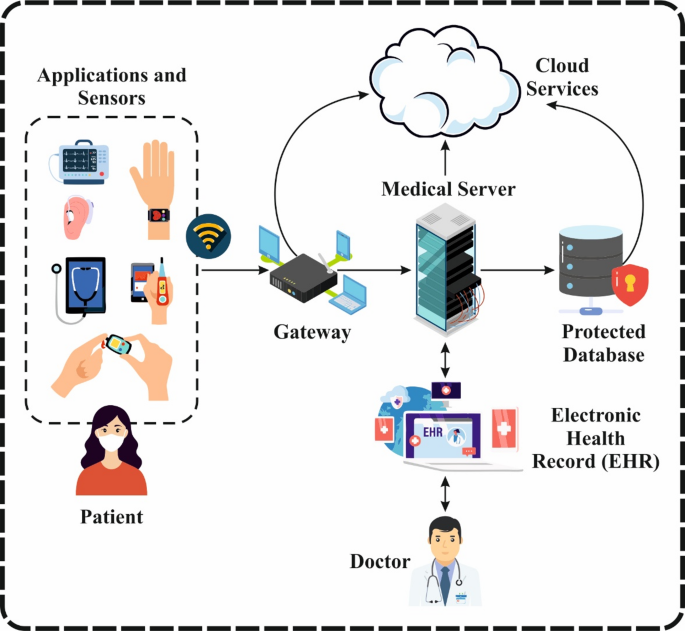
Artificial intelligence is transforming the Internet of Health Things (IoHT) in smart cities. New research introduces the SADDBN-AMOA technique, designed to improve security breach detection in healthcare environments. This innovative method enhances cybersecurity, ensuring safer data management. First, it utilizes Z-score normalization for data pre-processing. This step standardizes data, enabling effective feature contribution and increasing model accuracy. Unlike conventional methods, Z-score normalization mitigates the impact of outliers, allowing various features to perform equally. This robust pre-processing improves the stability and reliability of integrated models in health-related applications.
Next, the SADDBN-AMOA model employs the Support Vector Machine Optimization (SMO) method for feature optimization. This powerful approach streamlines data analysis by selecting relevant features while reducing dimensional complexity. As a result, this leads to faster model performance without sacrificing essential data quality. With efficient classification capabilities, this model proves particularly advantageous for densely populated urban areas where healthcare data security is a priority. Furthermore, the Deep Belief Network (DBN) method enhances attack detection, efficiently learning complex feature representations from high-dimensional data. Finally, the Intelligent Harris Hawks Optimization (IHHO) technique fine-tunes the model, improving detection accuracy and minimizing false positives. These advancements collectively contribute to creating a safer and more responsive smart city environment.
Improving Quality of Life Through Innovation
The impact of the SADDBN-AMOA technique extends beyond security. It directly influences the quality of life for residents in smart cities. Increased security in IoHT networks boosts trust in healthcare systems, allowing citizens to feel more secure about their data. As these technologies continue to develop, they open the door for enhanced health surveillance and response systems. Therefore, residents benefit from quicker diagnosis and treatment, ultimately leading to improved health outcomes.
Moreover, adopting advanced AI technologies fosters an environment of innovation and progress. Cities that prioritize smart health initiatives demonstrate their commitment to integration and inclusivity. This approach helps bridge the gap between technology and healthcare, ensuring that all residents have access to essential services. By investing in these systems, smart cities enhance their overall resilience, effectively preparing for and responding to future challenges. The integration of optimized AI security measures not only strengthens healthcare but also cultivates a brighter future for urban living.
Continue Your Tech Journey
Explore the future of technology with our detailed insights on Artificial Intelligence.
Learn more about cutting-edge innovations supported by the National Science Foundation (NSF).
IoTV1
