

Top Highlights
-
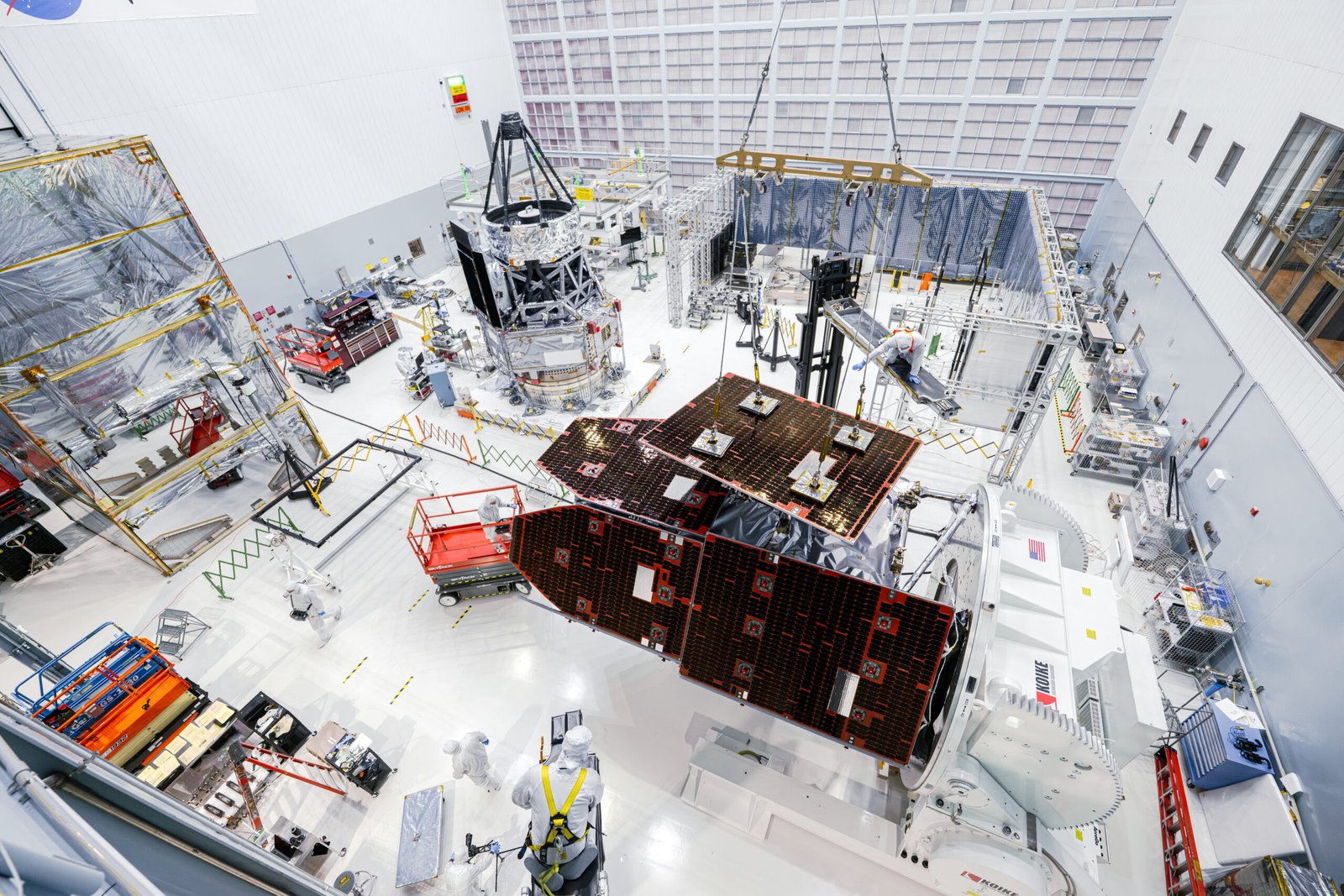
Solar Panel Installation Completed: Technicians installed solar panels on NASA’s Nancy Grace Roman Space Telescope, marking a key milestone in the observatory’s assembly.
-
90% Complete and Ahead of Schedule: The telescope is now 90% complete, with plans for potential launch as early as fall 2026, well ahead of the May 2027 deadline.
-
Critical Thermal Management: The Solar Array Sun Shield, consisting of six panels, will provide essential power and cooling for the observatory’s infrared instruments, preventing overheating.
- Upcoming Tests and Assembly: Final connections and testing of the observatory’s components are planned for November, aiming for a fully assembled system by the end of the year.
Technicians at NASA’s Goddard Space Flight Center recently took a significant step in the assembly of the Nancy Grace Roman Space Telescope. On June 14 and 16, they installed solar panels onto the observatory, marking one of the final stages of construction. Collectively called the Solar Array Sun Shield, these panels serve dual purposes. They will provide power and shade to the observatory, which is crucial for its infrared observations.
As work progresses, the observatory is now about 90% complete. The Solar Array Sun Shield consists of six panels, with two central panels fixed and four deployable. Once in space, the deployable panels will align to ensure the telescope receives a consistent power supply from the Sun. This design also helps keep the instruments cool. Since the telescope looks for infrared signals, excess heat could interfere with its observations.
With the panels installed, technicians will prepare for testing. They plan to deploy both the solar panels and the observatory’s aperture cover, known as the visor. These tests will simulate the harsh conditions of space. This process will help confirm that the system operates as intended.
Moreover, the schedule remains optimistic. Engineers expect that they could finish connecting the observatory’s core and outer segments by November. If all goes well, the telescope could launch as early as fall 2026.
This ambitious project illustrates how advances in technology can enhance our understanding of the universe. The collaboration includes numerous organizations, each contributing its expertise. The diverse partnerships also emphasize how joint efforts in research and technology can improve life on Earth and beyond.
For those interested in exploring more, a virtual tour of the telescope is available online. Meanwhile, the mission continues to inspire excitement within the scientific community. Considering the potential discoveries ahead, the impact of this telescope could be profound.
Stay Ahead with the Latest Tech Trends
Learn how the Internet of Things (IoT) is transforming everyday life.
Access comprehensive resources on technology by visiting Wikipedia.
SciV1
