

Top Highlights
-
Breakthrough in Frequency Combs: MIT researchers developed a compact, integrated device using a novel mirror to generate stable optical frequency combs with broad bandwidth, essential for precise chemical detection.
-
Addressing Dispersion Challenges: The team tackled dispersion issues, which typically limit bandwidth, using a double-chirped mirror (DCM) designed for infrared waves, drastically improving the performance of frequency combs.
-
Portable Applications: This technology enables the creation of scalable remote sensors and portable spectrometers capable of real-time monitoring of multiple chemicals, enhancing environmental monitoring.
-
Future Potential: The innovative design opens pathways for further advancements in frequency comb technology, aiming for even greater bandwidth and power suitable for diverse applications in chemical sensing and communications.
MIT’s New Laser “Comb” Revolutionizes Chemical Detection
MIT researchers have introduced a groundbreaking laser technology that could change chemical detection. This new device uses optical frequency combs to identify chemicals with extreme precision. As a result, it can help monitor pollutants and trace gases more effectively.
Optical frequency combs act like rulers for measuring light frequencies. They consist of laser lines, similar to teeth on a comb. Traditional models face challenges due to their bulky components, limiting their scalability and performance. This innovation overcomes those hurdles.
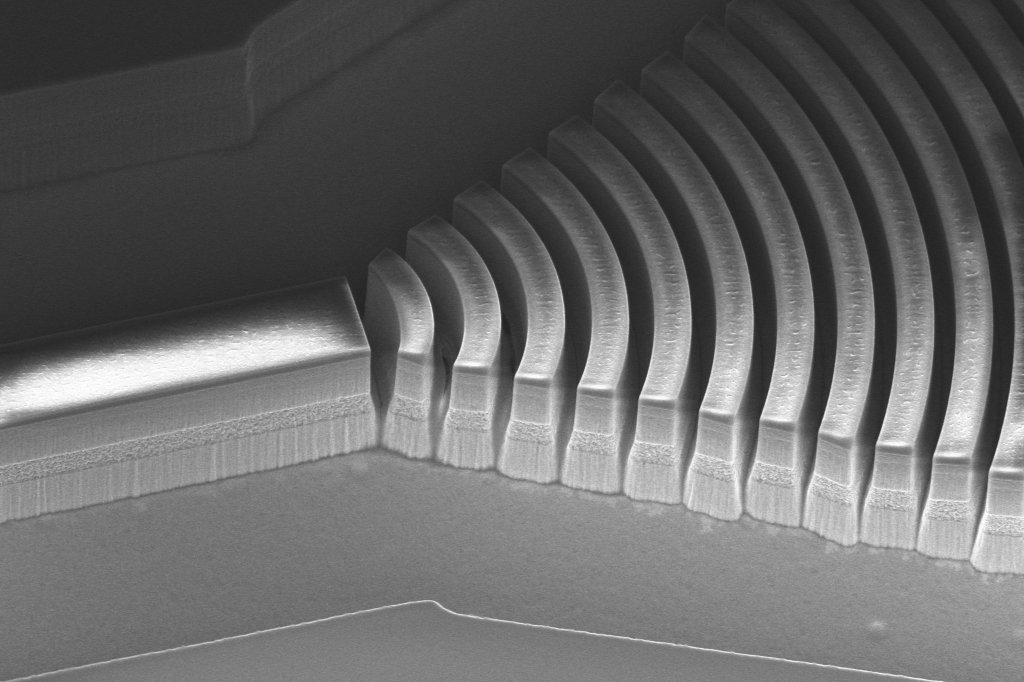
The researchers, led by Qing Hu, developed a compact, integrated device that employs a specially designed mirror. This mirror generates a frequency comb with broad bandwidth. Such advancements allow for real-time chemical monitoring without complex equipment.
“Dispersion limits bandwidth, but we made it the focus of our research,” Hu said. This approach improves the reliability of detecting harmful chemicals. It could lead to more robust environmental monitoring solutions.
Dual-comb spectroscopy, a technique utilized in this research, examines chemical samples by comparing two beams from different frequency combs. This method enhances sensitivity and accuracy, producing clearer results for scientists.
The team encountered challenges in developing the mirror for infrared lasers, which required extreme precision. They initially struggled due to the high dispersion rates associated with long-wave infrared technology. However, they found a solution by adapting their design to compensate for these issues.
Now, the researchers envision extending their technology to develop even more powerful laser systems. This progress has far-reaching implications for areas such as environmental monitoring and free-space communications.
As Hu noted, “Our flexible approach allows us to design frequency combs for various applications.” Experts in the field, like Jacob B. Khurgin from Johns Hopkins University, agree that this innovative approach opens up a world of possibilities for practical applications.
Overall, MIT’s new laser comb sets the stage for advancements in chemical detection technologies. It highlights the potential of compact devices that can perform complex tasks efficiently, promising a brighter future for environmental safety and technological innovation.
Discover More Technology Insights
Explore the future of technology with our detailed insights on Artificial Intelligence.
Access comprehensive resources on technology by visiting Wikipedia.
QuantumV1
