

Fast Facts
-
Starpath’s Achievement: Starpath secured second place in NASA’s Break the Ice Lunar Challenge, which focused on designing robotic technologies for lunar regolith excavation and transportation.
-
Testing at NASA: The team utilized NASA’s Marshall Space Flight Center’s 20-foot thermal vacuum chamber to test their advanced lunar rover, built to operate in extreme lunar conditions.
-
Innovative Technology: The four-wheeled rover features a dual drum barrel that efficiently excavates regolith, targeting the Moon’s South Pole, a key site for NASA’s Artemis missions.
-
Future Implications: This technology aims to support lunar missions by excelling in ice extraction, crucial for providing water and fuel in future space explorations.
Starpath Tests Innovative Robot at NASA Marshall’s Thermal Vacuum Chamber
HUNTSVILLE, Ala. — Starpath, a small technology company based in Hawthorne, California, recently tested its upgraded lunar rover at NASA’s Marshall Space Flight Center. This test followed their impressive second-place finish in NASA’s Break the Ice Lunar Challenge. The competition, which concluded in June 2024, aimed to inspire advancements in robotic technologies for lunar exploration.
The 20-foot thermal vacuum chamber at NASA Marshall allowed the team to simulate the harsh conditions of the lunar South Pole. Here, the rover underwent rigorous testing for its ability to excavate and transport lunar regolith, or the rocky soil found on the Moon.
“NASA’s Centennial Challenges discover new technologies for future missions,” said the Break the Ice Lunar Challenge manager. The collaboration between NASA and winners like Starpath illustrates how such competitions can lead to meaningful advancements in space exploration.
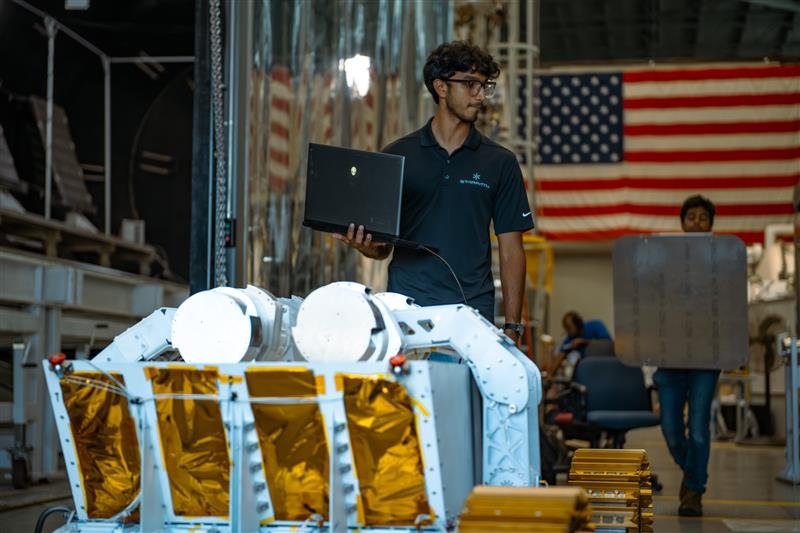
Starpath’s rover features a unique design. With four wheels and a dual drum barrel, the robot mimics the movement of a crab’s claws. This design allows for efficient excavation while conserving battery life—critical for operations on the Moon.
Before arriving in Alabama for testing, NASA staff prepared a specialized testbed. The rocky terrain within the thermal vacuum chamber replicated the Moon’s environment, providing ideal conditions for evaluation. During their three-day stay, Starpath collected essential data on the rover’s performance.
As NASA aims for future missions to the lunar South Pole, robots like Starpath’s could become vital. This area contains ice that could be extracted for drinking water and rocket fuel. The Break the Ice challenge directly addresses these needs, encouraging innovations that may transform lunar operations.
The Break the Ice Lunar Challenge ran from 2020 to 2024, supported by both NASA’s Marshall and Kennedy Space Centers. These initiatives demonstrate NASA’s commitment to harnessing innovative solutions for space exploration challenges.
For more information about the challenge and its results, visit nasa.gov/winit.
Discover More Technology Insights
Stay informed on the revolutionary breakthroughs in Quantum Computing research.
Explore past and present digital transformations on the Internet Archive.
SciV1
