

Essential Insights
-
Next-Gen Optical Fibers: Researchers at the University of Bath have developed specialty optical fibers with micro-structured cores to enhance data transfer for emerging quantum computing technologies.
-
Quantum Internet Necessities: The new fibers are designed to address the limitations of traditional optical fibers, enabling a robust quantum internet that facilitates secure communication and advanced computational capabilities.
-
Enhanced Light Manipulation: The unique air pocket pattern allows for manipulation of light properties, enabling the creation of entangled photons and augmenting capabilities for quantum networks.
-
Supporting Future Technologies: These innovations are poised to support scalable quantum networks, potentially leading to breakthroughs in quantum computing, precision sensing, and secure communication, addressing ongoing research challenges in the field.
New-Gen Optical Fibers Usher in Quantum Computing Era
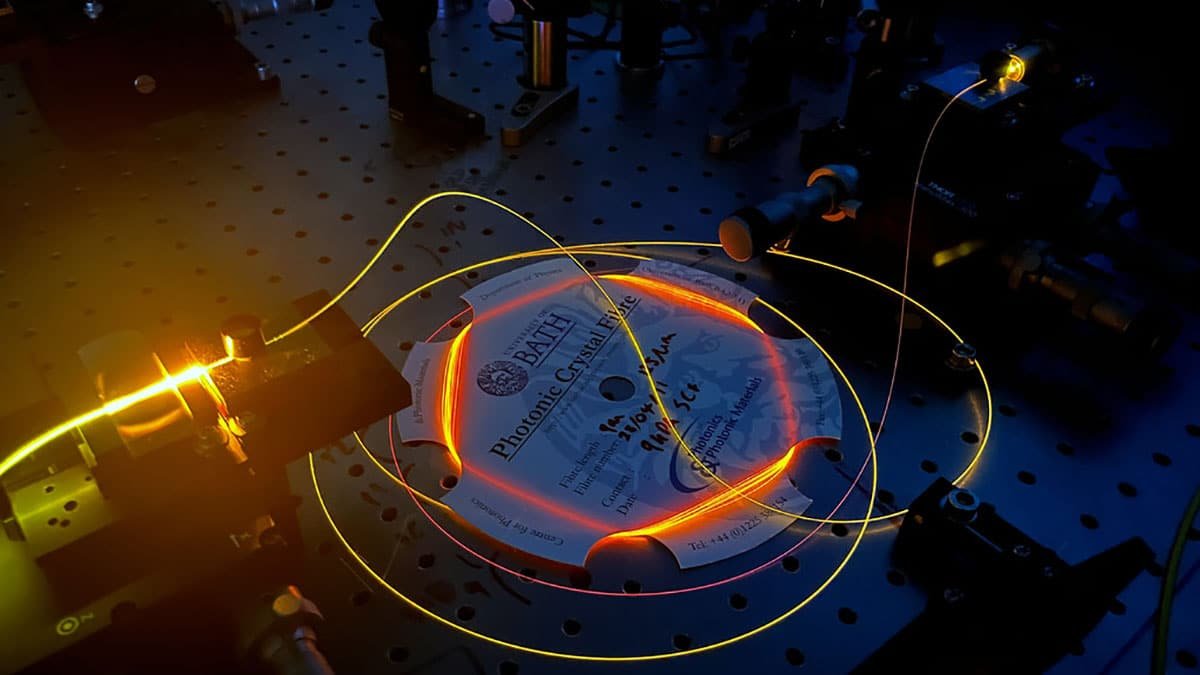
Physicists at the University of Bath have unveiled a groundbreaking set of specialty optical fibers. They designed these fibers to meet the demands of future data transfer as quantum computing emerges.
Quantum technologies promise immense computational power. They could solve complex problems, advance medical research, and enable unbreakable communication. However, traditional optical fibers fall short. Their solid cores limit compatibility with the needs of quantum communications.
In contrast, the new optical fibers feature a micro-structured core. This core contains a complex pattern of air pockets that run along the entire length. These fibers allow for better manipulation of light, which is crucial for quantum technologies.
Dr. Kristina Rusimova, a leading researcher at Bath, noted, “Current optical fibers transmit light at wavelengths governed by silica glass. These wavelengths do not work for the single-photon sources and qubits necessary for light-based quantum technologies.”
The new fibers aim to bridge this gap. They could serve as sources of entangled photons, quantum wavelength converters, and low-loss switches. These capabilities open pathways for a robust quantum network.
“A quantum internet will function much like today’s internet,” said Dr. Cameron McGarry, another key researcher. He emphasized that optical fibers will play a vital role in delivering information between nodes. “We need different technologies and designs compared to those used currently.”
Moreover, these fibers promise enhanced possibilities for quantum computation. They could generate exotic states of light, which has applications in quantum computing and secure communications.
Experts believe that advancements in optical fiber technology will spark industry interest. Dr. Kerrianne Harrington commented on the excitement surrounding these developments and their significance for future quantum technologies.
Despite the promise of quantum advantage—where quantum devices outperform classical ones—challenges remain. The research from the University of Bath aims to address those challenges and set the stage for future advancements. The optical fibers developed in this study will likely play a crucial role in this transformative journey toward quantum computing.
For further reading, reference the journal article: McGarry, C., Harrington, K., Davis, A. O. C., Mosley, P. J., & Rusimova, K. R. (2024). Microstructured optical fibers for quantum applications: Perspective. Applied Physics Letters Quantum. DOI: 10.1063/5.0211055.
Expand Your Tech Knowledge
Stay informed on the revolutionary breakthroughs in Quantum Computing research.
Explore past and present digital transformations on the Internet Archive.
QuantumV1
