

Summary Points
-
Testing Milestones Achieved: NASA’s Nancy Grace Roman Space Telescope successfully passed critical shake and acoustic tests, ensuring it can withstand launch conditions.
-
Thermal Vacuum Success: The telescope’s core components completed a rigorous 65-day thermal vacuum test, confirming their readiness to function in the extreme environment of space.
-
Upcoming Assembly and Launch Timeline: The integration of the outer and core components is expected in November, with final tests leading to a targeted launch between late 2026 and May 2027.
-
Collaboration and Management: The mission involves a multi-agency collaboration led by NASA’s Goddard Space Flight Center, with contributions from key industrial partners and various research institutions.
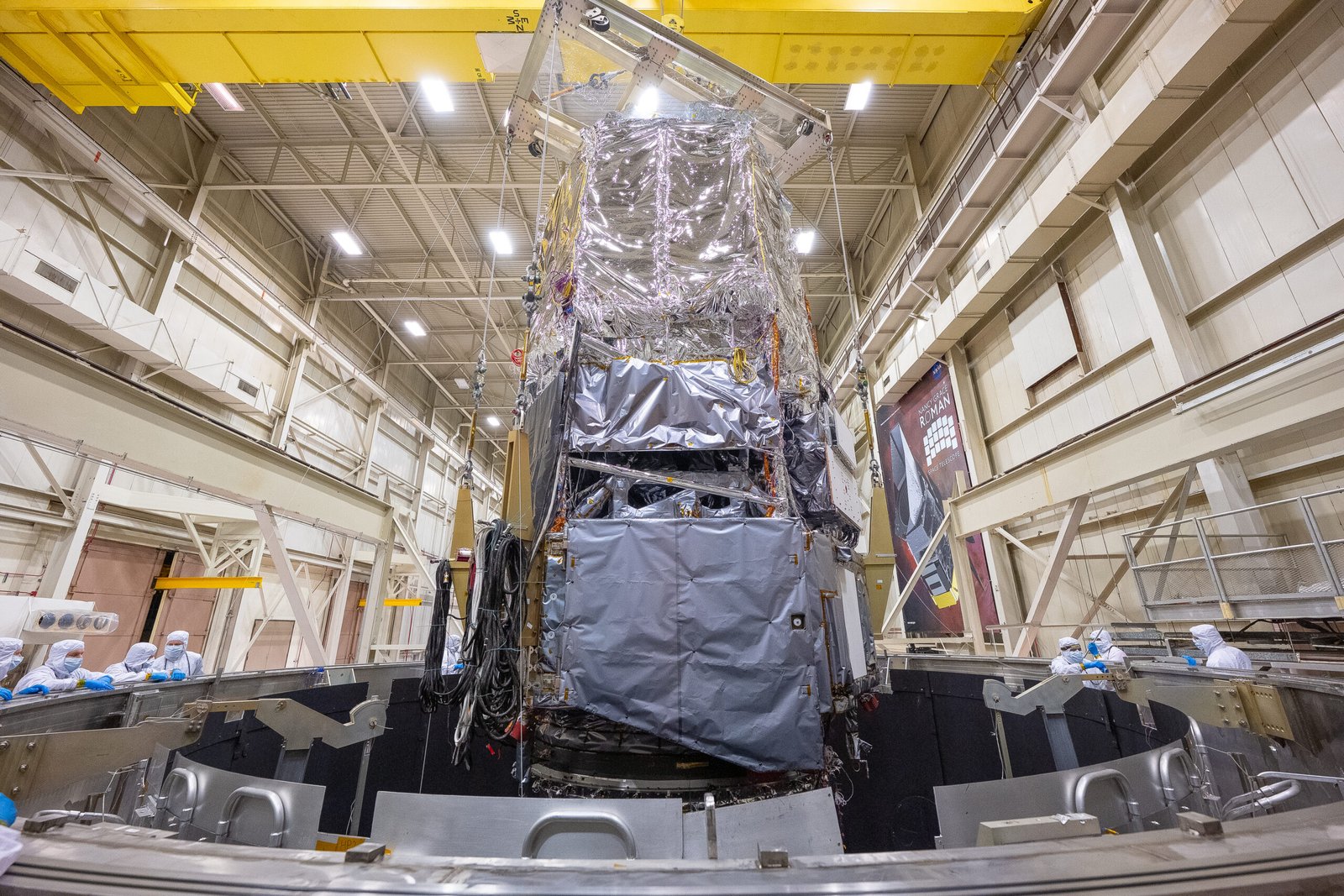
NASA’s nearly complete Nancy Grace Roman Space Telescope recently passed a series of pivotal tests, moving closer to its anticipated launch. This fall, the observatory’s outer section underwent both a shake test and an intense acoustic evaluation. These simulations aimed to prepare the telescope for the challenges of launch.
For the shake test, engineers placed the outer assembly on a massive shaker table. This simulated the vibrations experienced during a rocket launch. Each test lasted only about a minute but covered a wide range of frequencies. Sensors captured the assembly’s response, helping engineers assess its structural integrity.
Simultaneously, heavy-duty sound testing occurred within a large chamber. Here, operators exposed the assembly to sounds reaching up to 138 decibels. This level surpasses the noise of a jet plane taking off, mimicking the harsh acoustic environment of a launch.
Rebecca Espina, a test director at NASA’s Goddard Space Flight Center, emphasized the importance of these assessments. “Our heaviest loads and stresses come from launch,” she said. By conducting these tests, engineers ensure Roman can withstand the most challenging conditions.
Meanwhile, the telescope’s core portion faced a rigorous journey of its own. It entered the Space Environment Simulator in August, experiencing extreme temperatures to replicate space conditions. Over 200 team members monitored its readiness for space operation. “This was the first time the telescope and instruments were used together,” noted one program scientist.
Looking ahead, the team plans to connect Roman’s two main sections in November, targeting a complete observatory by year’s end. After final evaluations, the telescope will move to NASA’s Kennedy Space Center in Florida, gearing up for launch slated for May 2027, with potential for an earlier launch by fall 2026.
This innovative telescope aims to explore vital causes of dark energy, study planets beyond our solar system, and advance astrophysics. Its development reflects significant technological advancements that could enhance our understanding of the universe. As NASA continues to make progress, the scientific community eagerly anticipates Roman’s contributions to space exploration.
For further details about the Roman Space Telescope, visit NASA’s website.
Discover More Technology Insights
Stay informed on the revolutionary breakthroughs in Quantum Computing research.
Explore past and present digital transformations on the Internet Archive.
SciV1
