

Quick Takeaways
-
Groundbreaking Simulation: A collaborative team from the Allen Institute and the University of Electro-Communications has developed one of the most comprehensive simulations of a mouse brain, modeling 9 million neurons and 26 billion synapses.
-
Disease Research Potential: This advanced simulation paves the way for studying brain diseases, including Alzheimer’s, by allowing precise tracking of neuron activities and cognitive processes in a three-dimensional moving map.
-
Supercomputer Utilization: The Fugaku supercomputer provided the necessary computational power, enabling researchers to efficiently process intricate brain activities without invasive methods.
-
Future Aspirations: The long-term goal is to create entire human brain models, enhancing our understanding of brain function, health, and disease at a biological level.
Supercomputer Simulates One of the Most Realistic Virtual Brains
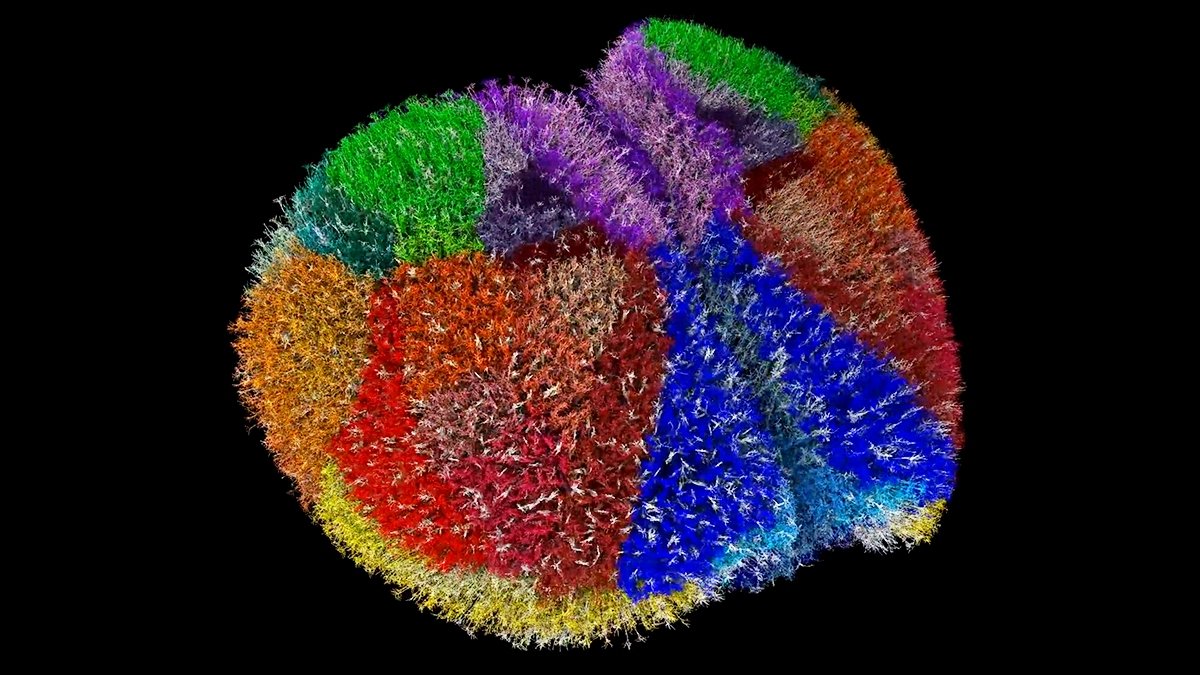
A groundbreaking achievement emerged recently from a collaboration between the Allen Institute in the U.S. and the University of Electro-Communications in Japan. Scientists created a highly detailed simulation of a mouse brain, a significant step in understanding brain functionality.
This new virtual brain features 9 million neurons and 26 billion synapses, or neuron connectors. While this is much smaller than a human brain, it still holds valuable insights due to similarities in rodent and human brain structures, making it a solid study tool.
The simulation models the entire mouse cortex. As a reference, a real mouse brain contains about 70 million neurons. Notably, the virtual model processes quadrillions of calculations every second. This astonishing capability allows researchers to track individual neuron activities.
Anton Arkhipov, a computational neuroscientist at the Allen Institute, emphasizes the importance of this advancement. “We can run brain simulations effectively with sufficient computing power,” he states. This project opens doors for even larger models, offering a glimpse into future possibilities.
The simulation enables exploration of intricate topics like cognition, consciousness, and disease progression. Researchers can now study how seizures spread through the brain or how brain waves foster concentration, all without invasive procedures.
The Fugaku supercomputer provided the necessary power for this project. It has been instrumental in various fields, such as drug discovery and meteorology. While its primary focus has varied, this time, it took on the challenge of neural circuit simulations.
“The research highlights the brain’s role in physical and mental health,” says Tadashi Yamazaki, a computer scientist at the university. The work signifies a shift toward expanding our understanding of this complex organ.
Researchers have already begun applying their findings to understand brain wave synchronization. They aim to explore how the left and right hemispheres of the mouse brain communicate. Arkhipov notes their ambitious long-term goal: “We want to build whole-brain models, eventually even human models.”
This simulation represents not only a significant technical milestone but also a leap forward in biological modeling. As the project continues to evolve, it promises to enhance our understanding of how brains function, paving the way for future advancements in neuroscience and related fields.
Stay Ahead with the Latest Tech Trends
Stay informed on the revolutionary breakthroughs in Quantum Computing research.
Stay inspired by the vast knowledge available on Wikipedia.
QuantumV1
