

Fast Facts
-
Adaptive Locomotion: Starfish can traverse various surfaces without a centralized nervous system; their movement adapts cleverly to different terrains through decentralized control of their many tube feet.
-
Hydraulic Mechanism: Each arm features rows of hydraulic tube feet that use a water vascular system for movement, allowing starfish to coordinate crawling efficiently without relying on a brain.
-
Footprint Analysis: Researchers used light changes on refractive glass to track starfish movement, revealing that their pace remains consistent regardless of foot contact but slows with increased adhesion time.
-
Mechanical Adaptation: Experiments with extra weight showed that starfish adjust their contact duration with surfaces based on load, demonstrating a flexible locomotion strategy suitable for various challenges.
Starfish Control Hundreds of Feet Without a Brain: A Closer Look
Starfish, also known as sea stars, exhibit remarkable climbing abilities. They can traverse various surfaces—vertical, horizontal, and even upside-down—without a centralized brain or nervous system. Recent research by an international team of biologists and engineers sheds light on this intriguing locomotion.
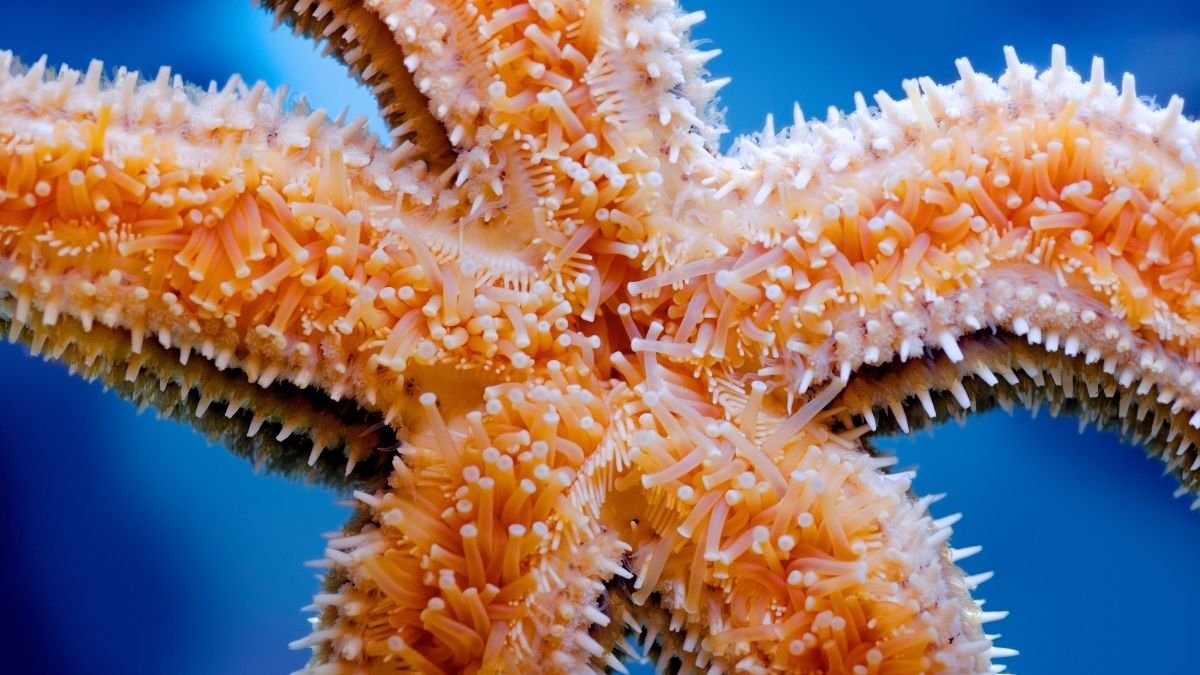
The study reveals the clever mechanisms that enable starfish to adapt to different challenges. Each arm of a starfish, especially the common starfish (Asterias rubens), features rows of hydraulic tube feet. These tube feet consist of a flexible stem that pumps fluid through a water vascular system. This system allows starfish to move effectively across diverse environments.
In the laboratory, scientists observed starfish crawling on specially designed glass. They measured how light changed as the starfish made contact, producing bright footprints. This innovative method provided insights into which tube feet engaged in movement.
Interestingly, the starfish maintained a consistent crawl speed regardless of how many feet were in contact with the surface. However, when they increased the duration of foot adhesion, their speed slowed down. This behavior suggests starfish manage movement by regulating how long each foot sticks to the ground, rather than relying on a brain.
Further experiments involved adding weighted backpacks to the starfish, increasing their total body weight by 25% or 50%. This additional load caused the starfish to lengthen the time their feet adhered to surfaces, revealing adaptive strategies in locomotion.
Researchers also explored how starfish navigate while inverted. They found tube feet adjusted their behavior when the animal was upside down relative to gravity. This adaptability underscores a decentralized strategy for navigating various terrains.
These findings not only enhance our understanding of starfish but also have implications for technology development. Engineers can draw inspiration from starfish locomotion for robotics and adaptive materials. The principles of decentralized movement could lead to advancements in robots that navigate challenging environments, much like starfish do in nature.
The study, published in the Proceedings of the National Academy of Sciences, highlights the ingenuity of evolution in simple organisms. As researchers continue to explore these natural innovations, exciting possibilities emerge in both biology and technology.
Expand Your Tech Knowledge
Explore the future of technology with our detailed insights on Artificial Intelligence.
Discover archived knowledge and digital history on the Internet Archive.
QuantumV1
