

Fast Facts
-
Artemis II Mission: NASA’s Artemis II will send four astronauts around the Moon, advancing plans for future manned missions to Mars, supported by cutting-edge communication technologies.
-
Global Communication Networks: The mission relies on the Near Space Network and Deep Space Network for seamless communication and tracking of the Orion spacecraft, ensuring crew safety and mission success.
-
Laser Communication Systems: The Orion Artemis II will test an optical communications system that can transmit data over laser links, potentially revolutionizing deep space communication capabilities for future missions.
-
Future Advances: NASA is developing Lunar Communication Relay satellites to eliminate signal blackouts and provide high-bandwidth communications for astronauts and equipment on and around the Moon.
Networks Keeping NASA’s Artemis II Mission Connected
NASA’s Artemis II mission aims to transport four astronauts around the Moon, bringing the agency closer to sending humans to Mars. Throughout this mission, effective communication plays a critical role. Signals carrying astronaut voices, images, and vital data will travel thousands of miles. NASA’s communications systems will ensure that every message reaches its destination.
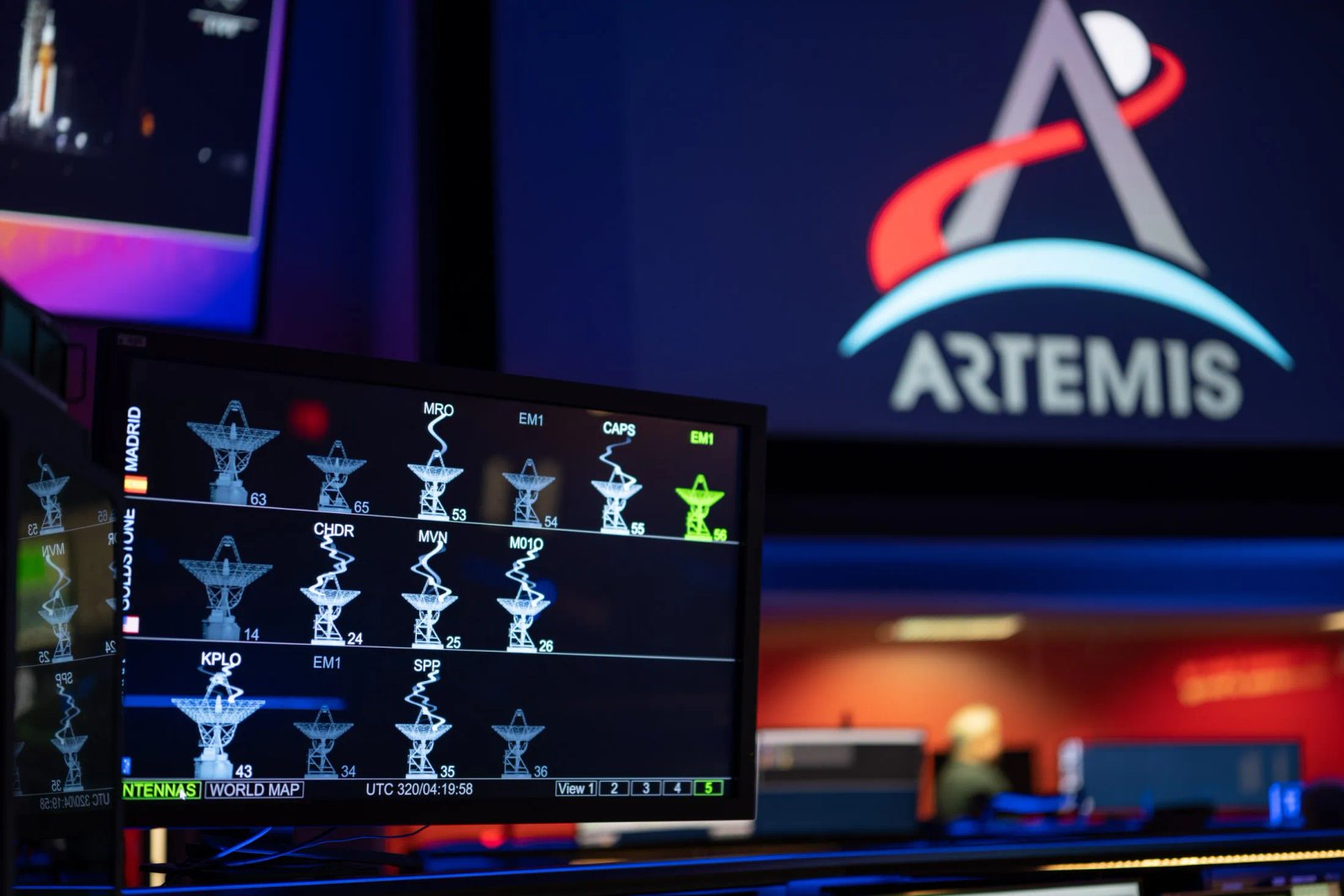
To accomplish this, Artemis relies on two primary networks: the Near Space Network and the Deep Space Network. These networks, overseen by NASA’s Space Communications and Navigation (SCaN) Program, provide robust infrastructure and global satellite coverage. They allow for seamless tracking and communication as the Orion spacecraft launches, orbits, and travels to the Moon.
“Strong space communications are not optional; they are essential for safety and mission success,” said a NASA official. Real-time conversations with mission controllers, combined with critical data analysis, keep astronauts connected to their teams on Earth. This connection allows for collaborative decision-making and brings a sense of community across the vast distances of space.
The Near Space Network will handle communications during Orion’s initial phases. Ground stations worldwide, along with a fleet of relay satellites, will support this mission. As the spacecraft prepares for its orbital journey, it will switch to the Deep Space Network for primary communications. This network boasts large antennas located in California, Spain, and Australia, providing a near-continuous connection with Orion.
“Reliable communications are the lifeline of human spaceflight,” mentioned a SCaN Program official. NASA collaborates with commercial partners to enhance these networks, ensuring greater resilience and capability for future missions.
In a technological leap, the Orion Artemis II mission will also include a laser communications system. This new technology can transmit data over laser links, offering a much larger bandwidth compared to traditional radio systems. While this capability won’t be operational in Artemis III, it could set the stage for advanced communications during future lunar and Mars missions.
Planned communication blackouts will occur when Orion passes behind the Moon. During this time, signals to and from Earth will be temporarily lost. However, when Orion re-emerges, the Deep Space Network will quickly reacquire the signal to restore communication. Similar situations have happened during previous missions and are to be expected.
Looking forward, NASA is working on a project to minimize these blackouts. By deploying relay satellites around the Moon, the upcoming Lunar Communications Relay and Navigation Systems will provide continuous communications and navigation services for astronauts, landers, and orbiters.
From liftoff to splashdown, NASA’s evolving networks will maintain vital connections, ensuring that the agency’s exploration missions keep humanity engaged every step of the way. These advancements not only enhance space exploration but also pave the way for exciting new technologies that can improve communication on Earth.
Stay Ahead with the Latest Tech Trends
Stay informed on the revolutionary breakthroughs in Quantum Computing research.
Stay inspired by the vast knowledge available on Wikipedia.
SciV1
