

Top Highlights
-
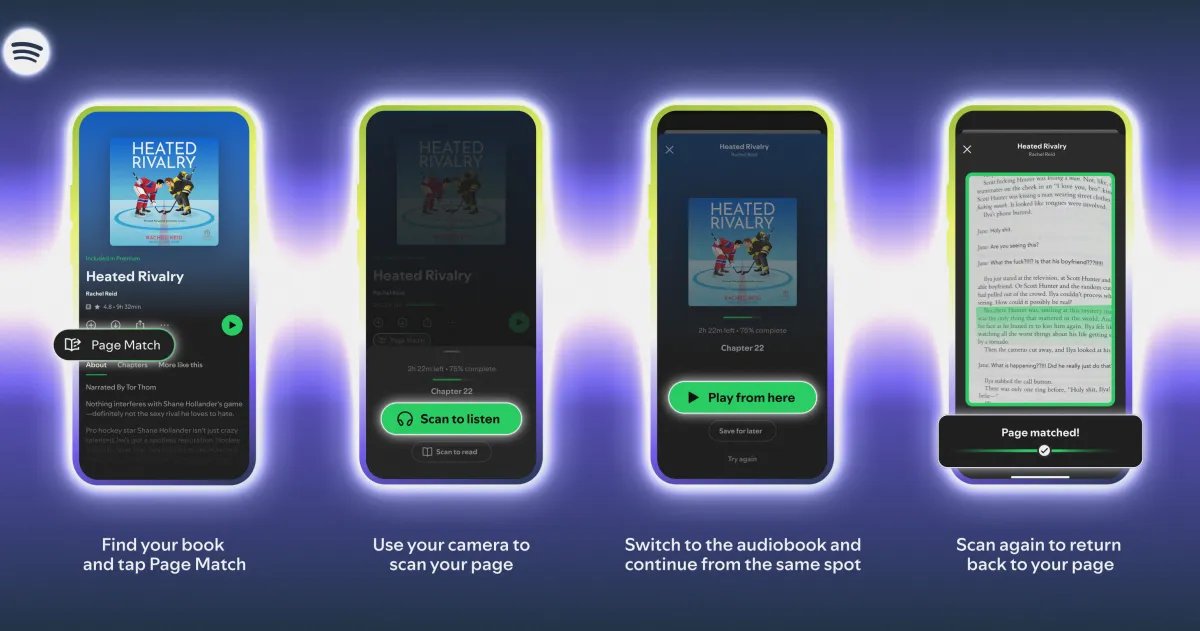
New Feature Launch: Spotify has introduced “Page Match,” allowing users to sync their physical or ebook reading with the corresponding audiobook by snapping a picture of the page.
-
Performance Insights: The feature offers reverse compatibility, guiding users on page turns but can be slow and inconsistent, taking up to 10 seconds to find the correct spot.
-
Audiobook Growth: Spotify’s audiobook library has surged from 150,000 to over 500,000 titles, showcasing a 36% increase in new audiobook listeners and a 37% rise in listening hours.
-
Strategic Expansion: The company plans to enhance its audiobook offerings and partnerships, demonstrating a commitment to diversifying content similar to its podcast strategy.
Seamless Synchronization: A New Era for Readers and Listeners
Spotify’s new feature, Page Match, offers an innovative way for users to sync their physical books with audiobooks. By simply pointing your smartphone camera at a page, the app uses computer vision technology to find the corresponding audio. This means you can switch seamlessly from reading “The Buffalo Hunter Hunter” to listening to it while driving. The experience mimics Amazon’s Whispersync for Voice, allowing users to alternate between reading and listening effortlessly. Unlike Whispersync, however, Page Match accommodates both physical books and ebooks on various e-readers, though phone screens are not supported.
As with any emerging technology, users may encounter inconsistencies. The app occasionally takes time to find the right audiobook section, demonstrating variability in speed. While some users may enjoy the novelty, others might find the slight lag off-putting. Nevertheless, the potential for improvement lies in practice. With user feedback, Spotify could refine this feature and make the experience more intuitive over time. Page Match’s ability to highlight passages on-screen and guide users through physical books adds a valuable layer to the reading experience.
Paving the Way for Audiobook Accessibility
Spotify’s foray into audiobooks increasingly shows its commitment to expanding this medium. Recent data reveals that only 16 percent of American adults read for pleasure, indicating considerable room for growth. In just two years, Spotify has catapulted its audiobook library from 150,000 to over 500,000 titles. This substantial growth reflects a shift in consumption habits, largely propelled by existing users.
Spotify aims to enhance listener engagement by diversifying content types, focusing on longer-form formats. Partnering with Bookshop.org for physical book purchases within the app creates a cohesive reading ecosystem. In this way, Spotify seeks to position itself as a one-stop platform for both audiobooks and their physical counterparts. As audiobooks continue to gain traction, Spotify’s Page Match feature could set a new standard for how people experience literature, enriching the human journey through the realms of reading and listening.
Continue Your Tech Journey
Explore the future of technology with our detailed insights on Artificial Intelligence.
Stay inspired by the vast knowledge available on Wikipedia.
TechV1
