

Essential Insights
-
Simulation Breakthrough: New NASA supercomputer simulations offer an unprecedented view of the magnetic interactions around city-sized neutron stars just before they merge, identifying potential detectable signals.
-
High-Energy Emissions: The study found that as neutron stars approach each other, their entangled magnetic fields generate observable high-energy X-rays and gamma rays, especially in the final milliseconds before the merger.
-
Magnetic Dynamics: The swirling plasma and rapidly changing magnetic fields can accelerate particles to extreme energies, affecting the brightness and distribution of emitted light, which varies based on the observer’s perspective.
-
Future Observations: Upcoming gravitational-wave observatories like LISA will provide alerts for impending mergers, enabling simultaneous observation of electromagnetic signals, significantly enhancing our understanding of gamma-ray bursts.
NASA Researchers Probe Tangled Magnetospheres of Merging Neutron Stars
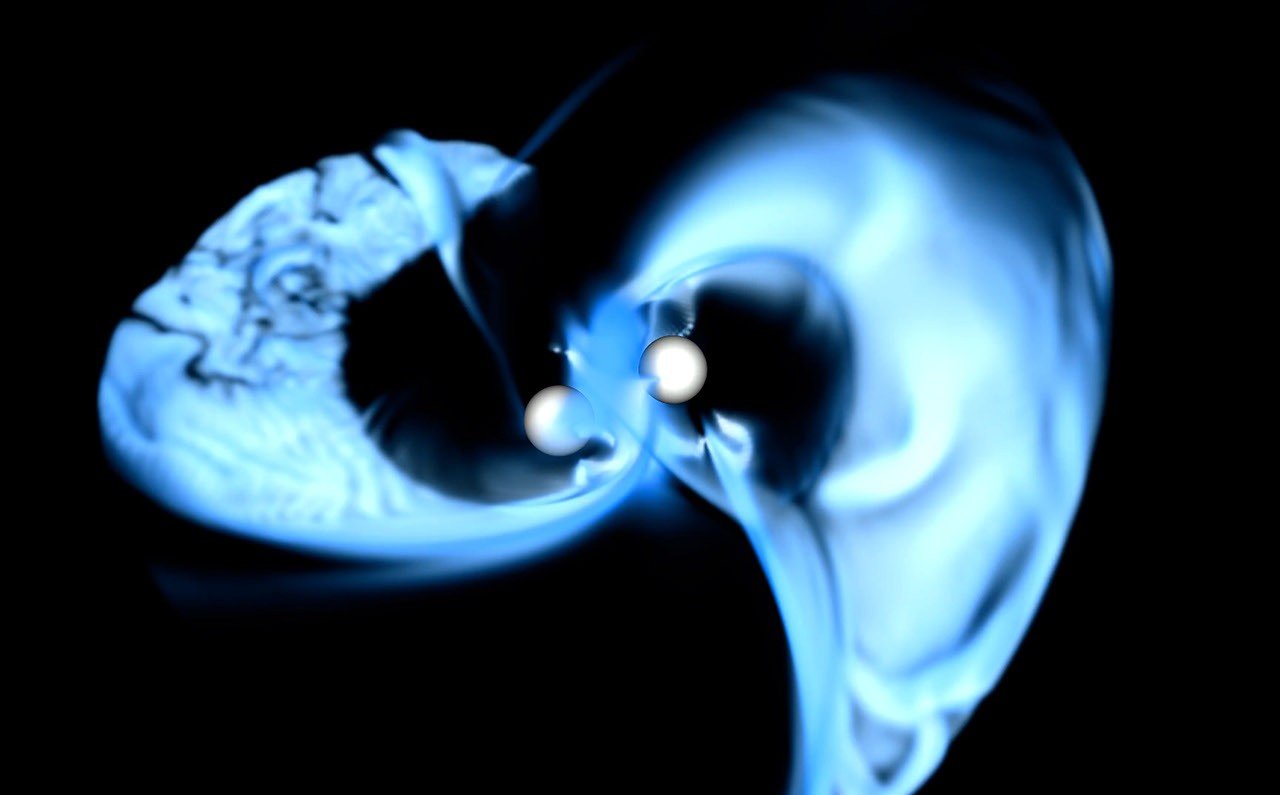
New simulations from NASA illuminate the chaotic interactions occurring in the magnetospheres of merging neutron stars. These city-sized stars, each about 15 miles across yet containing more mass than our Sun, present a captivating yet powerful phenomenon as they spiral toward each other.
As the neutron stars orbit, their highly magnetized plasma-filled regions, known as magnetospheres, engage in dramatic changes. Researchers discovered that during these final moments, the stars may emit detectable signals like X-rays and gamma rays. This could enhance our understanding of the universe’s most explosive events.
“Before neutron stars crash, their magnetospheres begin interacting strongly,” said a lead scientist from the University of Patras in Greece. “We modeled the last several orbits where twin magnetic fields rapidly change.”
This research included over 100 simulations on NASA’s Pleiades supercomputer, focusing on the last 7.7 milliseconds before the merger. The team examined how different configurations of magnetic fields could affect electromagnetic energy—light in all its forms—emitted during the merger.
Researchers noted that observers’ perspectives on these events significantly impact signal detection. The light emitted from merging systems varies greatly in brightness, depending on the magnetic orientations of the neutron stars. As the stars approach, the signals intensify.
Future observatories could capture these high-energy emissions. Ground-based gravitational-wave facilities, including LIGO and Virgo, currently detect neutron star mergers. Upcoming space missions, like the Laser Interferometer Space Antenna (LISA), plan to observe earlier stages of these collisions.
The findings suggest a promising future for capturing both gravitational waves and electromagnetic signals. More research will help clarify how electromagnetic forces at play affect the merger’s final moments.
By understanding these systems, scientists improve the technology and methodologies used in astronomy. This dual approach helps deepen our insights into cosmic phenomena, ultimately enhancing our quality of life through advancements in science and technology. As researchers unlock these mysteries, the potential for groundbreaking discoveries continues to grow.
Expand Your Tech Knowledge
Learn how the Internet of Things (IoT) is transforming everyday life.
Access comprehensive resources on technology by visiting Wikipedia.
SciV1
