

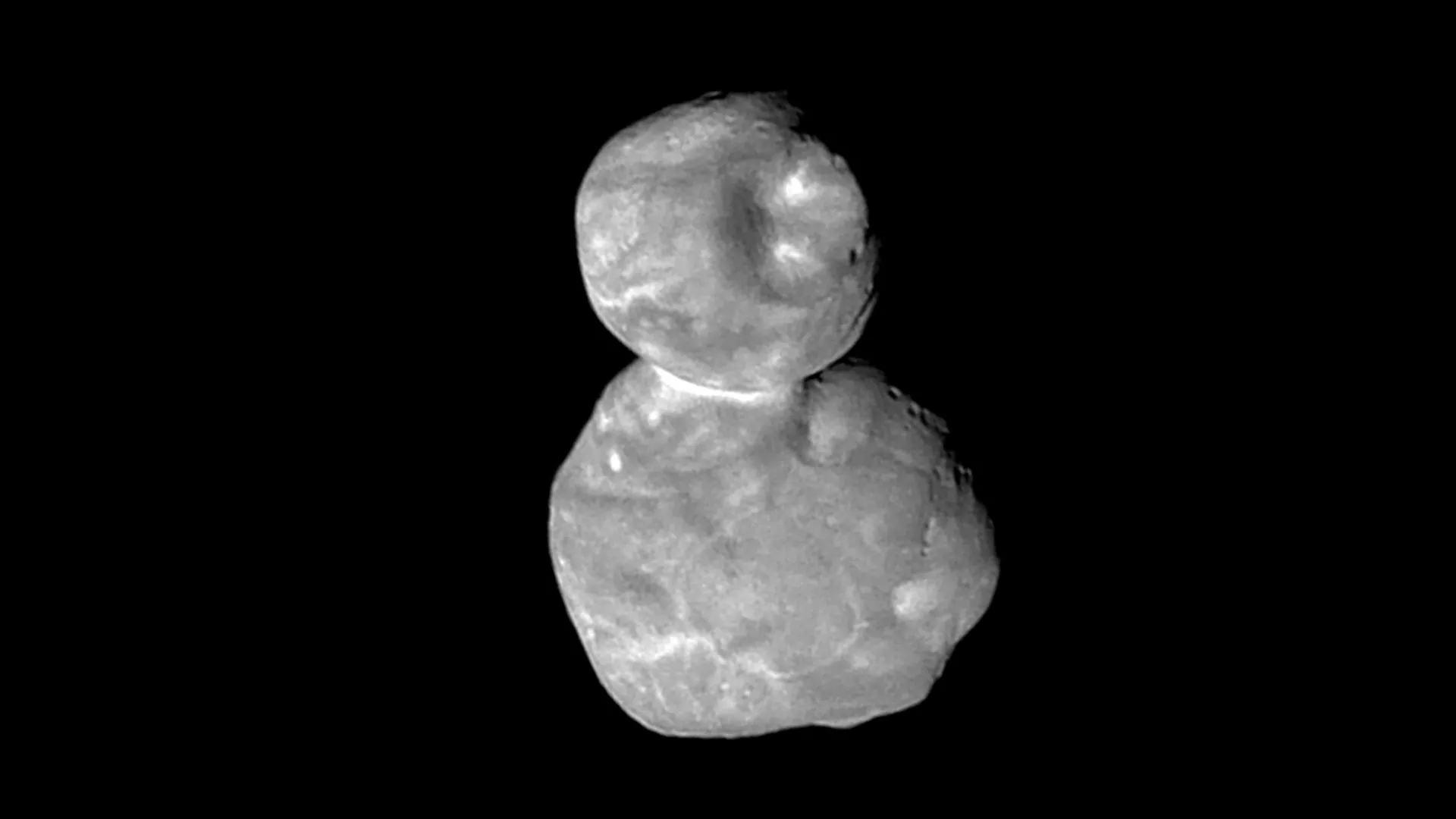
Fast Facts
-
Formation of Snowman-Like Structures: Researchers at Michigan State University demonstrate that icy bodies in the Kuiper Belt, resembling snowmen, form naturally through a process of gravitational collapse, challenging previous theories based on rare cosmic events.
-
Innovative Simulation: Graduate student Jackson Barnes developed a pioneering computer simulation that accurately recreates the double-lobed structures of contact binaries by retaining the structural integrity of colliding bodies, refining previous models that oversimplified impacts.
-
Stability of Contact Binaries: The study reveals that contact binaries can survive billions of years due to the low likelihood of collisions in the sparsely populated Kuiper Belt, allowing them to maintain their distinctive shapes over vast time periods.
-
Implications for Future Research: The findings pave the way for further exploration of intricate systems involving multiple connected objects and anticipate the discovery of more snowman-shaped worlds with upcoming NASA missions.
Understanding Cosmic Snowmen
For decades, astronomers have puzzled over the peculiar shapes of icy bodies in the outer solar system. Many of these frozen relics resemble snowmen, with two rounded lobes joined together. Recent research from Michigan State University sheds light on this mystery. It turns out, a straightforward process explains how these unusual contact binaries form.
Astronomers study the Kuiper Belt, a distant region filled with planetesimals, which are the remnants of the solar system’s early formation. About 10 percent of these frozen objects take on a snowman-like appearance. Scientists long struggled to understand how such forms developed naturally. Initially, some theories relied on rare cosmic events. However, these scenarios couldn’t account for the commonality of these shapes.
New computer simulations have changed everything. Researchers developed a model showing that gravitational collapse allows two objects to gently settle against each other rather than merge into a single sphere. This insight aligns perfectly with the observed data, suggesting that the formation of contact binaries is a more common process than previously thought.
The Role of NASA’s Discoveries
NASA’s New Horizons spacecraft played a pivotal role in bringing attention to contact binaries. In 2019, it captured stunning images of one such object, prompting further investigation into others. The sparse conditions of the Kuiper Belt, marked by few collisions, allow these fragile structures to remain intact over billions of years. This stability invites further exploration and discovery.
The formation process resembles snowflakes coming together to create a snowball. As planetesimals form, they can split into two rotating bodies, which then gently fuse. As new simulations unveil more about these cosmic snowmen, researchers aim to study even more complex structures.
This research not only clarifies the origins of contact binaries but also opens doors to understanding the broader nature of planet formation in our solar system. As we continue to explore these icy worlds, we may uncover even more snowman-shaped objects waiting in the cosmos. These findings illustrate how even the simplest shapes can hold profound insights into our universe.
Expand Your Tech Knowledge
Stay informed on the revolutionary breakthroughs in Quantum Computing research.
Stay inspired by the vast knowledge available on Wikipedia.
TechV1
