

Top Highlights
-
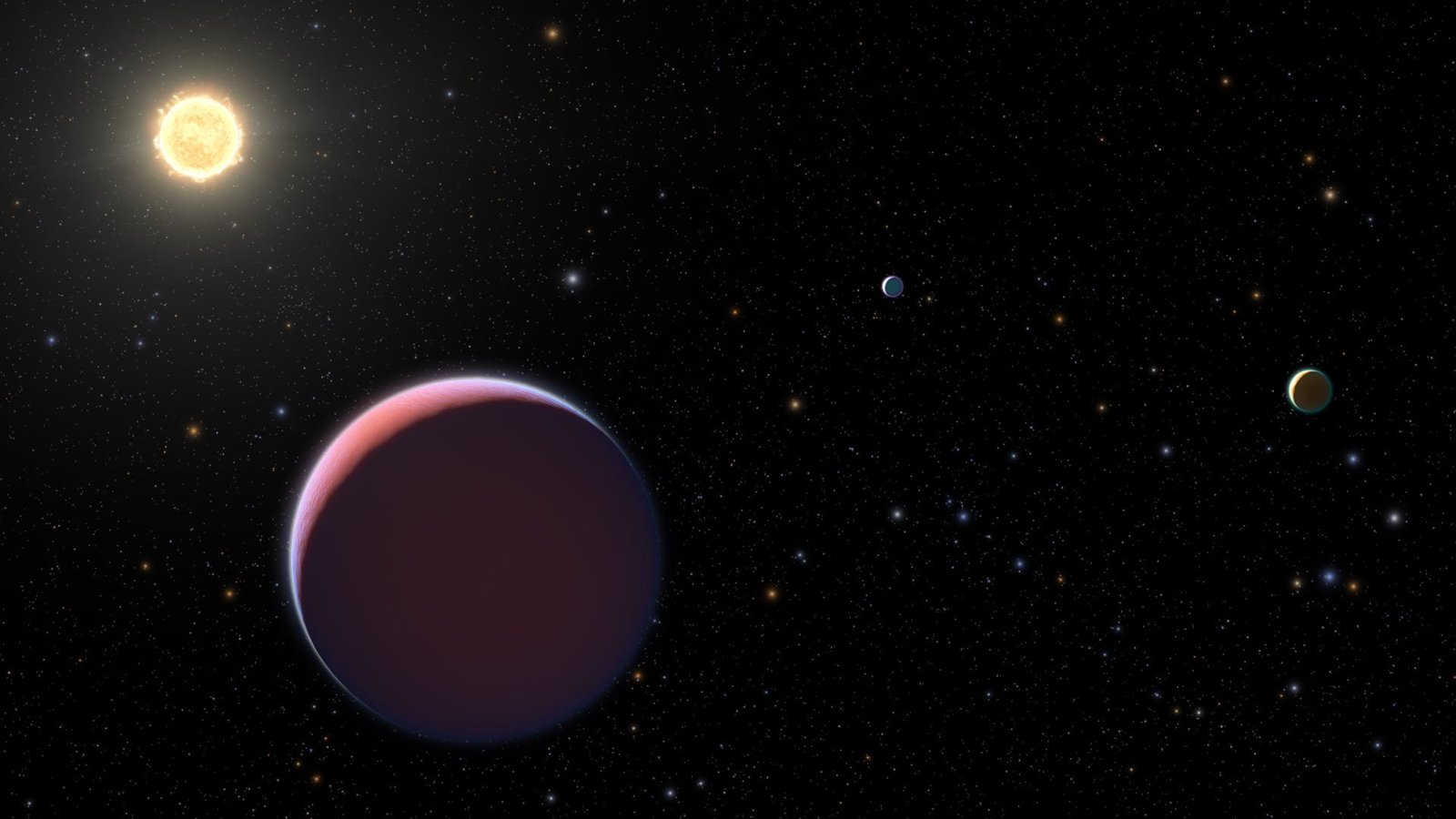
Ultra-Low Density Discovery: Kepler-51d, an exoplanet so lightweight it could float on water, has baffled astronomers with a thick haze that obscures its atmospheric secrets, defying conventional gas giant formation theories.
-
Unusual Properties: Despite being similar in size to Saturn, Kepler-51d and its neighboring planets have densities akin to cotton candy, with disproportionately small cores and massive atmospheres.
-
Failed Observations: Both Hubble and the James Webb Space Telescope have struggled to detect atmospheric chemistry in Kepler-51d due to its unprecedentedly thick haze, leaving their origins and formation process a mystery.
-
Young Stellar System: The Kepler-51 system is relatively young at 500 million years, suggesting ongoing evolution, potentially leading to atmospheric loss, and further complicating the understanding of these unique planets.
Hazy Cotton Candy Exoplanets Challenge Astronomers
Scientists have encountered a perplexing challenge with a group of ultra-low density exoplanets, including Kepler-51d. This intriguing world, located 2,615 light-years away, hides its secrets beneath a thick haze, defying even the advanced capabilities of the James Webb Space Telescope (JWST). Researchers labeled these planets “cotton candy” due to their light mass and large atmospheres.
Kepler-51d and its siblings, planets 51b and 51c, resemble Saturn in size but possess far less mass. While Saturn’s mass dwarfs Earth’s by 95 times, these exoplanets weigh only a fraction more than our planet. This unusual feature ignites curiosity about their formation. Experts like Jessica Libby-Roberts emphasize the rarity of such planets, stating they complicate existing gas giant formation theories.
Despite attempts to analyze their atmospheres using both the Hubble Space Telescope and JWST, astronomers found no chemical signatures. The JWST used transit spectroscopy, where light from a star passes through a planet’s atmosphere during its orbit. Unfortunately, the thick haze obstructed further insights, making these observations the most challenging yet.
Interestingly, the haze on Kepler-51d resembles the thick atmosphere of Titan, Saturn’s largest moon, which contains hydrocarbons like methane. Researchers suspect that as the surrounding star remains active, it might strip away the exoplanets’ outer layers. This dynamic environment raises questions about the planets’ histories and future.
As research on the Kepler-51 system continues, astronomers hope to uncover the mysteries surrounding these oddball planets. Future observations may finally provide clues about their atmospheric compositions.
The discoveries in this field not only expand our understanding of planetary systems but also inspire new technologies and methods for exploring distant worlds. Understanding these unique exoplanets could lead to advancements in the study of planetary formation and evolution, benefiting scientific progress for generations to come.
Expand Your Tech Knowledge
Stay informed on the revolutionary breakthroughs in Quantum Computing research.
Stay inspired by the vast knowledge available on Wikipedia.
SciV1
