

Top Highlights
-
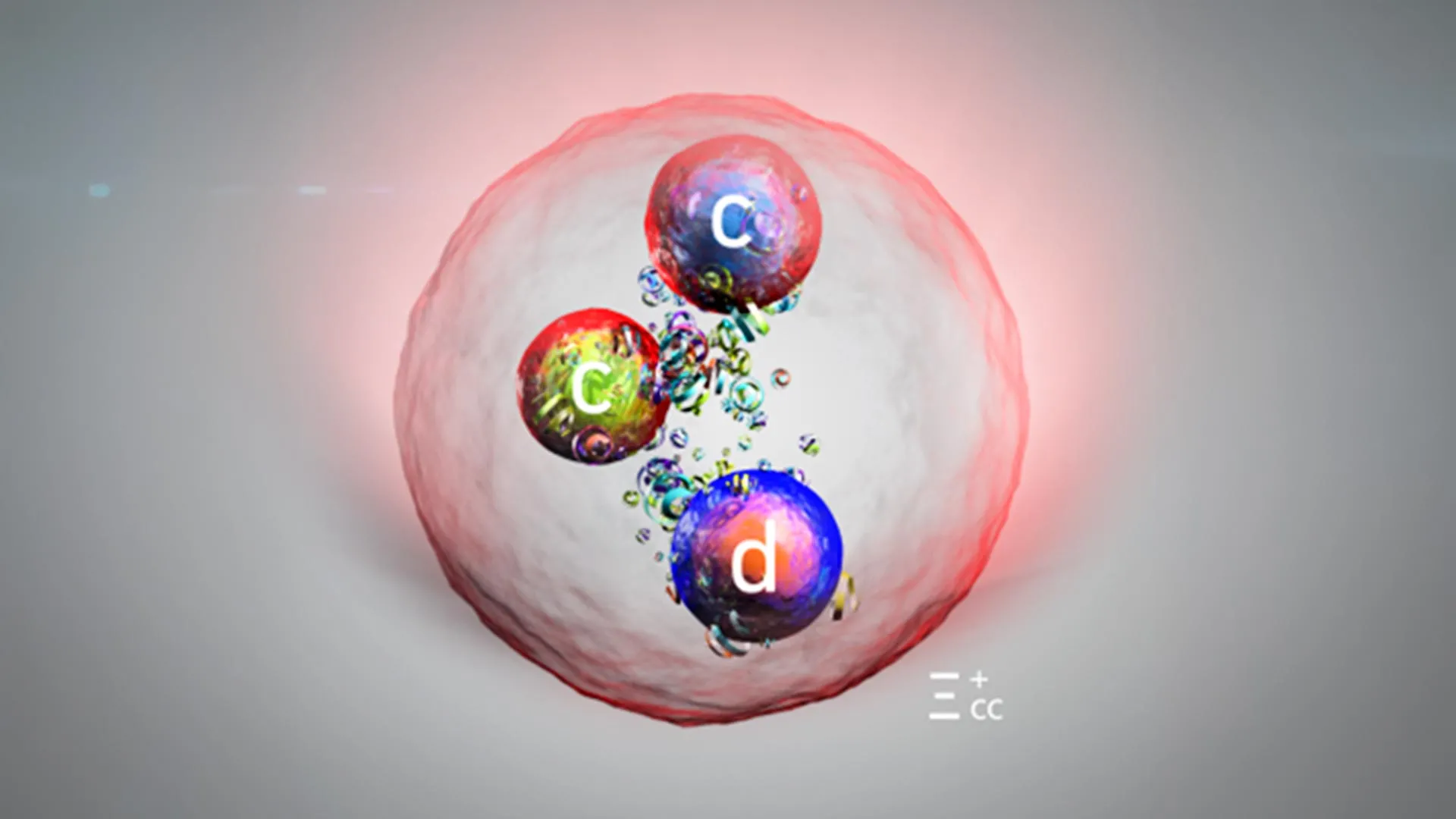
Major Discovery: Scientists from The University of Manchester identified the Ξcc⁺ particle at CERN’s LHC, a heavy proton-like particle made of two charm quarks and one down quark, marking a milestone in particle physics.
-
Significant Upgrade: The discovery is the first using the upgraded LHCb detector, crucially supported by over 1,000 researchers globally, with the UK leading contributions, particularly from Manchester.
-
Historical Context: This finding continues Manchester’s legacy in particle physics research, tracing back to the first identification of a proton by Ernest Rutherford, and builds on decades of expertise in the field.
-
Future Prospects: The University will spearhead the upcoming LHCb Upgrade 2, leveraging advanced technology to gather more data and investigate rare particles, further enhancing understanding of the universe.
A Heavier Relative of the Proton
Physicists recently uncovered a fascinating new particle at CERN’s Large Hadron Collider (LHC). Named Ξcc⁺, this heavy cousin of the proton contains two charm quarks and one down quark, making it significantly heavier than traditional protons. The discovery marks a significant milestone; it is the first particle identified using the upgraded LHCb detector, which represents a collaborative effort of over 1,000 researchers from 20 nations. Notably, the United Kingdom, especially The University of Manchester, took a leading role in this groundbreaking research.
This particle’s significance lies in its relation to the proton, first discovered in Manchester during the early 20th century. The Ξcc⁺ aligns with a long history of particle physics at the university. In the 1950s, Manchester scientists distinguished a member of the Ξ particle family, setting the stage for further advancements in the field. The discovery of Ξcc⁺ thus not only adds to our understanding of subatomic particles but also celebrates Manchester’s legacy in physics research.
Advanced Detector Captures Particle Collisions
The upgraded LHCb detector plays a crucial role in this discovery. Acting like a high-speed camera, it captures particle decays at an impressive rate of 40 million frames per second. This cutting-edge technology enables scientists to observe how the Ξcc⁺ decays into lighter particles during proton-proton collisions. The research team recorded approximately 915 decay events, confirming the particle’s existence through measurable signals.
Looking forward, The University of Manchester plans to deepen its contributions as the LHC program advances into its next phase, known as LHCb Upgrade 2. This upgrade aims to collect even more data and examine rare particles more closely. The findings surrounding the Ξcc⁺ are not merely academic; they embody humanity’s quest for understanding the building blocks of matter, showcasing the continued relevance of curiosity-driven research.
Discover More Technology Insights
Explore the future of technology with our detailed insights on Artificial Intelligence.
Explore past and present digital transformations on the Internet Archive.
TechV1
