

Fast Facts
-
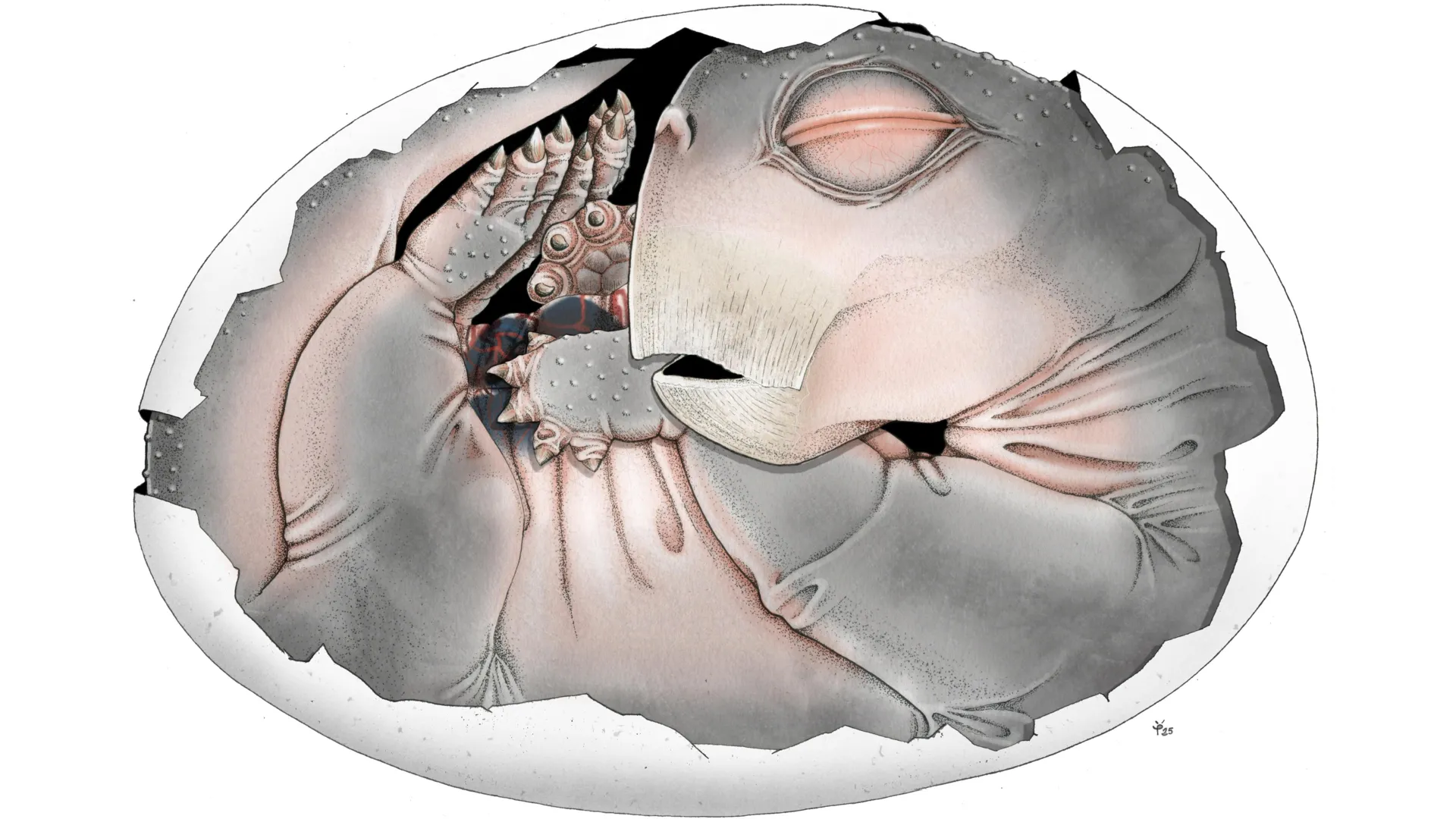
Groundbreaking Fossil Discovery: Researchers unveiled the first confirmed egg of Lystrosaurus, a crucial link in understanding early mammal evolution and confirming that mammal ancestors laid eggs.
-
Soft-Shelled Egg Rarity: The soft-shelled nature of Lystrosaurus eggs explains their scarcity in the fossil record, as they are less likely to be preserved compared to hard-shelled dinosaur eggs.
-
Advanced Imaging Insights: Modern synchrotron x-ray CT technology allowed scientists to examine the fossil in detail, revealing an unhatched Lystrosaurus embryo and providing key insights into its developmental stage.
-
Survival Strategy: Lystrosaurus thrived post-extinction by producing large, nutrient-rich eggs and precocial young, showcasing adaptability and resilience in extreme environmental conditions, offering valuable lessons for contemporary biodiversity challenges.
The Remarkable Journey of Lystrosaurus
A groundbreaking fossil discovery sheds light on a pivotal moment in evolutionary history. Researchers recently uncovered an egg containing a Lystrosaurus embryo, dating back about 250 million years. This finding confirms that mammal ancestors, like Lystrosaurus, laid eggs. After the catastrophic End-Permian Mass Extinction, Lystrosaurus thrived in harsh conditions. The species not only survived but dominated its environment, demonstrating remarkable adaptability.
Previous studies on reproduction in ancient species faced challenges, largely due to the rarity of preserved soft-shelled eggs. Many decayed before they could become fossils, leaving a gap in our understanding. This new find, however, fills that gap and clarifies evolutionary pathways. Scientists utilized advanced imaging techniques to explore the fossil’s interior, finally revealing the delicate structure and condition of the embryo.
Implications for Modern Science
The discovery provides insights into the reproductive strategies of ancient species during extreme conditions. By producing larger eggs rich in yolk, Lystrosaurus young were more independent and capable of rapid development. This strategy likely contributed to their success in post-extinction ecosystems, illustrating how adaptable reproductive traits can enhance survival.
Beyond paleontology, this finding resonates with current challenges. As species face climate change and ecological crises today, understanding how Lystrosaurus thrived offers valuable lessons in resilience and adaptability. Researchers emphasize the importance of these insights for predicting how modern organisms will cope with rapid environmental shifts. Thus, this discovery is not merely an academic achievement; it enriches our comprehension of survival across epochs and the enduring lessons life offers us.
Discover More Technology Insights
Stay informed on the revolutionary breakthroughs in Quantum Computing research.
Discover archived knowledge and digital history on the Internet Archive.
TechV1
