

Quick Takeaways
- NASA and SpaceX plan mid-May launch to deliver supplies to ISS.
- SpaceX Dragon carries 6,500 pounds of cargo, docking autonomously with ISS.
- New science experiments aim to advance research on microgravity effects.
- Dragon will return key equipment and research findings in mid-June.
Mission Overview and Objectives
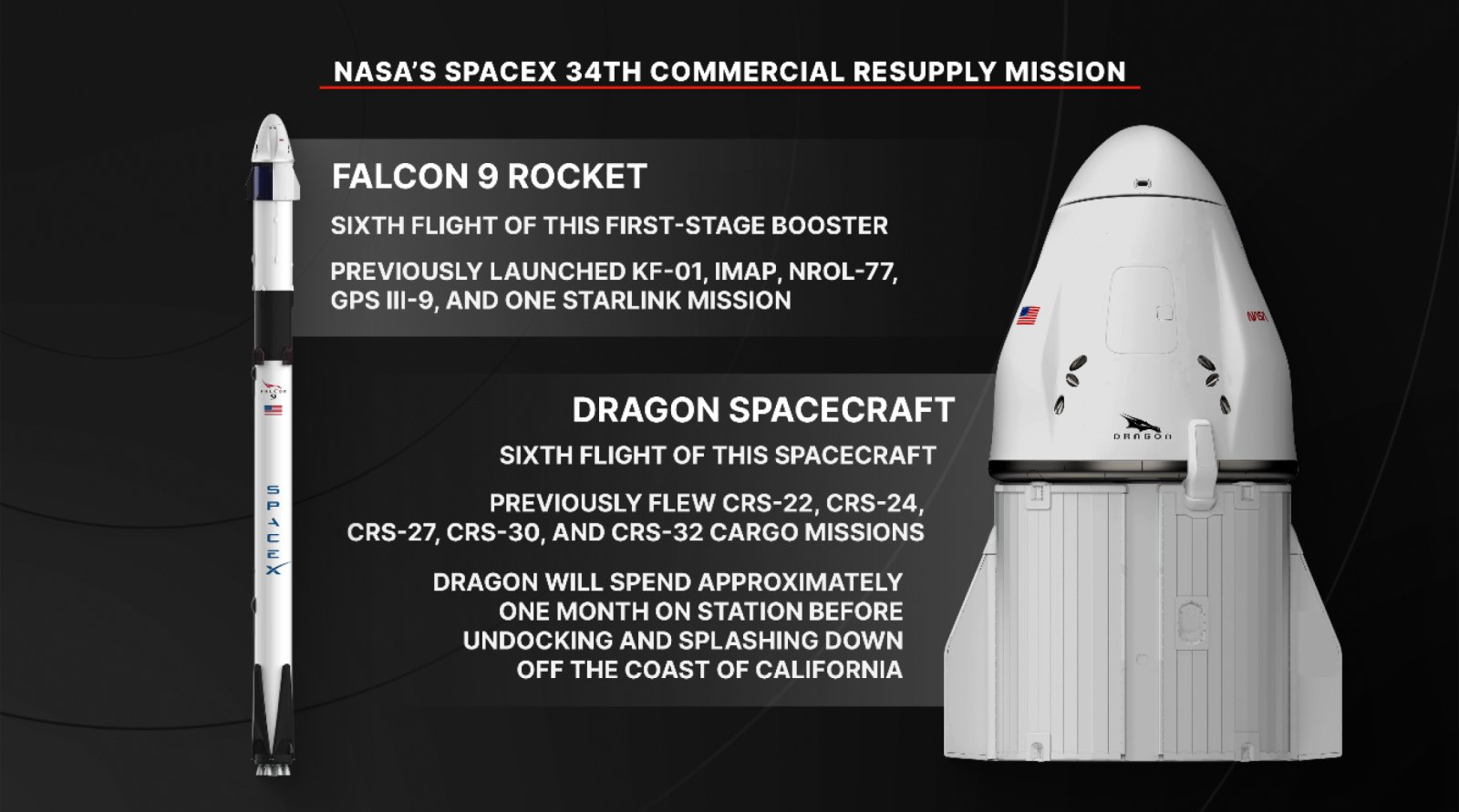
NASA and SpaceX are gearing up for the 34th Commercial Resupply Mission ( CRS-34), targeting a mid-May launch. This mission aims to send approximately 6,500 pounds of supplies, scientific investigations, and equipment to the International Space Station (ISS). The SpaceX Dragon spacecraft will launch atop a Falcon 9 rocket from Launch Complex 40 at Cape Canaveral Space Force Station in Florida. After reaching the ISS, Dragon will autonomously dock with the Harmony module, facilitating the transfer of cargo directly to the station.
The ISS has been a crucial research platform for over 25 years, enabling scientists from more than 110 countries to conduct 4,000 experiments in microgravity. Research aboard the ISS not only aids in long-duration missions, such as those planned under the Artemis program to the Moon and beyond to Mars, but also provides benefits that extend to Earthly applications. Multiple science experiments will accompany this mission, focusing on various fields, including materials science, human health, and atmospheric studies.
Key Experiments and Equipment
This resupply mission includes several significant scientific experiments. The ODYSSEY experiment will assess how effectively Earth-based microgravity simulators mirror actual space conditions. By comparing bacterial behavior observed in space to results from simulators, researchers aim to enhance our understanding of microbial dynamics in these environments.
Another critical investigation, STORIE, will monitor charged particles in Earth’s orbit that respond to space weather. This research could lead to improved predictive capabilities for events that may disrupt power grids and satellite functions.
Laplace will delve into the movement and collision of dust particles in microgravity, shedding light on fundamental processes that govern planetary formation. This knowledge could contribute to our understanding of Earth’s origins and the development of other celestial bodies.
Green Bone will observe the growth of bone cells in a microgravity setting, utilizing a wooden scaffold. Insights gained may lead to advancements in treating conditions like osteoporosis, affecting millions worldwide. The SPARK experiment will investigate changes in red blood cells and spleen function during space travel, helping to protect astronaut health for long-term missions.
In addition to experiments, Dragon will deliver essential hardware for the ISS, including a replacement power cable for the European Enhanced Exploration Exercise Device and a catalytic reactor for the Water Recovery Management System. The mission also includes a variety of tools and components for maintaining the station’s systems.
Upon its return in mid-June, the Dragon spacecraft will bring back valuable equipment, including an ocular imaging device for monitoring crew eye health and an advanced plant habitat used for plant biology studies. This mission plays a key role in sustaining research aboard the ISS and enhancing the knowledge base for future space exploration.
Stay Ahead with the Latest Tech Trends
Stay informed on the revolutionary breakthroughs in Quantum Computing research.
Stay inspired by the vast knowledge available on Wikipedia.
Space
