

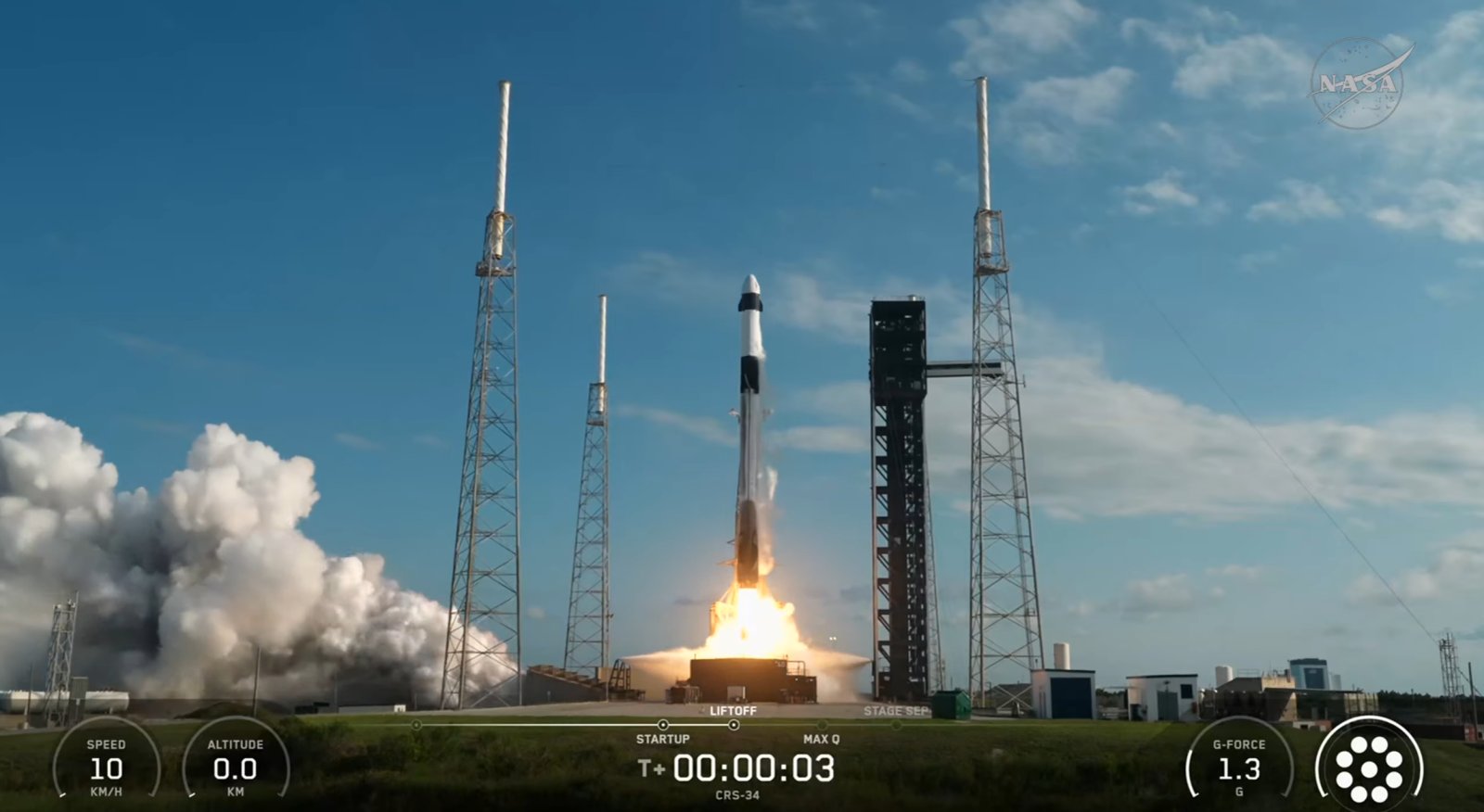
Summary Points
- SpaceX launched its 34th cargo mission to the ISS with experiments.
- Nearly 6,500 pounds of cargo will support the Expedition 74 crew.
- New experiments will study microgravity effects and environmental phenomena.
- The Dragon spacecraft will return to Earth by mid-June with research.
Launch Overview and Mission Details
NASA’s 34th commercial resupply mission with SpaceX successfully lifted off on May 15, 2023, at 6:05 p.m. EDT. A Falcon 9 rocket launched from Space Launch Complex 40 at Cape Canaveral Space Force Station in Florida. This mission will deliver nearly 6,500 pounds of cargo to the International Space Station (ISS) for the Expedition 74 crew. The SpaceX Dragon spacecraft is scheduled to dock autonomously at around 7 a.m. on Sunday, May 17, at the forward port of the station’s Harmony module.
Live coverage of this mission will be available on various platforms, including NASA+, Amazon Prime, and NASA’s YouTube channel. Viewers can tune in from 5:30 a.m. to watch the spacecraft’s rendezvous and docking.
Scientific Experiments and Innovations
The Dragon spacecraft is not just carrying supplies; it also brings a suite of scientific experiments. One of the key projects aims to evaluate how well Earth-based simulators replicate microgravity conditions. Understanding this will help refine research protocols for space experiments.
Another innovative experiment involves a bone scaffold made from wood. This scaffold could lead to new treatments for fragile bone conditions like osteoporosis. Alongside this, the spacecraft carries equipment to analyze how red blood cells and the spleen behave in microgravity, expanding our knowledge of human biology in space.
Additionally, the Dragon contains a new instrument designed to study charged particles around Earth. This research is crucial, as understanding these particles can inform how they affect power grids and satellites. There’s also an investigation focusing on the highly accurate measurement of sunlight reflected from Earth and the Moon, which could enhance our grasp of planetary formation processes.
These experiments contribute to the ongoing scientific inquiries at the ISS. Scientists are continually conducting research in biology, biotechnology, physical sciences, and Earth and space science. For over 25 years, the ISS has provided a unique platform for advancing human knowledge and fostering breakthroughs impossible to achieve on Earth.
The Dragon spacecraft will remain at the ISS until mid-June. It will return to Earth with valuable research and cargo, culminating in a splashdown off the coast of California. NASA’s commitment to space research continues to pave the way for future human exploration, including the Artemis program aimed at returning to the Moon and eventually reaching Mars.
Expand Your Tech Knowledge
Stay informed on the revolutionary breakthroughs in Quantum Computing research.
Explore past and present digital transformations on the Internet Archive.
Space
