

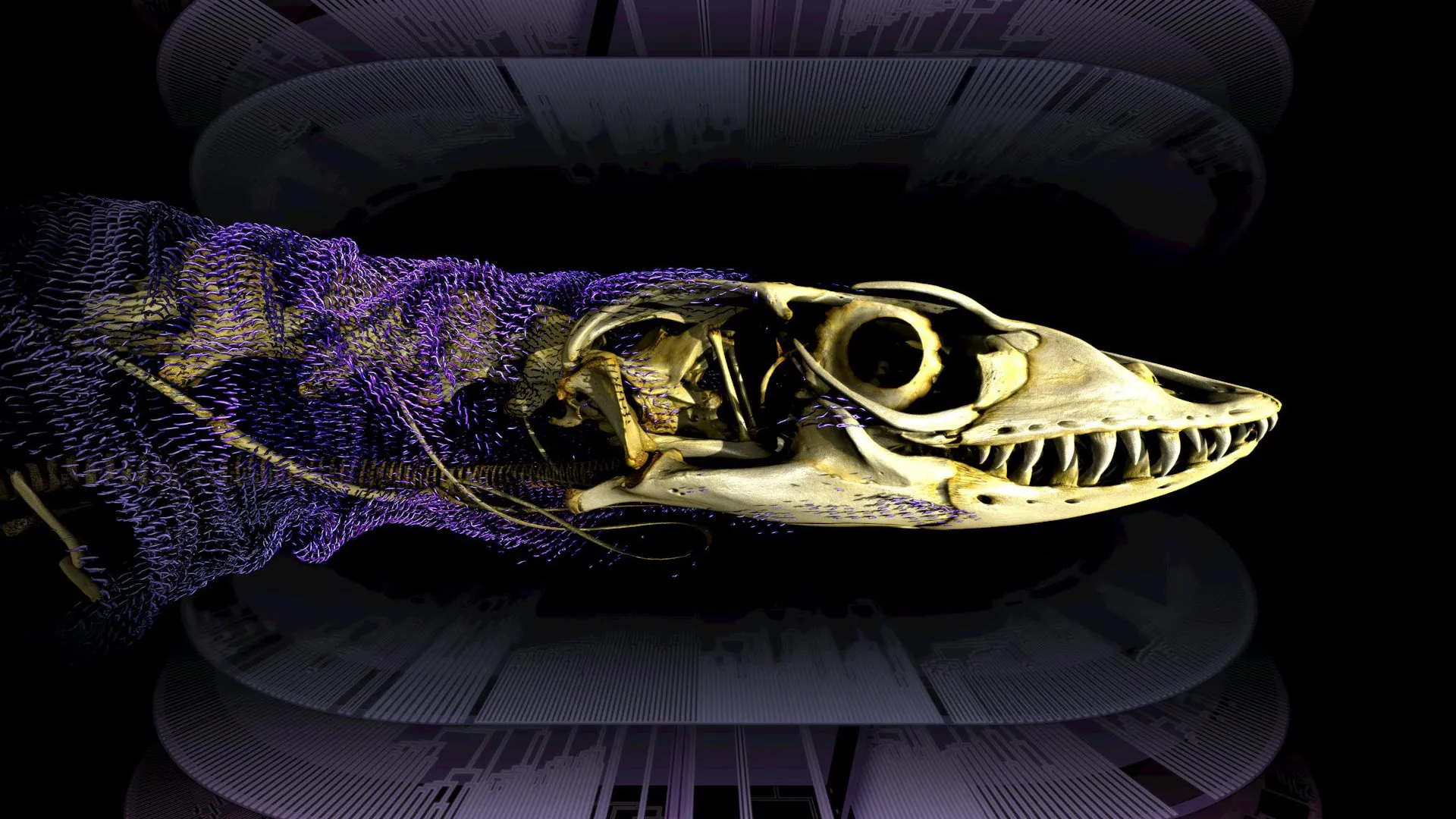
Essential Insights
- Skin bones originated in animals’ skin, not deep inside their bodies.
- Lizard lineages independently evolved osteoderms over 320 million years.
- Goannas uniquely lost and then regained osteoderms during Australia’s dry climate.
- Study reveals evolution’s non-linear path, challenging previous assumptions about traits.
The Evolutionary Puzzle of Skin Bones
Scientists recently unraveled a 320-million-year mystery about reptile bone armor. A study published in the Biological Journal of the Linnean Society reveals how skin bones, or osteoderms, have evolved multiple times across various lizard lineages. This discovery raises intriguing questions: Why do these bones keep appearing in such diverse groups, from turtles to dinosaurs? Did a single ancestor with skin bones give rise to them all?
Fossil evidence indicates that some of the oldest skin bones date back 475 million years. Early vertebrates developed a bony exoskeleton before their internal skeleton emerged. This history contradicts our understanding of vertebrate evolution, showing that skin can produce bony tissue long before bones reside deep inside the body. The re-emergence of osteoderms highlights the skin’s adaptability in responding to environmental challenges, such as predation and changing ecosystems.
This new research employed modern computational tools coupled with fossil records from 643 species. As scientists pieced together this complex puzzle, they found that lizards first evolved osteoderms during the Late Jurassic and Early Cretaceous periods. During this era, iconic dinosaurs roamed the Earth, and changing climates shaped ecosystems. Skin bones helped certain lizards survive in harsh conditions, offering protection as they moved into new habitats.
The Unexpected Comeback of the Goanna
Among the findings, one stands out: the goanna lineage. These monitor lizards lost their osteoderms long ago. Researchers believe their active lifestyle made weighty armor unnecessary. Remarkably, when ancestors of goannas migrated to Australia around 20 million years ago, they evolved osteoderms again. This re-evolution occurred during the Miocene, a period marked by increasingly arid conditions.
The ability of goannas to regain osteoderms challenges the long-held Dollo’s law, which posits that once a trait disappears, it cannot reappear. This evolutionary twist shows that nature constantly adapts.
This study not only settles a century-old debate in evolutionary biology but also merges fossil evidence with modern techniques. By narrowing down thousands of evolutionary scenarios to form a coherent narrative, researchers set the stage for further investigation. Understanding the genetic and developmental mechanisms behind osteoderm evolution could yield insights into how species adapt and survive over time. This research stands as a testament to the intricate pathways evolution navigates, particularly in a dynamic landscape like Australia.
Stay Ahead with the Latest Tech Trends
Stay informed on the revolutionary breakthroughs in Quantum Computing research.
Stay inspired by the vast knowledge available on Wikipedia.
TechV1
