

Summary Points
- NASA’s Swift Observatory resumed science instruments after months in low-drag mode.
- Rescue mission using LINK spacecraft failed due to technical issues, no orbit boost.
- Swift, launched in 2004, studies cosmic explosions across multiple light spectrums.
- Without orbital intervention, Swift may re-enter Earth’s atmosphere within one to two months.
NASA’s Doomed Swift Space Telescope Restarts Science Work After Rescue Mission Fails
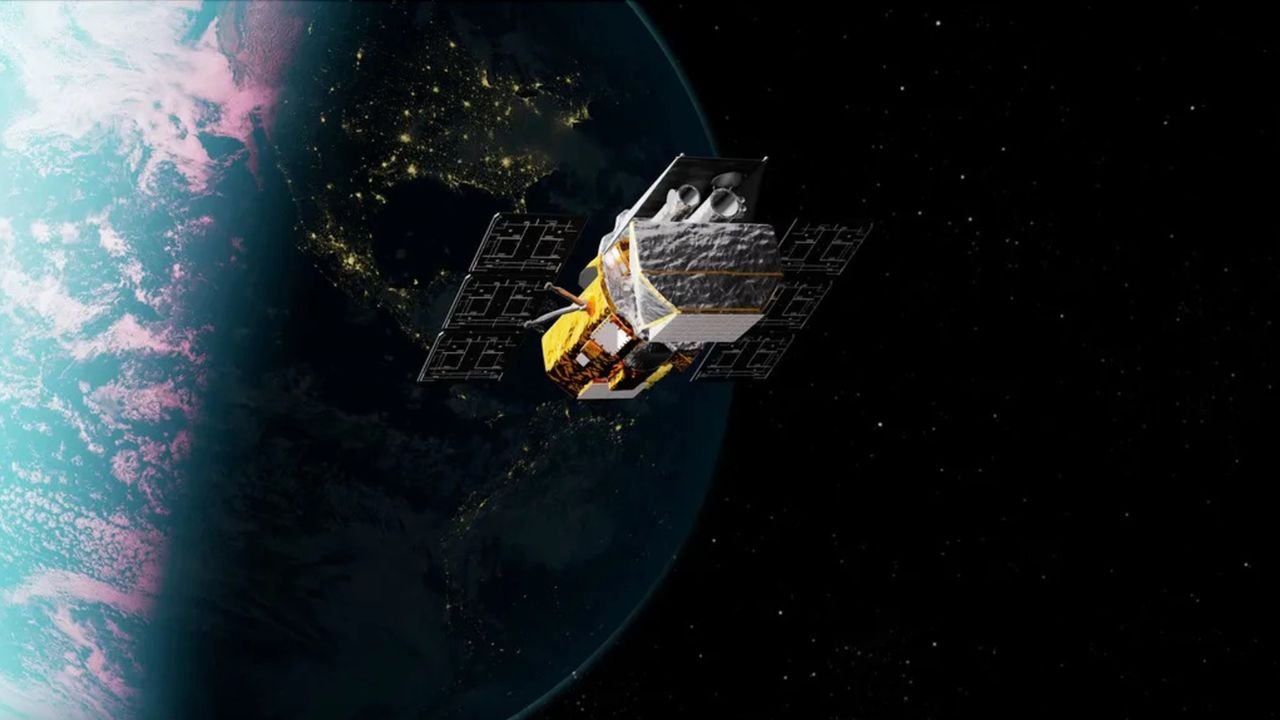
NASA’s Neil Gehrels Swift Observatory is back to studying the universe after months in a low-drag configuration. The space telescope had been waiting for an orbital rescue, but the attempt to boost its altitude failed. Despite this setback, Swift has resumed some of its scientific work, offering hope that it can continue its mission a little longer.
NASA turned off two of Swift’s three instruments in February to reduce atmospheric drag. Its goal was to keep the aging spacecraft in orbit until a rescue mission could arrive. On Aug. 26, mission controllers restarted the X-ray Telescope (XRT) and the Ultraviolet/Optical Telescope (UVOT). These instruments are key to Swift’s ability to study cosmic events, from gamma-ray bursts to supernovae. The third instrument, the Burst Alert Telescope (BAT), remained offline as it was shut down in April to conserve power and further reduce drag. NASA plans to restart BAT within a few weeks.
However, the rescue plan did not go as hoped. A spacecraft called LINK, built by Katalyst Space, was launched July 3 aboard a Northrop Grumman Pegasus XL rocket. Its mission was to reach Swift and boost it to a higher orbit, extending its lifespan. But trouble arose in late July when LINK’s attitude control system failed. The spacecraft spun uncontrollably, losing two of its three reaction wheels and experiencing issues with its thrusters. Engineers managed to stabilize LINK’s spin, but it could no longer complete the orbit boost. NASA and Katalyst decided not to pursue the rescue; instead, LINK will do proximity operations to demonstrate technologies for future missions.
Challenges of an Aging Spacecraft
Launched in 2004, Swift was originally designed to study gamma-ray bursts over a short two-year mission. It has far exceeded expectations. The observatory observes gamma-ray, X-ray, ultraviolet, and visible light. It quickly detects bursts and alerts other telescopes to study the same events. Swift’s ability to rapidly point at fleeting cosmic phenomena makes it a valuable tool for astronomers.
But Swift faces challenges common to aging satellites. Unlike some newer spacecraft, it has no propulsion system to counteract atmospheric drag. As solar activity heats Earth’s upper atmosphere, it expands. This increases drag on Swift, which slowly loses altitude. Engineers performed low-drag operations to keep Swift above about 185 miles (300 kilometers). Without intervention, the spacecraft will drop below that level. NASA expects Swift to reach this threshold within one to two months, after which its orbit will decay faster. If no rescue occurs, Swift will likely re-enter Earth’s atmosphere and burn up later this year.
NASA’s efforts highlight the limits of long-term space missions. Even with cautious management, aging equipment faces increasing risks. The telescope continues to gather valuable data while it lasts. Yet, the outlook remains uncertain. The failed rescue mission means no orbital boost, leaving Swift’s future hanging in the balance. For now, the observatory is making the most of its remaining time, scanning the universe for cosmic secrets.
Continue Your Tech Journey
Dive deeper into the world of Cryptocurrency and its impact on global finance.
Discover archived knowledge and digital history on the Internet Archive.
Space
