

Quick Takeaways
NASA’s humans and robots will work together in space exploration.
Robots improve safety, performance, and capabilities for astronauts.
The team develops reliable, versatile robots for extreme environments.
iMETRO facility tests robotics in simulated lunar and space scenarios.
Reliable Robots: Meet Johnson’s Dexterous Robotics Team
Humans and robots working side-by-side in space once belonged to the realm of science fiction. Today, NASA is turning that idea into reality. As missions go farther into space, robotic systems become more important. They help astronauts perform tasks, stay safe, and explore new worlds. The Dexterous Robotics Team at NASA’s Johnson Space Center in Houston leads the effort to create these advanced robots. Their focus is on developing machines that can do what human hands can do, especially in harsh and complex environments.
This team aims not to replace astronauts with robots. Instead, they want to make space exploration safer and more sustainable. “Our team is not trying to replace human explorers with robots but instead make human exploration safer and more sustainable,” said Shaun Azimi, team lead. “If we can send more capable robots, we can reduce the risk and make people more effective in doing the things that people do best.”
Building Capable and Trustworthy Robots for Space Missions
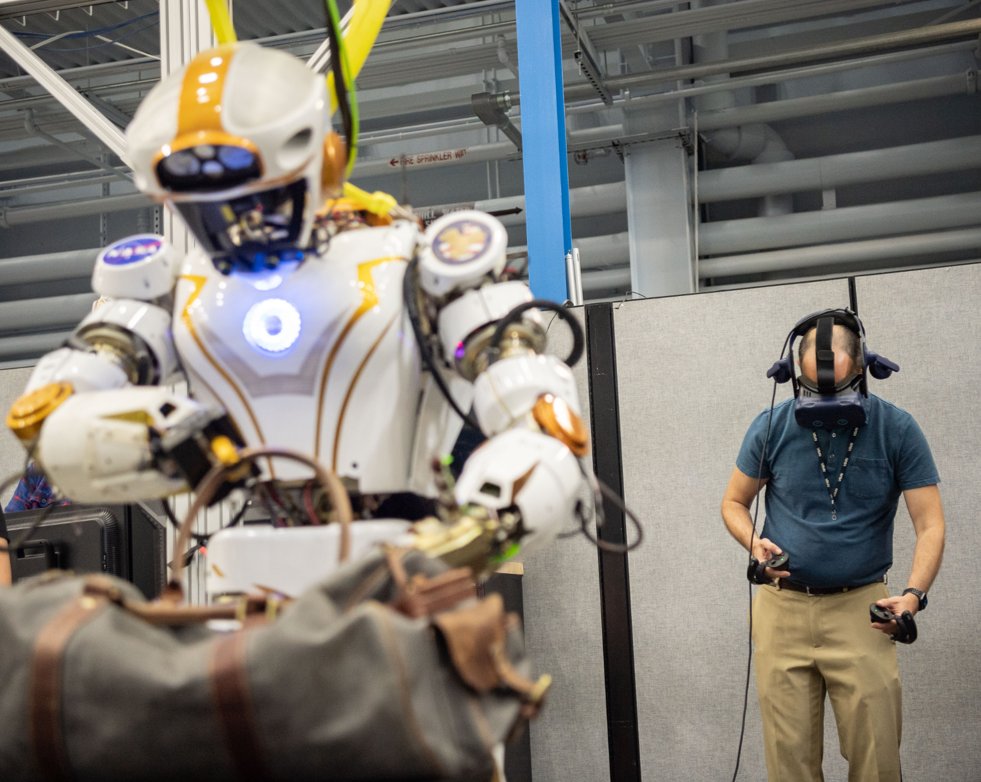
The 16-member team is part of NASA’s Robotic System Technology Branch, which also works on planetary rovers that move across distant landscapes. Many team members have experience in both electronics and mechanics. They also develop software for simulating and analyzing robotic tasks. Their background comes from working on famous robots like Robonaut 2 and Valkyrie. Robonaut 2 spent seven years aboard the International Space Station, testing robotic technologies. Valkyrie was NASA’s first humanoid robot designed to walk and work like a person. Many employees involved in those projects now help develop the robots of today, building on that legacy.
The team’s work supports a wide range of NASA projects, including efforts to build the Moon Base, humanity’s first lunar outpost. They combine research with practical technology development. They also collaborate with private companies and external partners. These partnerships aim to solve problems faced not just in space but also in harsh environments on Earth, such as deep-water oil rigs. Their goal is to create robots that can assist humans safely and efficiently in extreme conditions.
Another key effort is the Integrated Mobile Evaluation Testbed for Robotics Operations (iMETRO). Located at NASA’s Johnson, this facility helps test and adapt terrestrial robotic technologies for space. It offers open-source software, simulations, space vehicle and habitat mockups, and outdoor testing areas. iMETRO provides flexibility to test entire robots or individual parts, both physically and virtually. “It helps remove the guesswork,” Azimi said. “It shows what we need, so external partners won’t have to guess.” The facility also allows developers to understand space habitats better. They learn how robots see, move, and interact with objects. This improves design features, such as handles or lighting, to make tasks easier for both robots and humans.
Test projects at iMETRO include a robotic arm that can recognize a hatch, open it, and transfer cargo. Another project involved developing software to inspect and maintain space station cold storage units. These tests show how robots can perform complex tasks in space environments, reducing the workload for astronauts and increasing safety.
Azimi emphasizes that the team focuses on technologies for lunar missions that could also support future Mars exploration. They are working with other NASA groups on challenges that invite the public to share ideas for technology solutions for Mars. This openness helps gather innovative solutions and prepare for long-term space goals.
Why a Robotics Team at Johnson Matters
Azimi explains that Johnson’s robotics team is uniquely positioned. Their expertise lies in designing robots to work alongside humans or in environments built for humans. They understand the conditions astronauts will face and help develop solutions that fit those needs. The team’s work bridges the gap between space habitat design and robotics, making sure these machines are practical, reliable, and ready to assist astronauts on any mission.
Stay Ahead with the Latest Tech Trends
Learn how the Internet of Things (IoT) is transforming everyday life.
Explore past and present digital transformations on the Internet Archive.
Space
