
Close Menu
    Facebook X (Twitter) Instagram
    Monday, October 26
    Top Stories:
    • AI Automation: Managing Digital Workers
    • Recordanelles: Single-Cell Transcriptome Recording in Human Cells
    • China’s Humanoid Robots Target South Korea’s Physical AI Boom
    Facebook X (Twitter) Instagram Pinterest Vimeo
    IO Tribune
    • Home
    • AI
    • Tech
      • Gadgets
      • Fashion Tech
    • Crypto
    • Smart Cities
      • IOT
    • Science
      • Space
      • Quantum
    • OPED
    IO Tribune
    Home » Oct. 25, 1671: Saturn’s Yin-Yang Moon Discovered
    Space

    Oct. 25, 1671: Saturn’s Yin-Yang Moon Discovered

    Staff ReporterBy Staff ReporterOctober 25, 2026No Comments3 Mins Read
    Share Facebook Twitter Pinterest LinkedIn Tumblr Reddit Telegram Email
    Share
    Facebook Twitter LinkedIn Pinterest Email

    Top Highlights

    • Giovanni Cassini discovered Saturn’s moon Iapetus on October 25, 1671.
    • Iapetus was Saturn’s second known moon, following Huygens’ discovery of Titan.
    • Its contrasting bright and dark hemispheres made it disappear from Cassini’s view.
    • Cassini spacecraft images of Iapetus’ yin-yang surface informed moon-formation theories.

    On this day in space! Oct. 25, 1671: Giovanni Cassini discovers Iapetus, Saturn’s “yin-yang” moon

    On Oct. 25, 1671, Italian astronomer Giovanni Cassini spotted a new moon orbiting Saturn. He had found Iapetus, the second moon known to circle the ringed planet. Its striking contrast between dark and bright terrain would eventually earn it the nickname the “yin-yang moon.”

    Cassini was the first of four moons he discovered at Saturn. Dutch astronomer Christiaan Huygens had found Titan, Saturn’s largest moon, about six years earlier. Cassini later discovered Rhea, Tethys and Dione.

    A moon that seemed to disappear

    Iapetus did not reveal itself easily. When Cassini first observed it, the moon appeared as a tiny point of light west of Saturn. He calculated its orbit and expected to see it again on the planet’s eastern side about 39 days later. But it was missing.

    When Iapetus came back into view on Saturn’s western side, Cassini recognized a possible explanation: the moon was much darker on one side than the other. When that darker hemisphere faced Earth, Iapetus reflected less sunlight and became harder to spot with the telescopes of the time.

    The episode shows both the power and the limits of early astronomy. Careful observation and orbital calculations helped Cassini identify a pattern, but his telescope could not reveal the moon’s surface in detail. That would take a much closer look.

    From a speck of light to a two-tone world

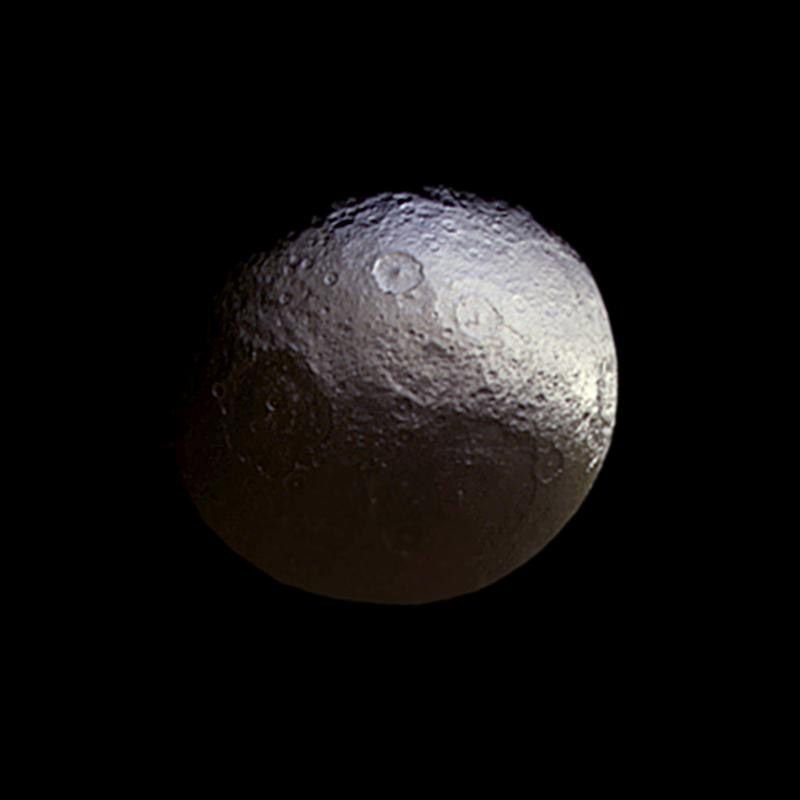
    More than three centuries later, NASA’s Cassini spacecraft studied Saturn and its moons up close. Its images showed Iapetus’s dramatic light-and-dark divide in detail. The view made the “yin-yang” comparison especially apt.

    This Cassini spacecraft image shows Iapetus’s two-tone surface without false color. Image credit: NASA/JPL-Caltech/Space Science Institute.

    The spacecraft transformed Iapetus from a difficult point of light into a world scientists could examine. Space missions are costly and take years to plan and operate, but they can collect close-up data that Earth-based telescopes cannot. Those observations help researchers test ideas about how moons and rings form.

    Some models suggest Saturn’s inner moons and rings are relatively young, while the more distant moons Titan and Iapetus may have formed earlier. In one proposed explanation, Saturn once had a different set of moons. Changes in their orbits, possibly linked to a resonance involving Saturn’s motion around the sun, could have brought neighboring moons into collision. The resulting debris may have helped form the rings and the moons seen today.

    That scenario is a scientific model, not a confirmed account of Saturn’s past. Iapetus’s unusual surface and orbit nevertheless give researchers valuable evidence as they investigate how the Saturn system evolved.

    Continue Your Tech Journey

    Learn how the Internet of Things (IoT) is transforming everyday life.

    Stay inspired by the vast knowledge available on Wikipedia.

    Space

    Cosmos NASA Research Space VT1
    Share. Facebook Twitter Pinterest LinkedIn Tumblr Email
    Previous ArticleSame AI Answer, Different Reason: The Power of Planted Hints
    Next Article Best Android Phone Alternative to the iPhone Duo
    Avatar photo
    Staff Reporter
    • Website

    John Marcelli is a staff writer for IO Tribune, with a passion for exploring and writing about the ever-evolving world of technology. From emerging trends to in-depth reviews of the latest gadgets, John stays at the forefront of innovation, delivering engaging content that informs and inspires readers. When he's not writing, he enjoys experimenting with new tech tools and diving into the digital landscape.

    Related Posts

    AI

    On-Policy Self-Distillation: A Post-Training Revolution?

    October 26, 2026
    Gadgets

    Best Android Phone Alternative to the iPhone Duo

    October 25, 2026
    AI

    Same AI Answer, Different Reason: The Power of Planted Hints

    October 25, 2026
    Add A Comment

    Comments are closed.

    Must Read

    On-Policy Self-Distillation: A Post-Training Revolution?

    October 26, 2026

    Best Android Phone Alternative to the iPhone Duo

    October 25, 2026

    Oct. 25, 1671: Saturn’s Yin-Yang Moon Discovered

    October 25, 2026

    Same AI Answer, Different Reason: The Power of Planted Hints

    October 25, 2026

    AI Automation: Managing Digital Workers

    October 25, 2026
    Categories
    • AI
    • Crypto
    • Fashion Tech
    • Gadgets
    • IOT
    • OPED
    • Quantum
    • Science
    • Smart Cities
    • Space
    • Tech
    Most Popular

    Surreal Philadelphia: Where Art Meets AI

    April 5, 2026

    Globe Unveils Smart City Digital Roadmap at INNOVANIA 2025

    August 19, 2025

    Apple Takes Legal Action Against Oppo Over Watch Trade Secret Theft

    August 23, 2025
    Our Picks

    Dreaming of Home Plate: The Umpire’s Journey

    August 13, 2025

    Unveiling the Pitfalls: A Stolen Kia and the Flaws in Connected Car Tech

    July 2, 2026

    Unpacking Roles: AI Engineers, Scientists, Deployments

    October 10, 2026
    Categories
    • AI
    • Crypto
    • Fashion Tech
    • Gadgets
    • IOT
    • OPED
    • Quantum
    • Science
    • Smart Cities
    • Space
    • Tech
    • Privacy Policy
    • Disclaimer
    • Terms and Conditions
    • About Us
    • Contact us
    Copyright © 2025 Iotribune.comAll Rights Reserved.

    Type above and press Enter to search. Press Esc to cancel.