
Close Menu
    Facebook X (Twitter) Instagram
    Monday, October 26
    Top Stories:
    • AI Automation: Managing Digital Workers
    • Recordanelles: Single-Cell Transcriptome Recording in Human Cells
    • China’s Humanoid Robots Target South Korea’s Physical AI Boom
    Facebook X (Twitter) Instagram Pinterest Vimeo
    IO Tribune
    • Home
    • AI
    • Tech
      • Gadgets
      • Fashion Tech
    • Crypto
    • Smart Cities
      • IOT
    • Science
      • Space
      • Quantum
    • OPED
    IO Tribune
    Home » Lumina Reveals How the Universe Emerged from the Dark AgesLumina Reveals How the Universe Emerged from the Dark Ages
    Quantum

    Lumina Reveals How the Universe Emerged from the Dark AgesLumina Reveals How the Universe Emerged from the Dark Ages

    Staff ReporterBy Staff ReporterOctober 26, 2026No Comments2 Mins Read
    Share Facebook Twitter Pinterest LinkedIn Tumblr Reddit Telegram Email
    Share
    Facebook Twitter LinkedIn Pinterest Email

    Summary Points

    Lumina simulates two billion years, capturing hydrogen and helium reionization.

    Early stars drove hydrogen reionization; black holes powered helium reionization.

    It models half a trillion elements across volumes 100 times larger than predecessors.

    Researchers can use Lumina to compare cosmic predictions with telescope observations.

    A new view of the early universe

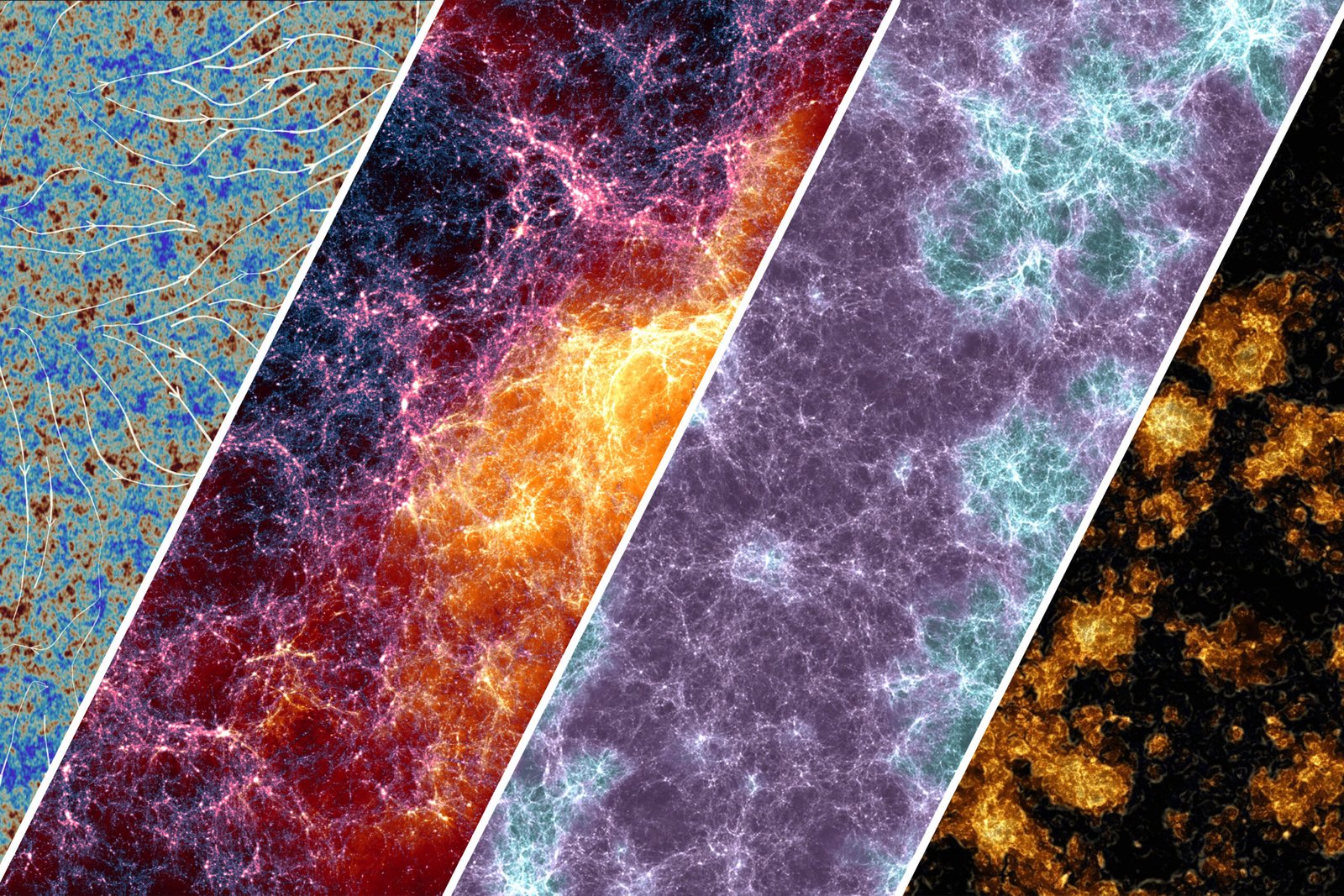
    For hundreds of millions of years after the Big Bang, neutral hydrogen filled the universe and blocked much of its light. A new simulation called Lumina follows how that darkness lifted — and how the first galaxies, stars and black holes reshaped the cosmos.

    Across two billion years of cosmic history, Lumina models two major changes. Early stars and galaxies produced ultraviolet light that stripped electrons from hydrogen, allowing light to travel more freely. Later, intense radiation from actively feeding supermassive black holes ionized helium. The simulation captures both processes together, offering a detailed way to study how the first cosmic structures formed.

    Big scale, significant computing demands

    Lumina combines an upgraded galaxy-formation model with calculations of how radiation travels through space. It tracks about half a trillion elements across a region roughly 500 megaparsecs wide. That is 100 times the volume of previous leading simulations, with about 30 times the resolution of its predecessor.

    The scale comes at a cost. Researchers ran Lumina on the Frontier supercomputer, using the equivalent of more than 100,000 CPU cores and about 15,000 GPUs at peak. That computing demand makes the project a major technical achievement, but also underscores how difficult it is to repeat or expand such work.

    The team is making the simulation available to scientists, who can compare its predictions with observations from current and future telescopes. Lumina does not replace those observations: Its results depend on the physical models and starting conditions built into the simulation. But by linking small-scale star formation with changes across vast regions of space, it gives researchers a powerful tool for testing ideas about the universe’s early history.

    Expand Your Tech Knowledge

    Learn how the Internet of Things (IoT) is transforming everyday life.

    Discover archived knowledge and digital history on the Internet Archive.

    QuantumV1

    Cosmology early universe epoch of reionization galaxy and star formation HPC Lumina simulation Mark Vogelsberger MIT Kavli Institute MIT Physics Oliver Zier Quantum VT1 Xuejian (Jacob) Shen
    Share. Facebook Twitter Pinterest LinkedIn Tumblr Email
    Previous ArticleCarPlay Bell Icon: What It Means and How to Use It
    Next Article Make Long-Running Python Simulations Self-Service
    Avatar photo
    Staff Reporter
    • Website

    John Marcelli is a staff writer for IO Tribune, with a passion for exploring and writing about the ever-evolving world of technology. From emerging trends to in-depth reviews of the latest gadgets, John stays at the forefront of innovation, delivering engaging content that informs and inspires readers. When he's not writing, he enjoys experimenting with new tech tools and diving into the digital landscape.

    Related Posts

    AI

    Make Long-Running Python Simulations Self-Service

    October 26, 2026
    Gadgets

    CarPlay Bell Icon: What It Means and How to Use It

    October 26, 2026
    AI

    Build Smarter Decisions with Hybrid LLM Workflows

    October 26, 2026
    Add A Comment

    Comments are closed.

    Must Read

    Make Long-Running Python Simulations Self-Service

    October 26, 2026

    Lumina Reveals How the Universe Emerged from the Dark AgesLumina Reveals How the Universe Emerged from the Dark Ages

    October 26, 2026

    CarPlay Bell Icon: What It Means and How to Use It

    October 26, 2026

    Build Smarter Decisions with Hybrid LLM Workflows

    October 26, 2026

    Why We Unknowingly Mimic Other People’s Accents

    October 26, 2026
    Categories
    • AI
    • Crypto
    • Fashion Tech
    • Gadgets
    • IOT
    • OPED
    • Quantum
    • Science
    • Smart Cities
    • Space
    • Tech
    Most Popular

    Arctic Greening Is Reversing—Here’s Why

    October 25, 2026

    Master Horse Trainer who Revolutionized Trust-Based Training Passes Away at 91

    August 8, 2026

    Build Smarter Decisions with Hybrid LLM Workflows

    October 26, 2026
    Our Picks

    ChatGPT Glossary: 60 Must-Know AI Terms

    November 7, 2025

    Unlock Your Potential: ZSA Voyager Keyboard & Navigator Trackball Review

    December 3, 2025

    Laughter: A Ancient Bond with Great Ape Relatives

    June 30, 2026
    Categories
    • AI
    • Crypto
    • Fashion Tech
    • Gadgets
    • IOT
    • OPED
    • Quantum
    • Science
    • Smart Cities
    • Space
    • Tech
    • Privacy Policy
    • Disclaimer
    • Terms and Conditions
    • About Us
    • Contact us
    Copyright © 2025 Iotribune.comAll Rights Reserved.

    Type above and press Enter to search. Press Esc to cancel.