

Fast Facts
- Four volunteers conclude 378 days of isolation in NASA’s simulated Mars habitat.
- CHAPEA Mission 2 tested operations amid communication delays, limited resources, and isolation.
- Researchers will use health and performance data to prepare future lunar missions.
- Findings may improve food systems, crew schedules, medical care, and behavioral support.
NASA Invites Media to Crew Completion of Yearlong Mars Simulation
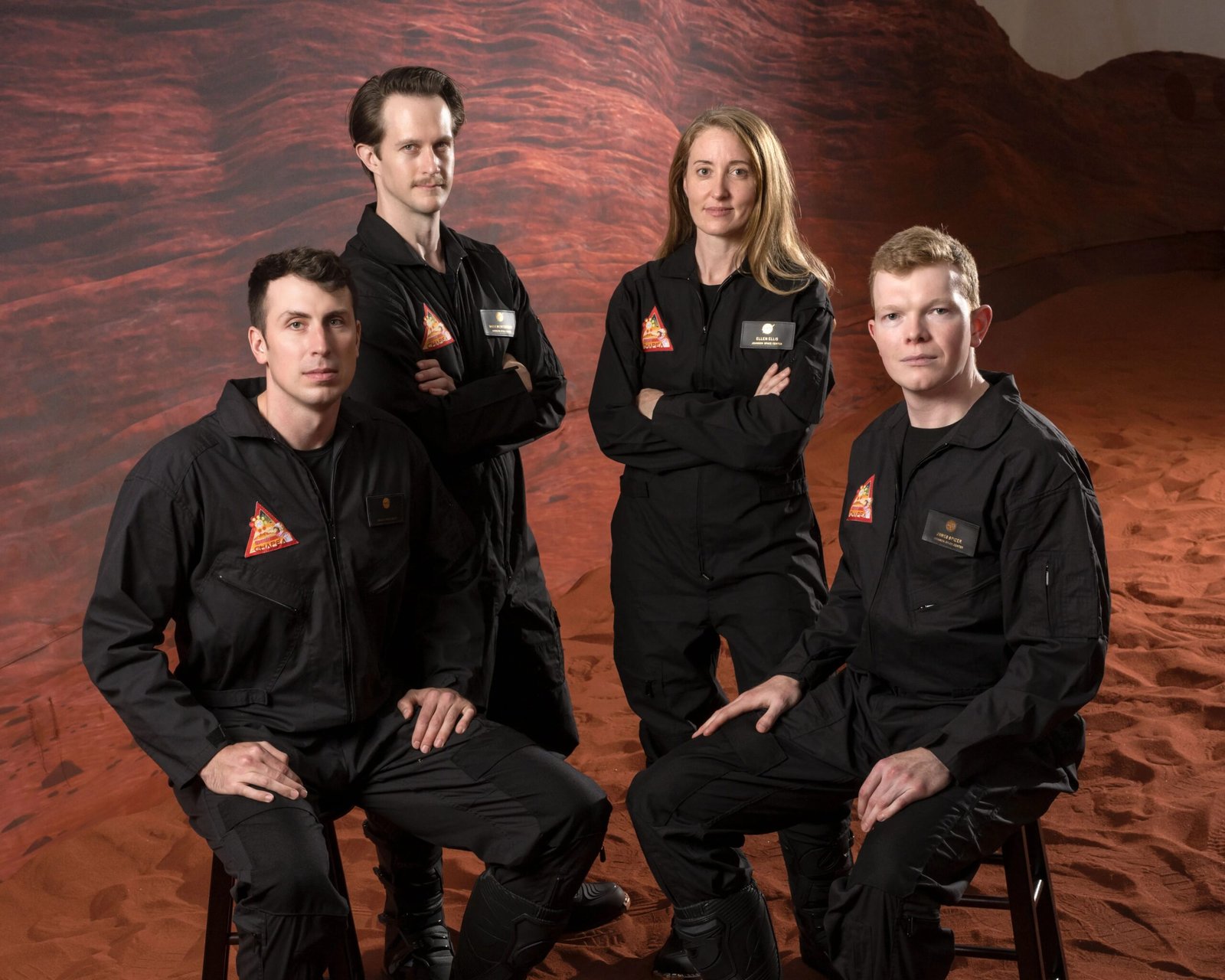
Four volunteers are preparing to leave a simulated Mars habitat after 378 days of isolation at NASA’s Johnson Space Center in Houston. Their departure on Saturday, Oct. 31, will mark the end of the second Crew Health and Performance Exploration Analog mission, known as CHAPEA.
NASA will stream the crew’s exit ceremony beginning at 3 p.m. EDT on NASA Johnson’s YouTube channel and social media accounts. Johnson Center Director Vanessa Wyche and NASA astronaut Jack Hathaway will offer remarks. Crew members Ross Elder, Ellen Ellis, James Spicer and Matthew Montgomery also will speak.
A year of simulated mission work
The four volunteers began the mission on Oct. 19, 2025. They lived and worked inside a 1,700-square-foot, 3D-printed facility designed to mimic some conditions of a Mars mission. Their routine included simulated spacewalks, exercise, habitat maintenance and plant cultivation.
The crew also faced challenges that future deep-space travelers may encounter, including communication delays, limited resources and isolation. These conditions let researchers study how people manage mission tasks and daily life when support and supplies are not readily available.
A habitat on Earth cannot reproduce every condition of a journey to Mars. Still, the mission can generate useful data on crew health, performance and operations. NASA can use those findings alongside other research to improve planning for future lunar and deep-space missions.
How the findings could inform future missions
NASA says CHAPEA data could help teams refine food systems, make better use of crew time and plan communications over the agency’s Deep Space Network. Researchers also can use the results to strengthen medical care and behavioral support, helping flight doctors and psychologists prepare crews for demanding missions.
The work may inform NASA’s Artemis lunar missions and plans for living on the Moon. It does not, by itself, establish that a particular system or practice will work in space. Researchers must weigh the benefits of new approaches against practical limits such as crew workload, available resources and communications capacity.
Media can watch the ceremony on a screen outside the hangar that houses the CHAPEA facility. Afterward, a subject matter expert will be available in person to answer questions. Media also will have a chance to photograph the crew as they step outside for the first time in more than a year.
U.S. media interested in attending in person, or in speaking virtually with crew members in the days after the mission, must contact the NASA Johnson newsroom by 2 p.m. EDT Friday, Oct. 30, at jsc-newsroom@mail.nasa.gov.
Learn more about NASA’s CHAPEA mission at nasa.gov/humans-in-space/chapea.
Discover More Technology Insights
Learn how the Internet of Things (IoT) is transforming everyday life.
Explore past and present digital transformations on the Internet Archive.
Space
