

Essential Insights
- Voyager 1 reaches one light-day from Earth Wednesday, over 16 billion miles away.
- NASA invites people to flash Voyager’s VGR call sign in Morse code.
- Since entering interstellar space in 2012, it measures fields and plasma waves.
- Golden Record carries 115 images, natural sounds, and greetings in 35 languages.
Voyager 1 Is About to Reach a One-Light-Day Distance From Earth
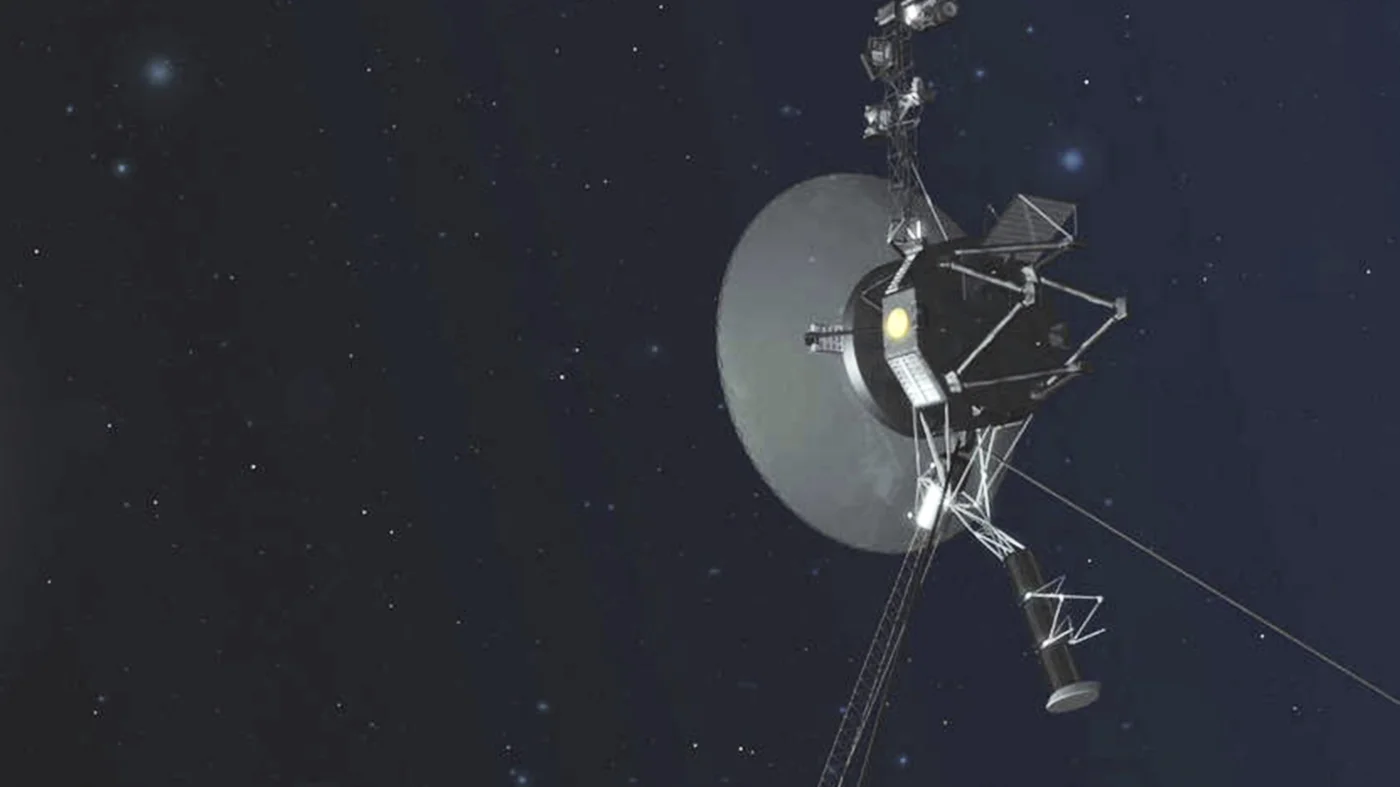
Voyager 1 has traveled farther from Earth than any other human-made object. It is nearing another milestone: a distance light would cross in 24 hours.
NASA estimates the spacecraft will reach “light-day status” at 5:16 a.m. ET on Wednesday, after nearly 50 years in space. The milestone offers a striking measure of how far the probe has gone—and how long it takes for even a radio message to cross the gap.
A light-day is a measure of distance, not time. Light travels more than 16 billion miles in a day. When Voyager 1 reaches that distance, a signal sent from Earth will take about 24 hours to reach it. A reply would take roughly another day to return.
NASA is marking the occasion with “Shine Bright for Voyager’s Light-Day.” The agency has invited the public to flash Voyager’s call sign, V-G-R, in Morse code on Tuesday night. Participants can use a flashlight, a phone light or another light source.
The sequence is simple: V is three short flashes followed by one long flash; G is two long flashes followed by one short flash; and R is one short flash, one long flash and one short flash. The gesture is symbolic. Voyager 1 is far too distant to see a flashlight from Earth.
A long journey beyond the planets
NASA launched Voyager 1 on Sept. 5, 1977. The spacecraft flew past Jupiter and Saturn, sending back observations that expanded scientists’ knowledge of the outer planets. In 1979, it found a faint ring system around Jupiter. A year later, it captured detailed images of Saturn’s rings and moons.
On Feb. 17, 1998, Voyager 1 passed Pioneer 10 and became the most distant human-made object. Its twin, Voyager 2, also traveled beyond the heliosphere, the vast region shaped by the solar wind and the Sun’s magnetic influence. The two probes are the only spacecraft to have operated outside that protective bubble.
Voyager 1 crossed the heliosphere’s outer boundary in 2012. It now studies the space between stars, measuring magnetic fields, particles and plasma waves. Those observations help researchers understand the environment beyond the Sun’s reach.
The mission faces a practical limit: power. Voyager 1 relies on a declining supply of electricity, so NASA has shut down instruments to extend its operating life. Earlier this year, the agency turned off the Low-energy Charged Particles experiment, which helped scientists map the structure of space. Two science instruments remain active: one measures magnetic fields, while the other detects plasma waves.
A message carried into interstellar space
Voyager 1 also carries the Golden Record, a gold-plated message designed to represent life on Earth. It contains 115 images, natural sounds such as surf, wind and animal calls, and spoken greetings in 35 languages. Symbols on the record provide instructions for playing it and information about the probe’s origin.
The record is an ambitious gesture, not a practical communication system. No one knows whether another civilization will ever find it. But its contents preserve a snapshot of how people chose to introduce Earth to an unknown audience.
Voyager 1’s continued operation depends on careful choices about which systems to keep running. Its instruments deliver rare measurements, while the spacecraft’s shrinking power supply makes every extension temporary. Even so, the probe continues to send data across a distance that soon will take light a full day to cross.
Stay Ahead with the Latest Tech Trends
Explore the future of technology with our detailed insights on Artificial Intelligence.
Stay inspired by the vast knowledge available on Wikipedia.
Space
