

Top Highlights
Astronomers witnessed red giant Big Bao engulf its smaller companion, Little Bao.
AT2025abao brightened gradually for years before its spectacular October 2025 eruption.
Little Bao plunged into Big Bao’s core, ejecting material and triggering eruption.
JWST estimated Little Bao’s mass at 70% of the Sun’s.
Astronomers watch a red giant star devour its companion before erupting
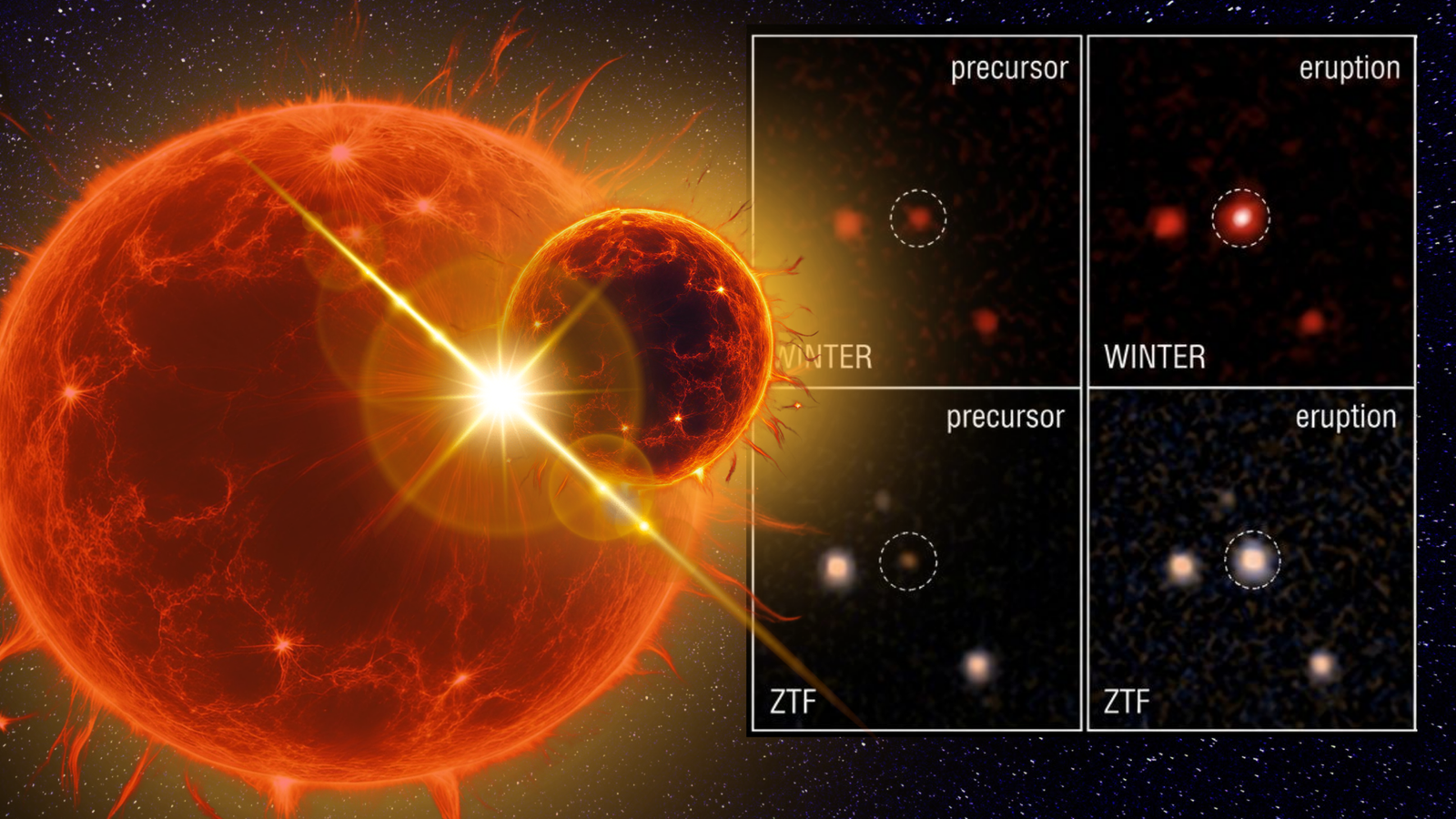
A red giant in the Andromeda galaxy spent years growing brighter. Then, in October 2025, it erupted in a dramatic flash. Astronomers say the outburst marked the final stage of a stellar merger: a swollen star had engulfed a smaller companion and dragged it into its core.
The event, named AT2025abao, earned the stars playful nicknames: “Big Bao” and “Little Bao.” Big Bao had expanded to about 350 times the Sun’s size. Little Bao, with an estimated mass about 70% of the Sun’s, was ultimately swallowed.
The nickname may sound lighthearted. The process was anything but. The observations offer a rare look at how a star can change in the years before it merges with a companion—and how the collision can trigger a brilliant eruption.
A slow brightening, then a sudden eruption
Astronomers first noticed a bright flash in Andromeda, where they had not expected an explosion. Looking back through earlier observations, they found that the star at the center of the event had begun brightening steadily in 2019. It had appeared stable for about three decades before that.
The gradual change was a crucial clue. A red giant forms when a star begins to run out of hydrogen fuel in its core and expands. The team’s explanation is that Big Bao grew so large that it engulfed Little Bao. The smaller star then spiraled toward Big Bao’s core, completing the plunge in fewer than 10 orbits.
Astronomers did not watch the companion’s entire journey in real time. Instead, they assembled the story from years of observations across different kinds of light. In July 2025, NASA’s SPHEREx mission found that Big Bao was dimming in visible light while growing brighter in infrared. That shift suggested the star was cooling and shedding dense clouds of gas and dust.
On Oct. 17, 2025, two instruments at California’s Palomar Observatory detected the eruption. Researchers think material thrown out during the merger—moving at about 1.8 million miles per hour—slammed into gas and dust Big Bao had already released. The collision produced the bright flash.
The eruption is classified as a luminous red nova, a type of outburst associated with a stellar merger. It is not the same as a supernova, which occurs when a star explodes through a different process.
Many telescopes, one developing picture
The discovery relied on a broad mix of observatories. NASA’s NEOWISE and SPHEREx missions, the James Webb Space Telescope, the W. M. Keck Observatory, and Palomar’s Zwicky Transient Facility and WINTER instrument each contributed observations. Their combined data helped researchers track changes before and after the outburst.
That coordination shows the practical strength of modern astronomy: instruments with different capabilities can fill in different parts of a complex event. Infrared measurements revealed dust and cooling. Optical observations tracked changes in brightness and captured the eruption. Later, JWST observations helped measure the gas and dust around Big Bao before the outburst, adding evidence that Little Bao had roughly 70% of the Sun’s mass.
There are limits, too. No single telescope recorded every stage, and the merger itself was reconstructed from indirect evidence. The conclusion depends on fitting observations from multiple facilities into one physical explanation. That takes careful analysis, but it can reveal a much richer timeline than a brief view of the final flash alone.
The study, published in the journal Nature, gives astronomers an unusually detailed account of a stellar merger’s lead-up. Big Bao’s years of gradual brightening were especially valuable: Such stars can remain relatively stable for thousands of years, so catching a system in transition is rare.
The “Bao” names make the story memorable. The science behind them is more consequential. AT2025abao shows how a companion star can reshape a giant star’s surroundings—and how patient, coordinated observations can turn a sudden cosmic flare into a story that began years before it appeared.
Discover More Technology Insights
Dive deeper into the world of Cryptocurrency and its impact on global finance.
Explore past and present digital transformations on the Internet Archive.
Space
