

Summary Points
-
Nuclear Deflection Viability: New simulations suggest that using nuclear devices to deflect incoming asteroids could be a practical last-resort strategy, as asteroids can endure more stress than previously thought.
-
Increased Material Strength: Research shows that asteroids grow stronger under intense impact, which implies that a nuclear explosion may prevent fragmentation, reducing the risk of multiple hazardous fragments hitting Earth.
-
Innovative Experimental Techniques: Utilizing CERN’s Super Proton Synchrotron, researchers successfully observed an iron meteorite’s deformation and strength changes in real-time, revealing critical data for asteroid deflection strategies.
-
Standoff Nuclear Detonation Strategy: Instead of planting explosives, scientists propose a standoff nuclear detonation to deflect an asteroid by vaporizing part of its mass, aiming for effective planetary defense without direct contact.
It May Be Safe to Nuke an Earthbound Asteroid After All, Simulation Suggests
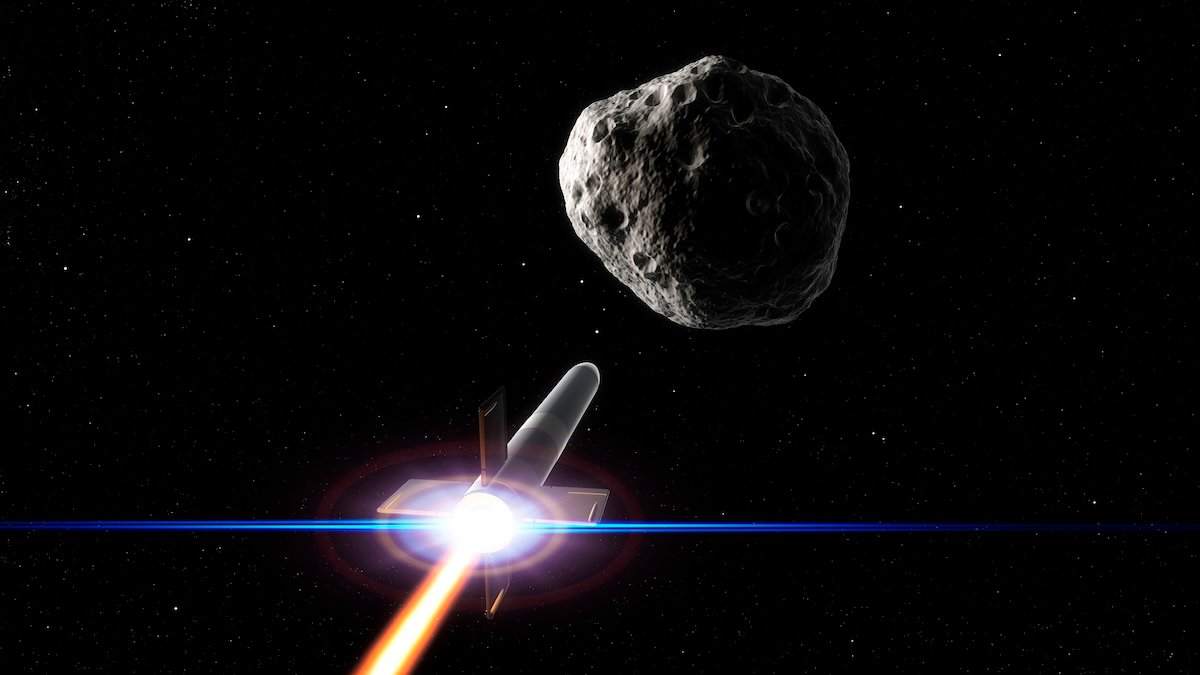
A recent simulation suggests that using nuclear weapons to deflect an incoming asteroid could be a viable option. Researchers have discovered that asteroids can withstand more stress than previously believed. This finding means that a nuclear blast may not shatter an asteroid but could help redirect it away from Earth.
The study involved a collaboration between physicists from the University of Oxford and the nuclear deflection startup OuSoCo. They tested how an iron meteorite would respond to various levels of stress. Co-founder Melanie Bochmann explained that their analyses aimed to observe the meteorite’s internal structure as it underwent irradiation. Surprisingly, they found that the meteorite actually strengthened when subjected to impact.
Similar to the DART mission in 2022, another method to avert disaster involves using a kinetic impactor—a device designed to collide with an asteroid. However, this technique presents risks. An incorrect hit might only postpone danger, potentially leading to fragmentation and multiple hazardous fragments heading toward Earth.
Determining the best approach requires detailed knowledge of an asteroid’s material properties. Such information—especially regarding how materials react during an impact—is scarce. Various models predict different outcomes regarding an asteroid’s yield strength, complicating decision-making for planetary defense.
This study represents a breakthrough. Researchers successfully measured how a meteorite responded to high-energy impacts without destroying it. They used the Super Proton Synchrotron at CERN to irradiate the meteorite, revealing its unique ability to soften and re-strengthen during stress. Findings showed that the harder the asteroid is struck, the better it dissipates energy.
Despite promising results, challenges remain. Future research will explore other types of asteroids to provide a comprehensive understanding of material responses. Karl-Georg Schlesinger, another OuSoCo co-founder, stressed that confidence in executing a nuclear mission is vital, even without real-world tests.
If humanity ever resorts to a nuclear option, it likely won’t involve drilling or traditional explosions. Instead, physicists suggest a standoff detonation to vaporize part of the asteroid, thereby changing its trajectory.
This innovative research, published in Nature Communications, opens new avenues for planetary defense and technological development, potentially making the prospect of protecting Earth much more feasible.
Expand Your Tech Knowledge
Learn how the Internet of Things (IoT) is transforming everyday life.
Stay inspired by the vast knowledge available on Wikipedia.
QuantumV1
