

Fast Facts
-
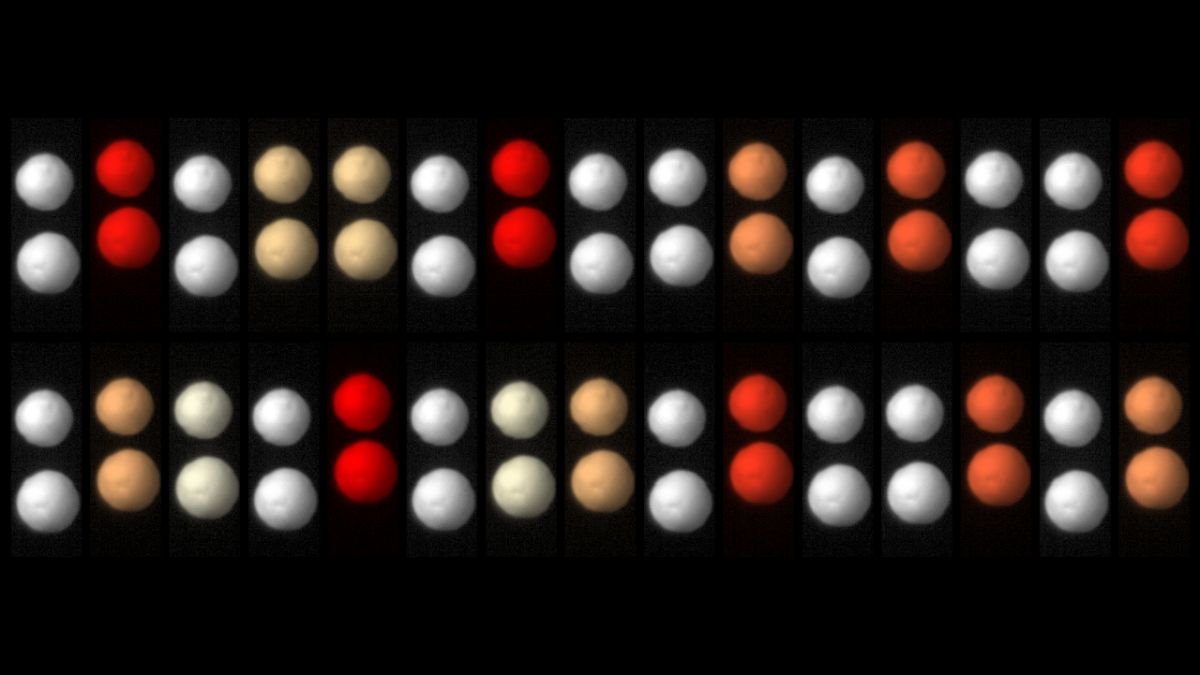
Discovery of Classical Time Crystals: Researchers at NYU demonstrated that classical time crystals can form using simple materials like speakers and styrofoam beads, rather than complex quantum systems.
-
Non-Reciprocal Interactions: The study utilized tiny polystyrene beads levitated by sound waves to explore non-reciprocal interactions, where the force exerted by one bead on another differs based on their sizes.
-
Temporal Pattern Formation: The beads interacted in such a way that they oscillated in a synchronized temporal pattern for extended periods, showcasing time crystal behavior without external influence.
-
Implications for Research: The findings suggest potential applications in studying biological systems and highlight that fundamental physical phenomena can be explored without high-tech equipment.
NYU Researchers Create Time Crystal with Simple Materials
In a groundbreaking experiment, a team from New York University (NYU) has created a classical time crystal using just styrofoam and sound waves. This discovery simplifies the concept of time crystals, once deemed a complex quantum phenomenon.
Time crystals, predicted in 2012, display unique behavior. Unlike regular crystals, which have spatial patterns, time crystals show patterns that repeat over time. NYU physicist David Grier highlighted the significance of this research, stating, “Our system is remarkable because it’s incredibly simple.”
To achieve this, researchers used tiny polystyrene beads. These beads, measuring just a millimeter, proved ideal for studying sound interactions. By employing a small speaker array, the scientists generated a standing sound wave. This wave levitated the beads, allowing them to interact through scattered sound waves.
Mia Morrell, another physicist on the team, explained, “Sound waves exert forces on particles — just like waves on the surface of a pond can exert forces on a floating leaf.” This interaction led to a non-reciprocal behavior, where larger beads influenced smaller ones more significantly.
Remarkably, this setup allowed the beads to oscillate in a stable temporal pattern for hours. This finding opens doors for future experiments. Although the practical applications are still unclear, the research may influence fields like biochemistry. For instance, some biological systems exhibit non-reciprocal relationships, potentially paralleling the interactions seen in this experiment.
The study illustrates that exploring complex scientific phenomena doesn’t always require advanced technology. Sometimes, innovation comes from using everyday materials. As researchers continue to delve into these behaviors, the potential for new discoveries remains vast.
These findings appeared in Physical Review Letters, promising new directions in the study of exotic states of matter.
Discover More Technology Insights
Dive deeper into the world of Cryptocurrency and its impact on global finance.
Explore past and present digital transformations on the Internet Archive.
QuantumV1
