

Fast Facts
-
NASA’s Hubble Space Telescope captures first images of newly developing stars, revealing insights into their formation despite being shrouded in dust.
-
The images, part of the SOFIA Massive Star Formation Survey, focus on massive stars over eight times the mass of the Sun and examine connections between their properties and evolutionary stages.
-
Notable star-forming regions include Cepheus A, located 2,400 light-years away, which features a luminous protostar and HII regions where ultraviolet radiation ionizes surrounding gas.
-
Hubble also images closer regions like G033.91+0.11 and GAL-305.20+00.21, showcasing reflection and emission nebulae created by hidden protostars and surrounding gas dynamics.
Hubble Snaps Stellar Baby Pictures
NASA’s Hubble Space Telescope has captured stunning images of newly forming stars. These images showcase infant stars, or protostars, hidden under layers of thick dust. This significant advancement helps scientists understand how massive stars evolve.
The Hubble Telescope detects near-infrared light. As light pierces through openings formed by gas and dust jets, it reveals crucial details about the protostars. Researchers can study the structure and energy of these “outflow cavities.” They aim to connect the features of young stars—such as brightness and mass—to their developmental stages.
These observations form part of the SOFIA Massive Star Formation Survey (SOMA). This project specifically examines stars with a mass greater than eight times that of our Sun.
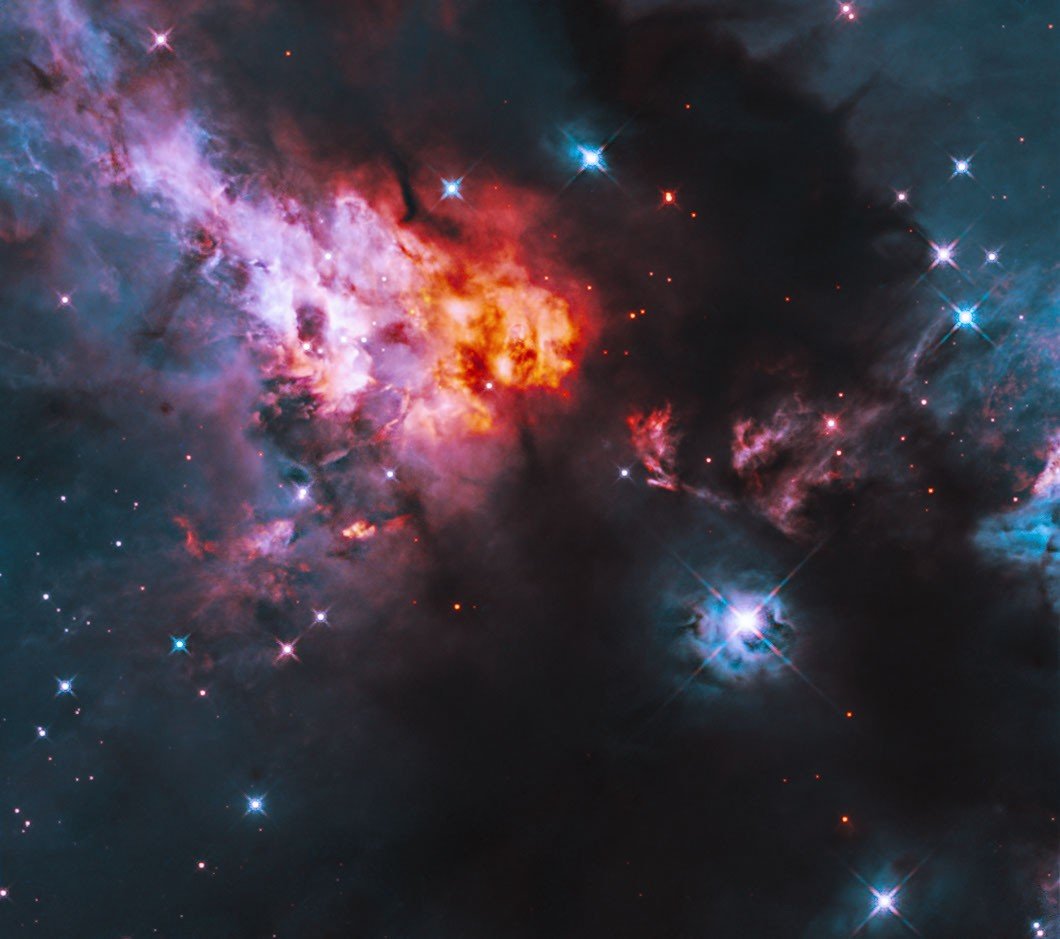
One of the highlights includes the high-mass star-forming region Cepheus A. This area is home to a luminous protostar that contributes significantly to the region’s brightness. Although much of Cepheus A is veiled in dense dust, light from hidden stars breaks through, creating beautiful pink and white nebulae. The pink regions signify HII areas, where intense ultraviolet radiation converts surrounding gas into glowing hydrogen. Cepheus A lies about 2,400 light-years away in the constellation Cepheus.
Closer to home, the Hubble images also capture G033.91+0.11, a star-forming region within our Milky Way. Hubble reveals a light patch at its center—a reflection nebula where light from a concealed protostar bounces off surrounding gas.
Additionally, Hubble shows the emission nebula in GAL-305.20+00.21. The bright spot here glows due to ionization from a protostar encased in gas and dust.
Another noteworthy image features the massive protostar IRAS 20126+4104. Located about 5,300 light-years away in Cygnus, this B-type protostar is notable for its high luminosity and temperature. Bright ionized hydrogen in the center of the image shines as jets emerge from the protostar’s poles.
These spectacular images not only deepen our understanding of star formation but also drive technological advancements. They illustrate how precision instruments like Hubble enhance our grasp of the universe. Each new image, released daily from January 12-17, 2026, provides a continuous source of inspiration and knowledge.
Stay updated with the latest from Hubble by following @NASAHubble on social media. For more images of young stellar objects, check out Hubble’s Stellar Construction Zones.
Stay Ahead with the Latest Tech Trends
Learn how the Internet of Things (IoT) is transforming everyday life.
Discover archived knowledge and digital history on the Internet Archive.
SciV1
