

Summary Points
-
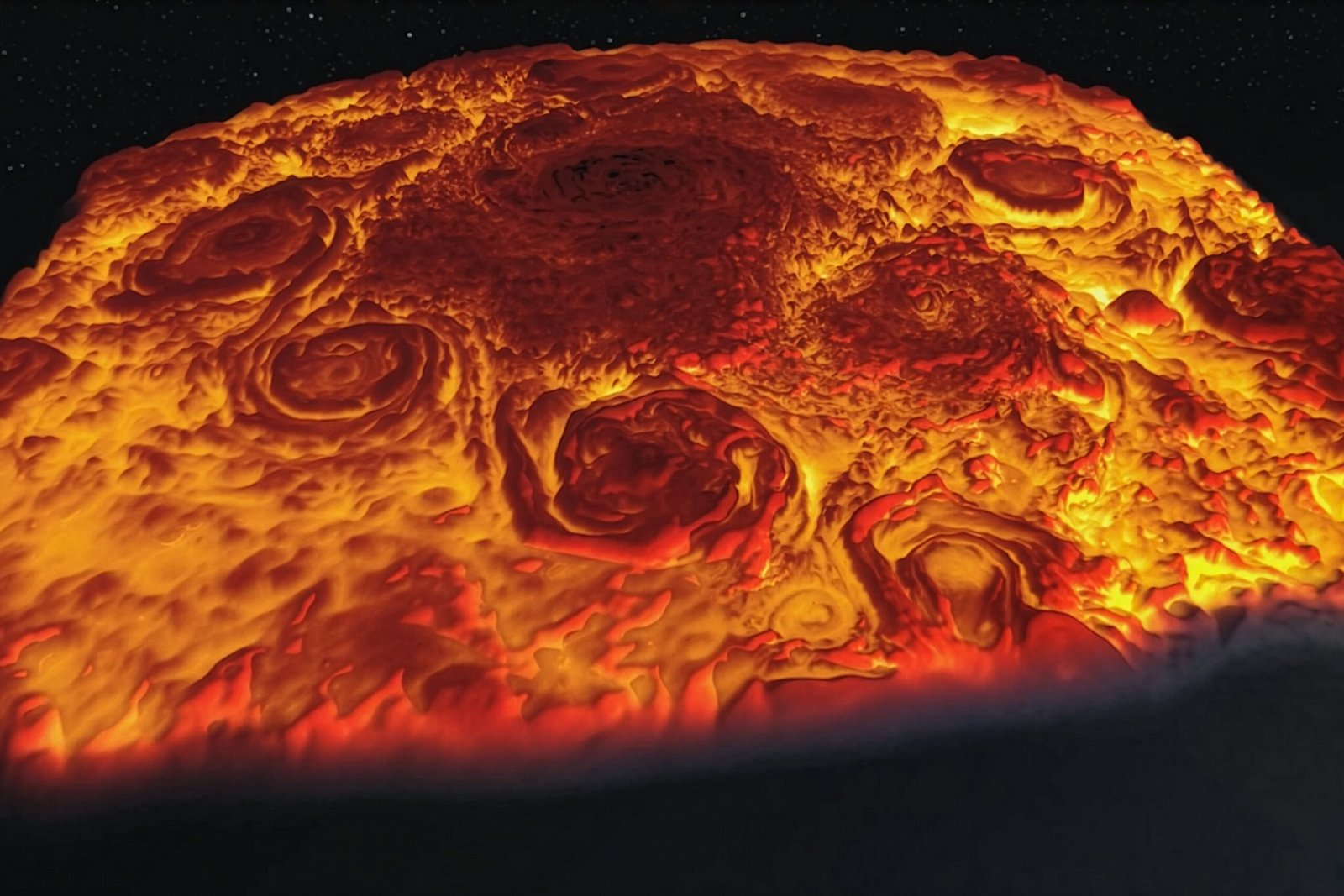
Distinct Polar Vortices: Jupiter and Saturn exhibit contrasting polar vortex patterns, with Jupiter featuring multiple smaller vortices and Saturn a single massive hexagonal vortex.
-
Mechanism Identified: MIT scientists identify that the “softness” of a vortex’s base, linked to a planet’s internal composition, determines whether a planet develops a single or multiple polar vortices.
-
Simulation Findings: Through simulations, researchers demonstrated that softer materials lead to multiple smaller vortices (Jupiter), while harder materials allow a single large vortex (Saturn).
-
Insight into Interiors: The study suggests that surface fluid patterns can reveal crucial information about the planets’ interiors, indicating that Jupiter may contain softer materials compared to the denser compositions of Saturn.
Polar Weather on Jupiter and Saturn Offers Insights Into Planetary Interiors
Recent research by MIT scientists sheds light on the polar weather patterns of Jupiter and Saturn, revealing potential links to their interiors. These gas giants exhibit strikingly different polar vortices: Saturn boasts a massive hexagonal vortex, while Jupiter showcases multiple smaller vortices arranged like a swirl of cinnamon rolls.
Scientists long questioned why these planets, despite their similarities in size and composition, display such differing weather phenomena. A new study in the Proceedings of the National Academy of Sciences provides a possible answer.
The research team, led by Wanying Kang and Jiaru Shi, used simulations to explore how random atmospheric movements could evolve into structured vortex patterns on gas giants. They discovered that the “softness” of the base beneath a vortex plays a crucial role. Softer bases limit vortex growth, resulting in multiple smaller vortices, as seen on Jupiter. Conversely, a harder base allows a single, larger vortex to dominate, like Saturn’s.
“Our findings suggest that different internal compositions could explain why one planet develops multiple vortices and the other a single one,” Kang said. This connection between surface weather and internal properties offers a new perspective on understanding these planets.
Research conducted with the Juno and Cassini spacecraft inspired this study. Juno’s stunning images of Jupiter’s vortices provide essential data, while Cassini’s hexagonal vortex observations of Saturn have intrigued scientists for over a decade.
As understanding deepens, researchers believe they can better infer the materials lurking beneath the clouds. Planetary models indicate that Saturn may have denser, metal-rich materials in its interior compared to Jupiter.
NASA’s mission teams and planetary scientists view this study as a pivotal progression. It combines advanced simulations with observational data, paving the way for more comprehensive analyses of gas giants.
Overall, this research underscores the implications of planetary weather patterns on our understanding of what lies beneath the surface. By unveiling the mysterious dynamics at play, scientists hope to advance both space exploration and our grasp of planetary formation and evolution.
Stay Ahead with the Latest Tech Trends
Explore the future of technology with our detailed insights on Artificial Intelligence.
Access comprehensive resources on technology by visiting Wikipedia.
QuantumV1
