

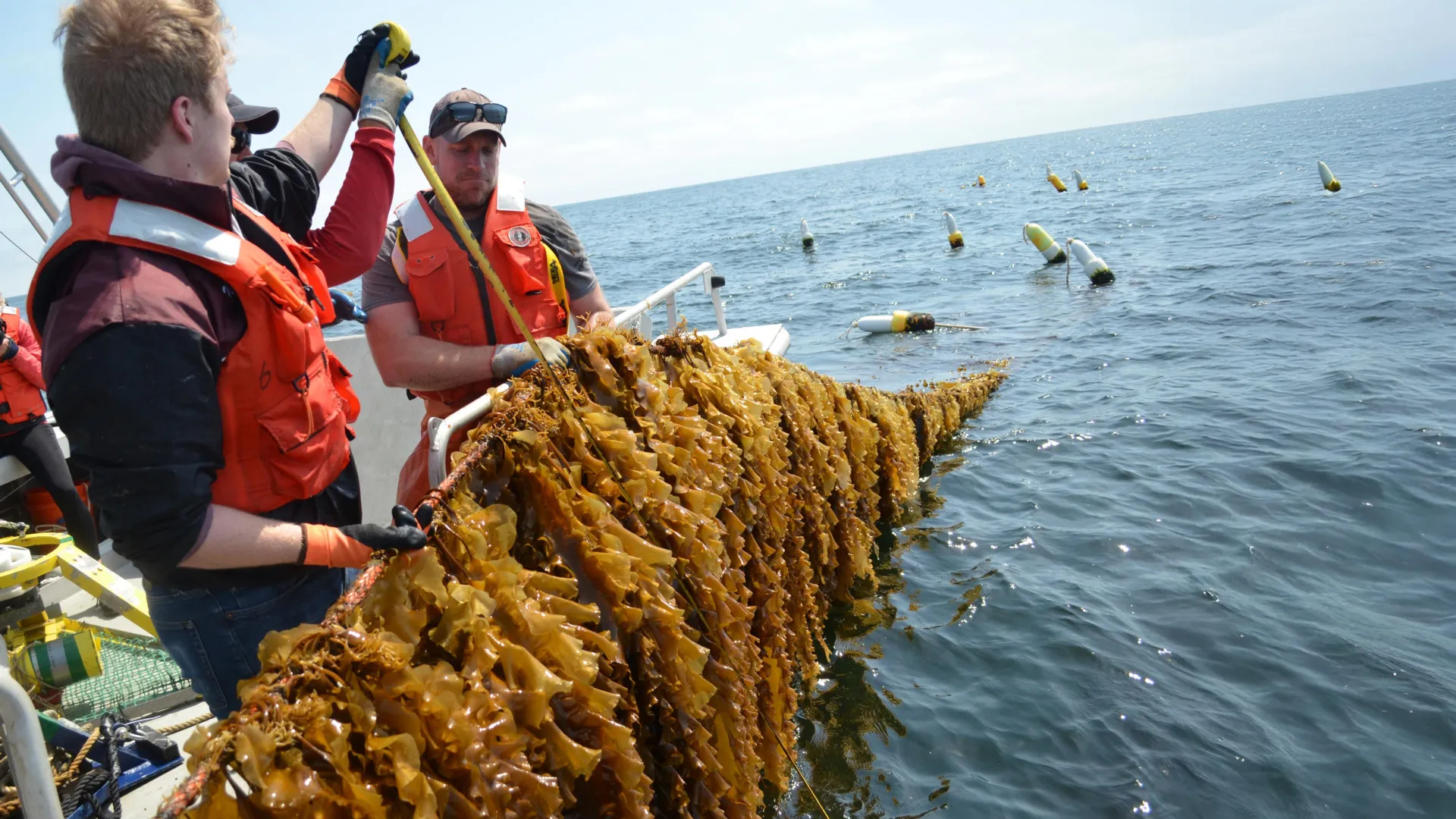
Fast Facts
-
Rapid Expansion of Kelp Farming: Maine’s kelp industry is growing for food, cosmetics, and fertilizers but faces high production costs and a lack of reliable cost analysis tools.
-
Innovative Economic Analysis Tool: Researchers from Kelson Marine and the University of Maine developed a comprehensive tool that analyzes costs and operational strategies for kelp farmers, factoring in environmental and logistical variables.
-
Significant Cost Reduction: Testing on a hypothetical sugar kelp farm showed potential production cost reductions from $2,618 to $383 per tonne through optimizations in design and operations.
-
Support for Maine’s Blue Economy: This tool aligns with ongoing efforts to enhance coastal economies sustainably, offering insights into the economic viability of kelp farming and advancing marine resource utilization.
Unlocking the Potential of Offshore Kelp Farming
Recent research reveals a promising development in offshore kelp farming. In Maine, this industry faces challenges primarily due to high costs. Many new growers struggle because they lack reliable cost analysis tools. As a result, they find it difficult to make informed spending decisions. Fortunately, a new model from researchers in Portland offers comprehensive economic analyses for kelp farming. This tool takes various factors into account, such as site conditions, weather patterns, and crop sizes. By doing so, it helps farmers explore cost-effective strategies.
For instance, Zach Moscicki, the project’s lead ocean engineer, emphasizes the importance of understanding tradeoffs in farm design and operational choices. By examining these factors, farmers can achieve economic sustainability. The tool does not just streamline costs; it also enhances overall productivity. An analysis of a hypothetical 1,000-acre sugar kelp operation, located 12 miles offshore, illustrates this concept. Initially, costs per tonne of fresh kelp reached $2,618. However, with targeted adjustments, researchers reduced these costs by 85% to just $383. This transformation underscores the model’s effectiveness in revolutionizing how we approach kelp farming.
Fostering Economic Sustainability and Innovation
The implications of this research extend beyond simple cost savings. They open doors for broader economic opportunities. The tool supports advancements in Maine’s blue economy, benefiting industries that draw from ocean resources. Additionally, it aligns with efforts to protect the environment while promoting growth. The partnership between researchers and institutions like the University of Maine emphasizes a collaborative model. By pooling knowledge and resources, they tackle the challenges of coastal communities head-on.
Moreover, this detailed analysis of offshore kelp farming is unprecedented in the U.S. It identifies critical areas for investment in technology that could dramatically alter the cost-benefit equation. As a result, kelp farmers across Maine and beyond can now operate with greater confidence and clarity. This innovative approach not only benefits individual farmers but also contributes to the sustainable development of marine resources. Ultimately, as the industry grows, it could lead to a fruitful engagement between technology and environmental stewardship, marking a significant milestone in the human journey toward sustainable resource management.
Continue Your Tech Journey
Learn how the Internet of Things (IoT) is transforming everyday life.
Stay inspired by the vast knowledge available on Wikipedia.
TechV1
