

Top Highlights
-
Innovative Concrete Batteries: MIT researchers created carbon concrete capable of storing and releasing electrical energy, potentially transforming everyday structures into energy sources.
-
Quantum Light Duality Confirmed: Physicists executed a precise version of the double-slit experiment, affirming that light behaves as both a particle and a wave, with implications for quantum physics.
-
Breakthroughs in AI and Medicine: Generative AI designed new antibiotics targeting drug-resistant infections, proving valuable in antibiotic development through innovative compound screening.
-
Environmental and Health Advances: Significant findings, including the healing of the Antarctic ozone layer and the development of a bionic knee, showcase MIT’s impactful contributions to sustainability and healthcare.
MIT’s Top Research Stories of 2025: Innovations Shaping the Future
In 2025, MIT researchers achieved significant milestones, advancing science and technology. Each breakthrough offers new possibilities for everyday life and industry.
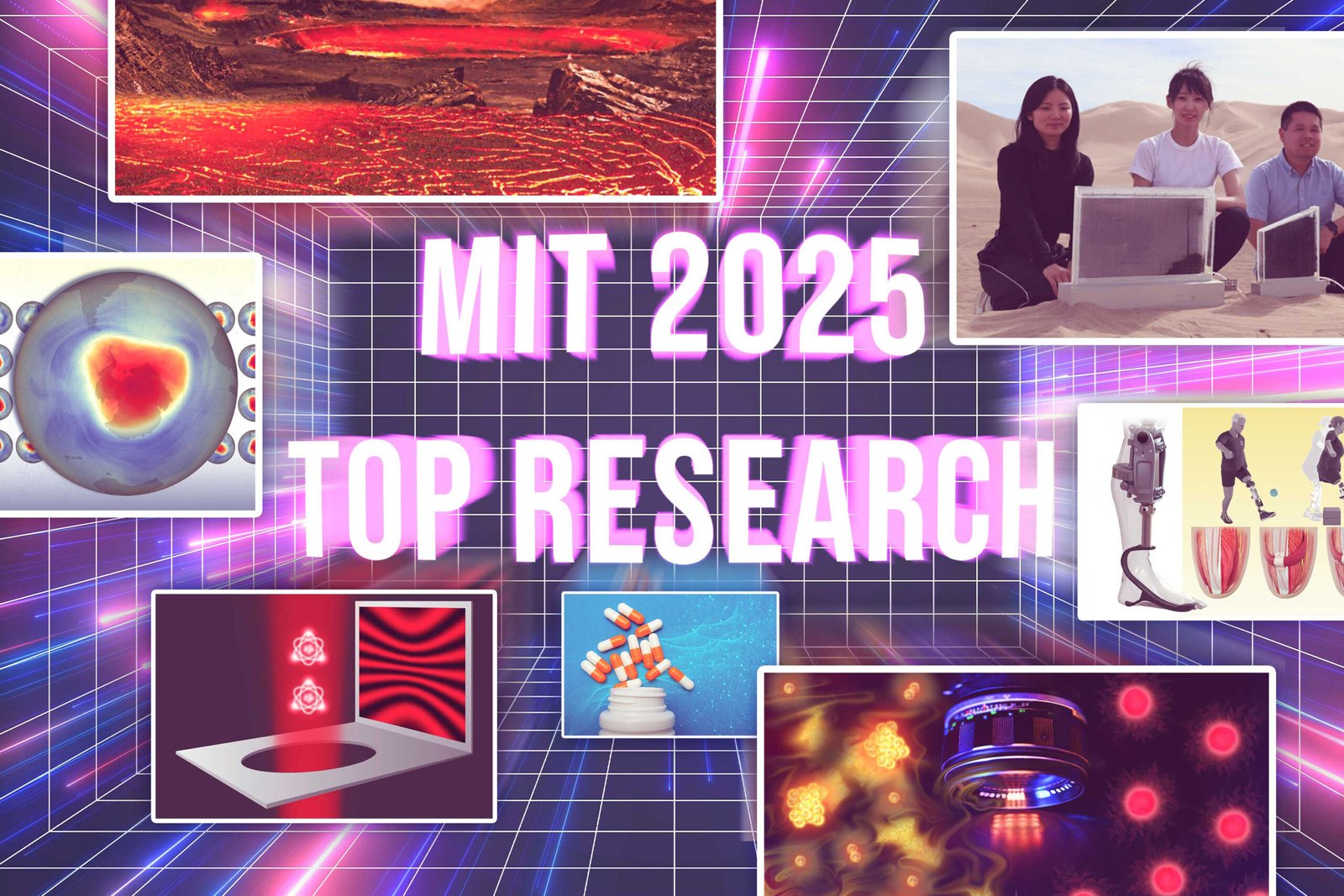
First, researchers developed more powerful concrete “batteries.” By mixing cement with carbon black and electrolytes, they created a material capable of storing and releasing electrical energy. This means structures like sidewalks and bridges could become energy-efficient.
Moreover, physicists confirmed the famous double-slit experiment, demonstrating light’s dual nature—both a particle and a wave. This experiment, refined with atomic-level precision, deepens our understanding of quantum mechanics.
Transitioning to artificial intelligence, MIT created a periodic table of machine learning algorithms. This table illustrates connections among more than 20 classical methods. Consequently, it could improve current AI models or inspire innovative ones.
In a groundbreaking achievement, physicists captured the first images of freely interacting atoms. Using single-atom microscopy, they revealed interatomic correlations never observed before. This discovery opens avenues in materials science and quantum physics.
Engineers also tackled water scarcity. They designed a window-sized device to harvest fresh water from the air, even in arid environments like Death Valley. This origami-inspired machine uses hydrogel technology, promising sustainable solutions for water access.
On the medical front, AI showed promise in combating drug-resistant bacteria. Researchers used generative AI to design over 35 million novel antibiotic compounds. Initial tests revealed candidates that differ significantly from existing antibiotics, offering hope in the fight against resistant infections.
In environmental science, a study confirmed that the Antarctic ozone layer is healing, thanks to global efforts to reduce harmful chemicals. This positive trend illustrates the effectiveness of international cooperation in addressing climate issues.
Scientists also made a remarkable find: remnants of “proto Earth,” dating back 4.5 billion years. These discoveries help clarify the early conditions that shaped our planet and solar system.
Additionally, researchers developed a bionic knee, improving mobility for individuals with above-the-knee amputations. Participants reported feeling more connected to the device, enabling them to walk faster and navigate obstacles more effectively.
Lastly, mathematicians studied crowd dynamics and created a model predicting pedestrian movement patterns. This research could enhance urban planning, promoting safety in crowded spaces.
Overall, MIT’s work in 2025 not only showcases innovation but also underscores the institute’s role in addressing global challenges through technology and research. These advancements hold promise for a more sustainable, healthy, and efficient future.
Discover More Technology Insights
Stay informed on the revolutionary breakthroughs in Quantum Computing research.
Access comprehensive resources on technology by visiting Wikipedia.
QuantumV1
