

Top Highlights
-
Titan’s Formation: Saturn’s moon Titan may have formed from a dramatic merger of two smaller moons, known as Chrysalis and the proto-Titan, about 100-200 million years ago, reshaping the Saturnian system.
-
Impact of Gravitational Forces: The collision led to a redistribution of Saturn’s mass, pulling the planet out of resonance with Neptune and causing anomalies like Titan’s broad atmosphere and the unique orbits of other moons.
-
Hyperion’s Role: The gravitational lock between Titan and Hyperion suggests that Hyperion may be a product of the collision rather than a pre-existing moon, supporting the hypothesis of Titan’s formation through upheaval.
-
Future Exploration and Evidence: While simulations provide compelling evidence for this theory, further verification is expected from NASA’s Dragonfly mission to Titan, set to launch in 2028, which might reveal signs of Titan’s youthful surface.
Did a Titanic Moon Crash Create Saturn’s Iconic Rings?
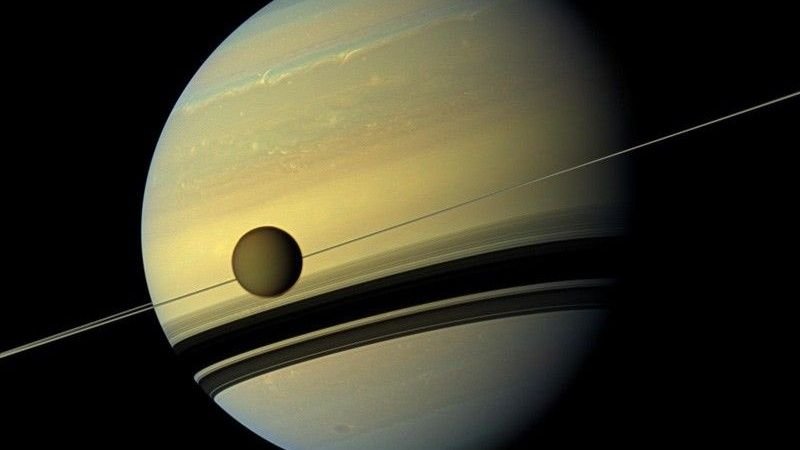
Recent research suggests that a massive collision among Saturn’s moons may have given rise to the planet’s stunning rings and peculiar moon system. Scientists speculate that Titan, Saturn’s largest moon, formed through a significant merger between two other moons, which triggered a series of events that altered Saturn’s dynamics.
When the Cassini spacecraft arrived in 2004, it revealed a vibrant collection of moons, each with unique features. Titan boasts a thick atmosphere rich in organic molecules, while Hyperion appears battered, resembling a giant pumice stone. In contrast, Iapetus showcases a striking two-tone appearance, likely due to encounters with Saturn’s E ring.
Previously, researchers believed Saturn’s rings might be around 100 million years old. However, the exact origin of these rings remained elusive. A breakthrough came when scientists examined Saturn’s “moment of inertia,” a factor that influences how the planet wobbles as it spins. The new data suggested that Saturn’s mass distribution was slightly different than expected, hinting that something disrupted its gravitational harmony with Neptune.
Initial theories proposed that an older moon, named Chrysalis, once influenced Saturn’s orbit. After a close encounter with Titan, Chrysalis may have spiraled too close to Saturn and disintegrated, leaving debris that eventually formed the rings.
However, new simulations indicated that Chrysalis likely collided with Titan instead. Matija Ćuk’s team identified Hyperion as a crucial clue in understanding this cosmic evolution. They discovered that Titan and Hyperion’s orbits are resonantly linked, meaning they influence each other’s movements.
This gravitational dance created instability, leading to the suggestion that Hyperion formed from the debris of the collision between Titan and Chrysalis around 100 to 200 million years ago. Prior to this event, Titan may have resembled Callisto, a moon of Jupiter, marked by many craters. Instead, Titan’s surface appears geologically young, which aligns with the impact theory.
The simulation also suggested that Titan’s changing orbit had further repercussions, affecting the smaller moons and contributing to the formation of the iconic ring system. This process may have even influenced Iapetus’s unusual orbital tilt.
While this theory remains unproven, researchers anticipate that NASA’s upcoming Dragonfly mission to Titan in 2028 could provide vital data. By studying the moon’s surface for signs of past upheavals, scientists hope to gather evidence of this monumental collision.
The ongoing exploration of Saturn and its moons not only deepens our understanding of planetary systems but also drives technology development. As missions like Dragonfly prepare to launch, they pave the way for advancements in space exploration techniques, enhancing our ability to study complex celestial phenomena.
Stay Ahead with the Latest Tech Trends
Explore the future of technology with our detailed insights on Artificial Intelligence.
Explore past and present digital transformations on the Internet Archive.
SciV1
