

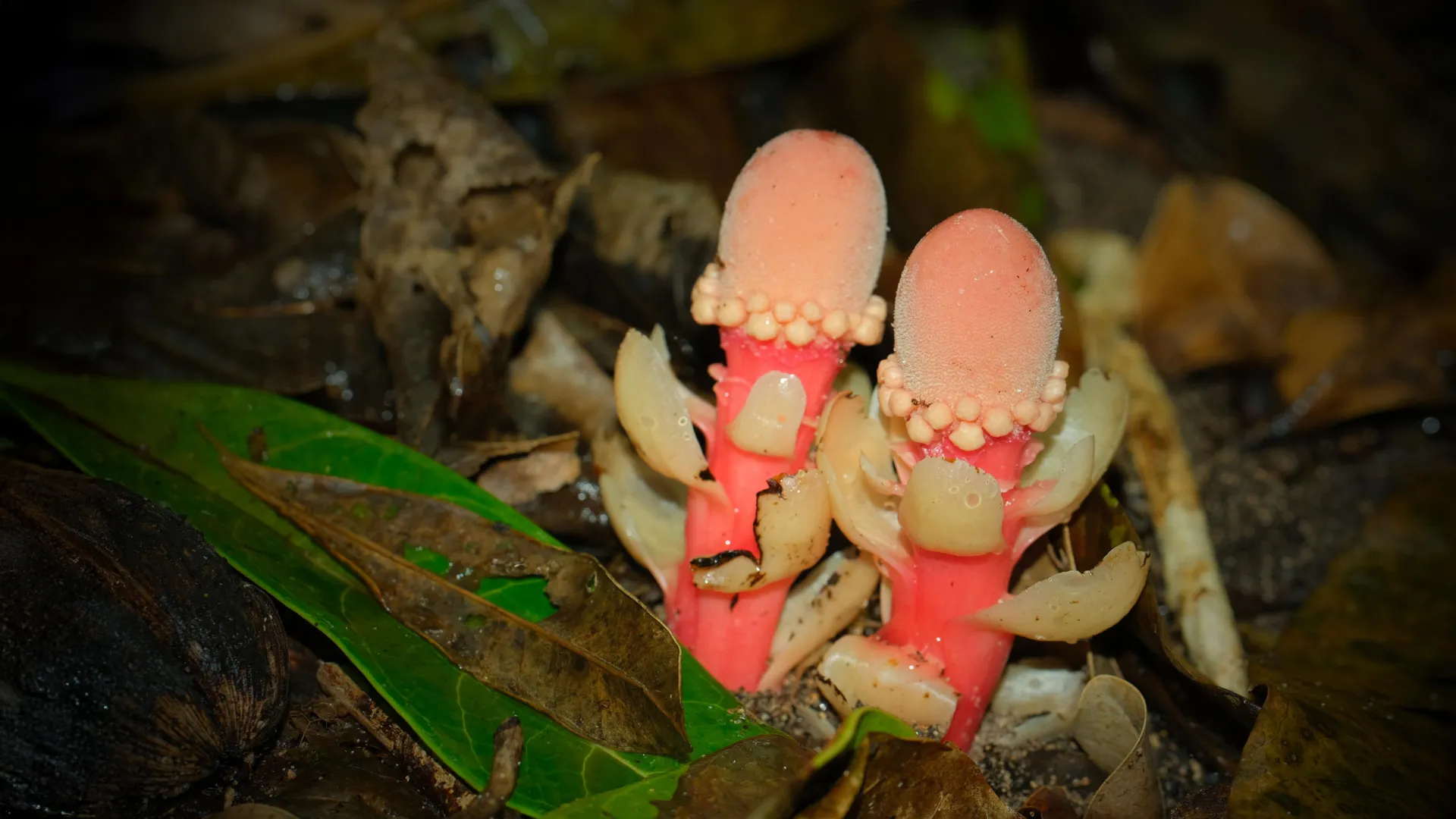
Fast Facts
-
Unique Parasitic Adaptations: Balanophora, a non-photosynthetic plant found in East Asia, survives by parasitizing tree roots, showcasing an extreme evolutionary shift from typical plant characteristics.
-
Minimized Plastids: Despite its reliance on host trees, Balanophora retains minimal plastids that perform essential functions, hinting at a complex evolutionary history similar to other parasitic organisms.
-
Reproductive Diversity: This plant exhibits rare reproductive strategies, including facultative and obligate agamospermy, allowing it to quickly establish populations in isolated habitats, particularly on islands.
-
Conservation Vulnerability: Balanophora’s specialization makes it highly susceptible to environmental changes, emphasizing the need for research and conservation efforts amidst increasing threats like deforestation.
The Enigmatic Balanophora
In the shadowy forests of Taiwan and Okinawa, an unusual organism thrives. It resembles a mushroom but belongs to an ancient lineage of plants known as Balanophora. This organism defies conventional botanical norms. It lacks chlorophyll, which means it cannot perform photosynthesis. Instead, it emerges as a parasite, attaching itself to the roots of nearby trees. By stealing nutrients, Balanophora successfully adapts to its unique environment.
Researchers from various institutions recently conducted extensive studies on this rare plant. Their findings reveal that Balanophora has evolved into a highly specialized organism. Instead of developing traditional roots, it has reduced its plastids, which are essential for processes like photosynthesis. These adaptations raise intriguing questions about evolution and resilience in the plant kingdom. Scientists also discovered that some species can reproduce without fertilization, a rare trait that may help them spread in their limited habitats.
Challenges Ahead for a Unique Plant
While Balanophora’s unique adaptations are fascinating, they come with inherent risks. The plant specifically relies on a narrow range of host trees, making it particularly vulnerable to environmental changes. Human activities, such as logging and habitat destruction, pose significant threats. Although some populations exist in protected areas, they are not immune to extinction.
The collaborative research efforts highlight the importance of conservation. Understanding and preserving Balanophora and its ecosystems can offer insights into broader ecological dynamics. As we explore this bizarre plant, we unearth lessons about resilience and adaptation in nature. Protecting such unique species contributes to the human journey, reminding us that every organism plays a vital role in the tapestry of life.
Discover More Technology Insights
Explore the future of technology with our detailed insights on Artificial Intelligence.
Explore past and present digital transformations on the Internet Archive.
TechV1
