

Fast Facts
-
Importance of Airflow: Airflow around rockets significantly influences mission success, prompting NASA to utilize advanced simulations for optimal launch conditions in the Artemis II test flight to the Moon.
-
LAVA Framework: Engineers employed the Launch, Ascent, and Vehicle Aerodynamics (LAVA) tool to analyze complex interactions between rocket plumes and sound suppression systems, enhancing understanding of flight environments.
-
Impact of Sound Suppression: Simulations revealed that while the sound suppression system effectively reduces pressure waves, rocket exhaust can redirect water, creating increased pressure at specific launchpad areas.
-
Future Collaboration: NASA plans to release the LAVA tool to the aerospace community, aiming to boost innovation and design optimization for rockets and aircraft, further supported through its Transformational Tools and Technologies project.
NASA Simulations Improve Artemis II Launch Environment
NASA has taken significant steps to enhance the launch conditions for the Artemis II mission. Airflow around rockets during ascent influences mission success. Therefore, NASA employed advanced simulations to optimize these conditions.
Engineers utilized a tool known as the Launch, Ascent, and Vehicle Aerodynamics (LAVA) framework. This software simulates the flow behavior of gases and liquids, essential in understanding how rockets interact with their environment.
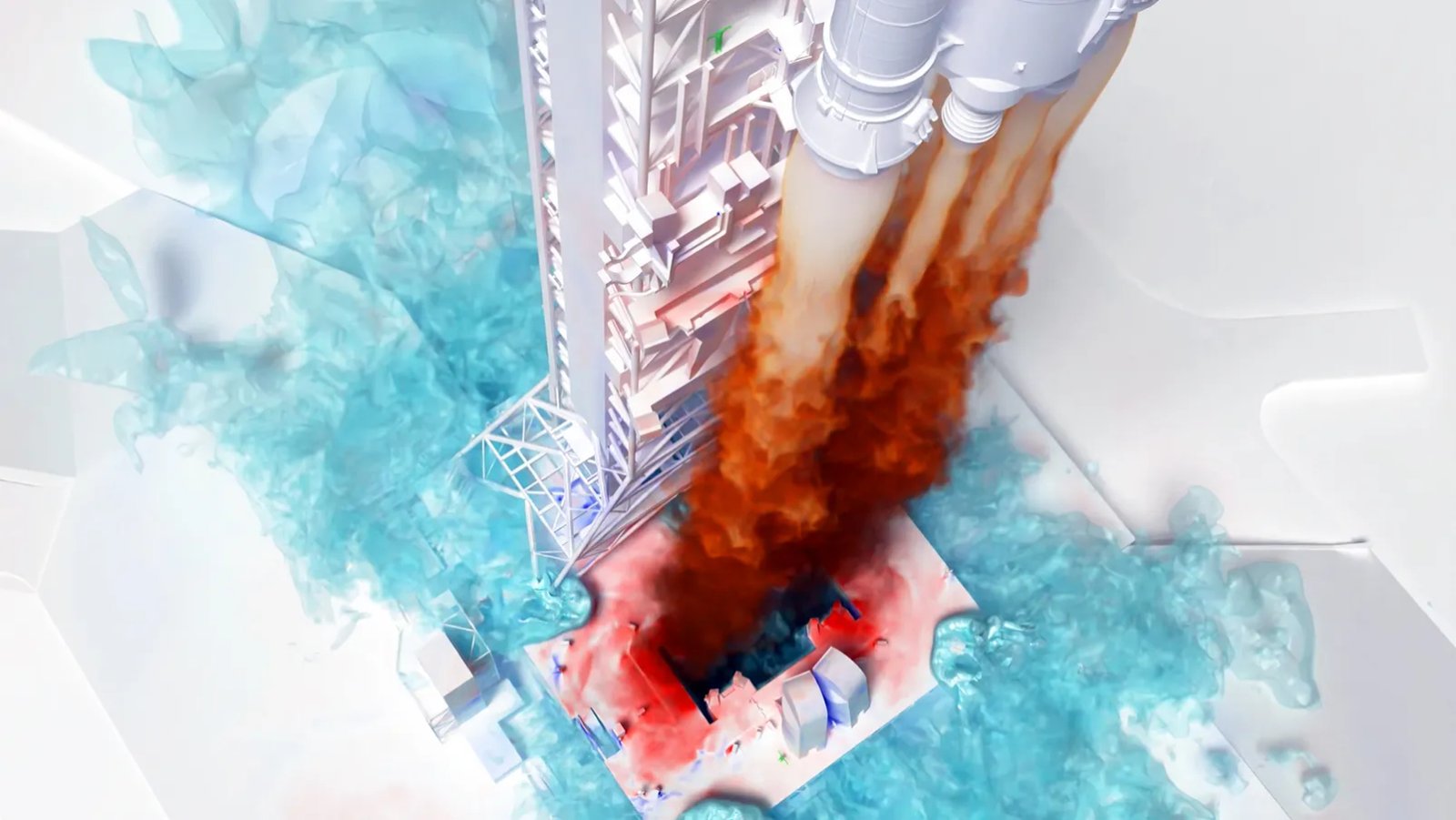
Earlier data from the Artemis I launch provided a foundation for this work. Researchers at NASA’s Ames Research Center analyzed complex interactions between the rocket’s plume and a sound suppression system. This system pumps water to dampen sound waves during liftoff, safeguarding the rocket and equipment.
The simulations revealed important insights. They confirmed that while the water effectively reduces sound pressure waves, the rocket’s exhaust can redirect water flow. This redirection can lead to significant pressure increases at certain areas on the launchpad.
Armed with this knowledge, aerospace engineers at NASA’s Kennedy Space Center refined the launch platform’s design. They adapted it to withstand anticipated pressures for Artemis II, which marks NASA’s return to human spaceflight with crew aboard the SLS and Orion spacecraft.
Coming soon, NASA plans to release LAVA to the aerospace community. This release aims to accelerate innovation, allowing U.S. companies and researchers to run complex simulations. Such capabilities will help optimize designs for both aircraft and rockets.
Recently, NASA conducted a seminar on LAVA’s use, showcasing its potential. The tool is part of a broader effort under NASA’s Transformational Tools and Technologies project, which focuses on developing new computational capabilities for aerospace performance.
Decades of aeronautics research have reinforced NASA’s space missions. By utilizing technologies like wind tunnel tests and cutting-edge software, NASA continues to enhance safety, reliability, and overall mission success. The advancements from these simulations demonstrate a clear path forward for future space exploration.
Stay Ahead with the Latest Tech Trends
Stay informed on the revolutionary breakthroughs in Quantum Computing research.
Stay inspired by the vast knowledge available on Wikipedia.
SciV1
