

Fast Facts
-
NASA’s Artemis 2 mission, featuring astronauts Reid Wiseman, Victor Glover, Christina Koch, and Jeremy Hansen, is set for liftoff between February and April 2026 as the first crewed mission of the Orion capsule and Space Launch System (SLS).
-
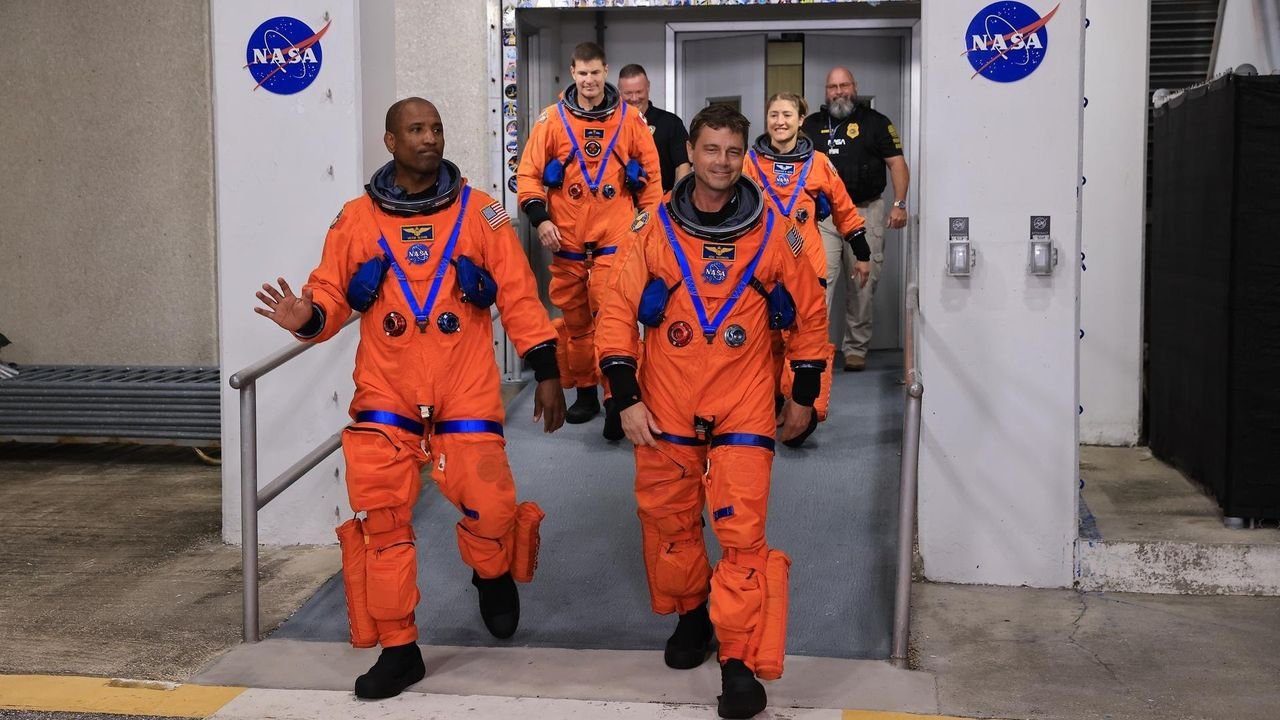
The crew recently completed a nighttime dress rehearsal at Kennedy Space Center, practicing launch protocols, emergency egress procedures, and communication strategies in various scenarios.
-
The astronauts simulated emergency egress using specialized baskets designed for rapid evacuation away from the launch tower, ensuring safety in case of a launch day emergency.
-
Following previous delays, the Artemis program is on track, with Artemis 3 expected to land astronauts on the moon by 2027, marking the first lunar landing since Apollo.
Artemis 2 Astronauts Suit Up for Nighttime Moon Launch Dress Rehearsal
NASA’s Artemis 2 astronauts are gearing up for a historic mission to the moon. Recently, they completed a nighttime dress rehearsal of launch procedures at Kennedy Space Center in Florida. This mission marks the first crewed flight of the Orion capsule and the Space Launch System (SLS), targeting liftoff between February and April 2026.
During the rehearsal, astronauts donned their spacesuits and practiced critical emergency protocols. They reviewed egress procedures from the launch tower to ensure their safety in case of an emergency. The crew, made up of four astronauts, will embark on a journey that loops around the moon before returning to Earth.
Over two nights, the astronauts rehearsed various launch scenarios. They traveled the nine miles from the Neil Armstrong Operations and Checkout Building to Launch Complex-39B. This exercise tested routes, communications, and timing. Notably, they simulated a launch scrub sequence, which prepares them for unexpected delays.
Additionally, they practiced emergency egress in the Vehicle Assembly Building’s High Bay 3. In an emergency situation, rapid exit from Orion is crucial. Astronauts would use cable trolleys to flee from the launch platform, ensuring they remain at a safe distance from the rocket.
Images from the rehearsal show the crew actively preparing for different scenarios. They moved from the VAB back to LC-39B, practicing emergency protocols and safe exit strategies. They even traveled in armored vehicles to designated safe zones to complete the exercise.
This rehearsal closely follows a daytime run-through from 2023. Delays have pushed the mission timeline from 2024 to early 2026. Despite setbacks, excitement surrounds Artemis 2. The mission represents a significant leap in human space exploration.
Once Artemis 2 successfully launches, NASA plans future missions, including Artemis 3, which aims to land astronauts on the moon by 2027. NASA has chosen SpaceX’s Starship as the lunar lander, but development challenges remain.
These advancements pave the way for technology development in space exploration. Each mission provides invaluable data and experience, enhancing safety and reliability. As humanity sets its sights on the moon and beyond, the Artemis program serves as a beacon of innovation for future generations.
Expand Your Tech Knowledge
Explore the future of technology with our detailed insights on Artificial Intelligence.
Explore past and present digital transformations on the Internet Archive.
SciV1
