

Summary Points
-
Revised Understanding of Titan: New analysis from NASA’s Cassini mission data indicates that Titan’s interior is likely composed of slushy ice layers with small pockets of warm water, rather than a vast liquid ocean beneath its surface.
-
Innovative Data Processing: Researchers utilized advanced techniques to reduce noise in Doppler data, revealing strong energy dissipation from Titan’s slushy interior, which challenges previous assumptions of a completely liquid layer.
-
Potential for Life: Titan’s unique geological conditions, with pockets of liquid water possibly reaching temperatures around 20°C (68°F), may support basic life forms, enhancing the moon’s astrobiological interest.
-
Future Exploration: NASA’s upcoming Dragonfly mission, set to launch by 2028, aims to provide crucial seismic measurements and further investigate Titan’s habitability by exploring its surface and internal structure.
NASA Study Suggests Saturn’s Moon Titan May Not Have Global Ocean
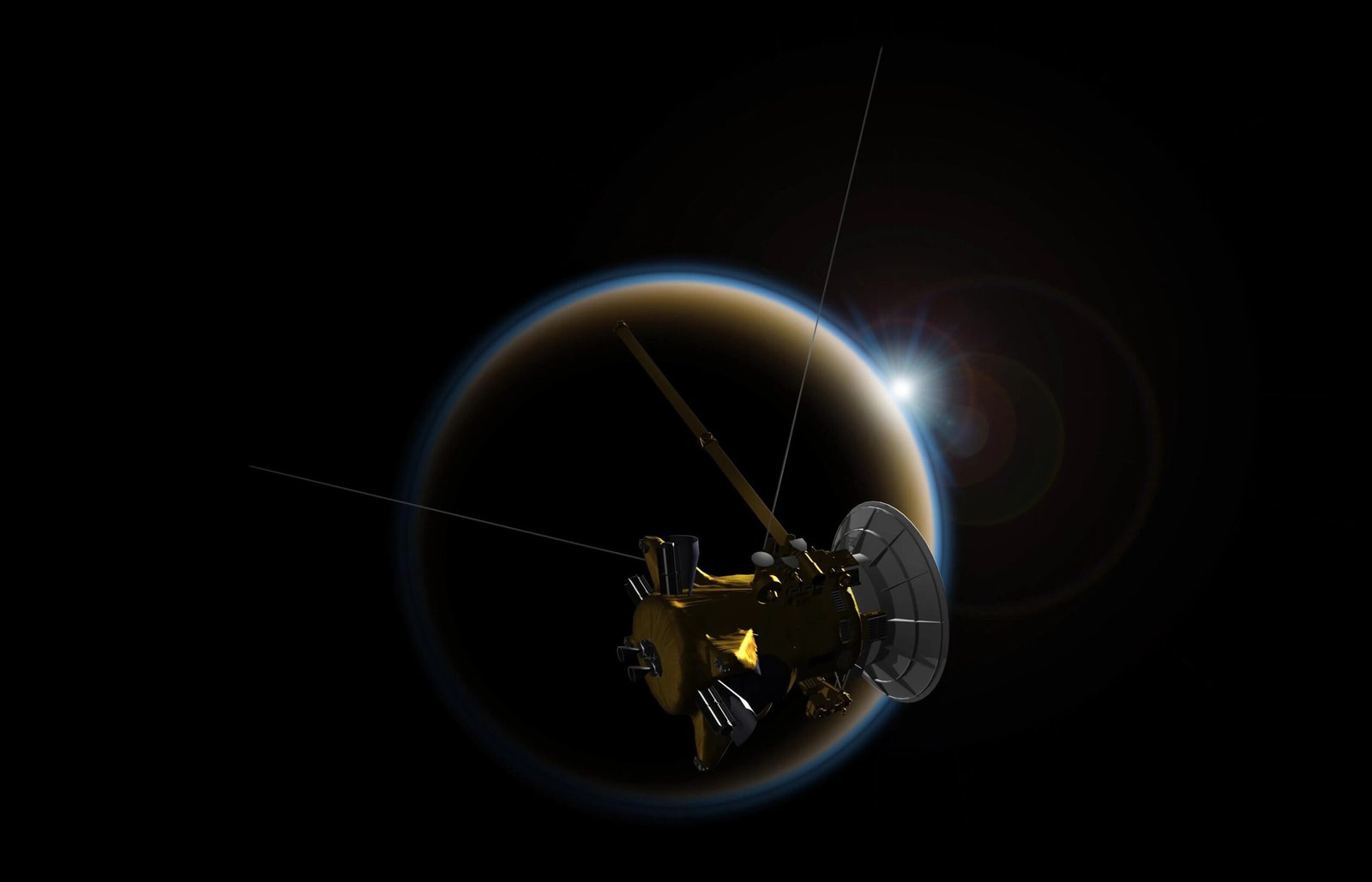
Recent findings from NASA challenge the long-held belief that Titan, Saturn’s largest moon, hosts a vast ocean beneath its surface. Initially, data from the Cassini mission in 2008 indicated a global ocean of liquid water. However, a new study published in Nature indicates a more complex internal structure.
Researchers from NASA’s Jet Propulsion Laboratory reexamined Cassini’s data. They propose that Titan’s interior likely consists of ice, slush, and small pockets of warm water. This breakthrough could transform our understanding of Titan and similar icy moons in our solar system.
Julie Castillo-Rogez, a senior research scientist, emphasized the importance of reanalyzing existing data. She noted that advanced analytical techniques can reveal more insights as time passes, showcasing the value of archival data.
To probe the moon’s mysteries, scientists analyzed radio frequency communications between spacecraft and NASA’s Deep Space Network. This intricate process involves studying changes in gravity fields as spacecraft travel through varying gravitational pulls, a phenomenon known as Doppler shift. These shifts provide valuable information about a moon’s shape and internal structure.
Researchers discovered that Titan undergoes significant tidal flexing due to Saturn’s gravitational forces. This flexing generates heat, which complicates the moon’s internal dynamics. Previous analyses interpreted the flexing as a sign of a liquid interior, similar to a water balloon. Yet, the new study suggests that Titan’s flexibility could result from a slushy interior rather than a fully liquid one.
By employing innovative processing techniques, scientists minimized noise in the data, revealing strong energy dissipation within Titan. This finding suggests layers of slush beneath a thick icy shell, with only small quantities of liquid water present.
While Titan may not possess a global ocean, the presence of pockets of meltwater offers intriguing possibilities for life. The pockets, warmed by dissipating tidal energy, could interact with organic molecules from below and meteoric material above. This raises the prospect for unique environments that might support basic life forms.
The upcoming Dragonfly mission, set for launch no earlier than 2028, aims to further explore Titan. This rotorcraft will investigate the moon’s surface and study its potential habitability, offering critical insights into its internal structure based on seismic activity.
Ultimately, this research not only enhances our understanding of Titan but also informs technology development in planetary exploration efforts. By refining data analysis techniques, scientists can glean more information from past missions, paving the way for future discoveries about our solar system’s intriguing bodies.
Discover More Technology Insights
Learn how the Internet of Things (IoT) is transforming everyday life.
Access comprehensive resources on technology by visiting Wikipedia.
SciV1
