

Fast Facts
-
Role in Artemis Program: Doug Parkinson is NASA’s SLS rocket lead for Launch Integration and Mission Operations, crucial in monitoring the rocket during its test and launch phases for the Artemis mission.
-
Background and Education: Following his father’s footsteps, Parkinson became a mechanical engineer at the University of Alabama in Huntsville, where he discovered his passion for propulsion technologies through hands-on research.
-
Career Progression: Joining NASA in 1999, he contributed to advanced rocket engine development and transitioned to the SLS program in 2012, leveraging his expertise to oversee operations and train the engineering support team.
-
Excitement for Artemis II: Parkinson is energized about the upcoming Artemis II mission, where the Orion spacecraft—launched by a rocket he helped develop—will transport astronauts around the Moon for groundbreaking scientific exploration.
NASA Engineer Prepares for Artemis II Mission
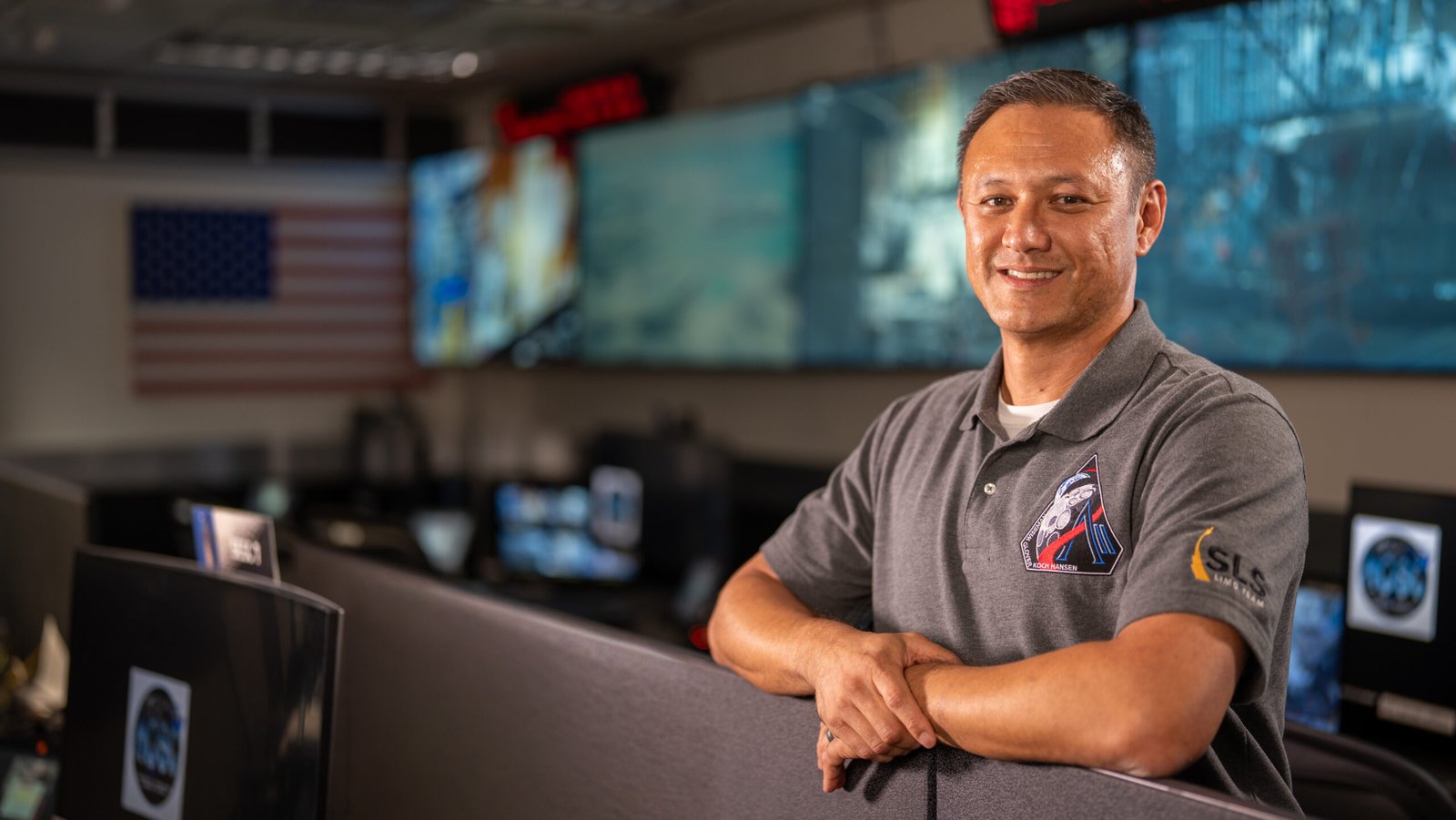
Doug Parkinson’s face lights up as he shares his journey. Originally from Wisconsin, he now plays a crucial role in NASA’s Artemis program. As the Space Launch System (SLS) rocket lead for Launch Integration and Mission Operations, he guides engineers monitoring the rocket at various stages.
Initially, Parkinson followed his father’s footsteps into engineering. He studied at the University of Alabama in Huntsville. Although he planned to work in computer technologies or automotive design, an opportunity arose in propulsion research. “I studied new propulsion technologies,” he said. This experience allowed him to apply classroom theories in practical settings.
In 1999, Parkinson joined NASA at the Marshall Space Flight Center. He focused on advanced liquid rocket engines, including the Fastrac and J-2X, which evolved from the Saturn V’s upper stage engine. His work with engine testing helped him transition smoothly to his current role.
In addition to his leadership in Launch Integration and Mission Operations, Parkinson also manages the SLS Engineering Support Center. This team plays a vital role in monitoring and ensuring the rocket’s systems function correctly.
“I love all aspects of the operations,” he remarked. “I like getting my hands dirty.” His passion for seeing innovative systems come together fuels his dedication.
When Artemis II launches, it will carry four astronauts on a journey around the Moon. Excitement fills Parkinson as he considers the mission. “I have goosebumps just thinking about it,” he said, knowing he will be on console, ready to support the crew.
This mission promises not only scientific discoveries but also economic benefits and a foundation for future human exploration of Mars. As Parkinson and his team prepare, their work exemplifies how advancements in technology can propel humanity into new realms of exploration and understanding.
Stay Ahead with the Latest Tech Trends
Explore the future of technology with our detailed insights on Artificial Intelligence.
Explore past and present digital transformations on the Internet Archive.
SciV1
