

Quick Takeaways
-
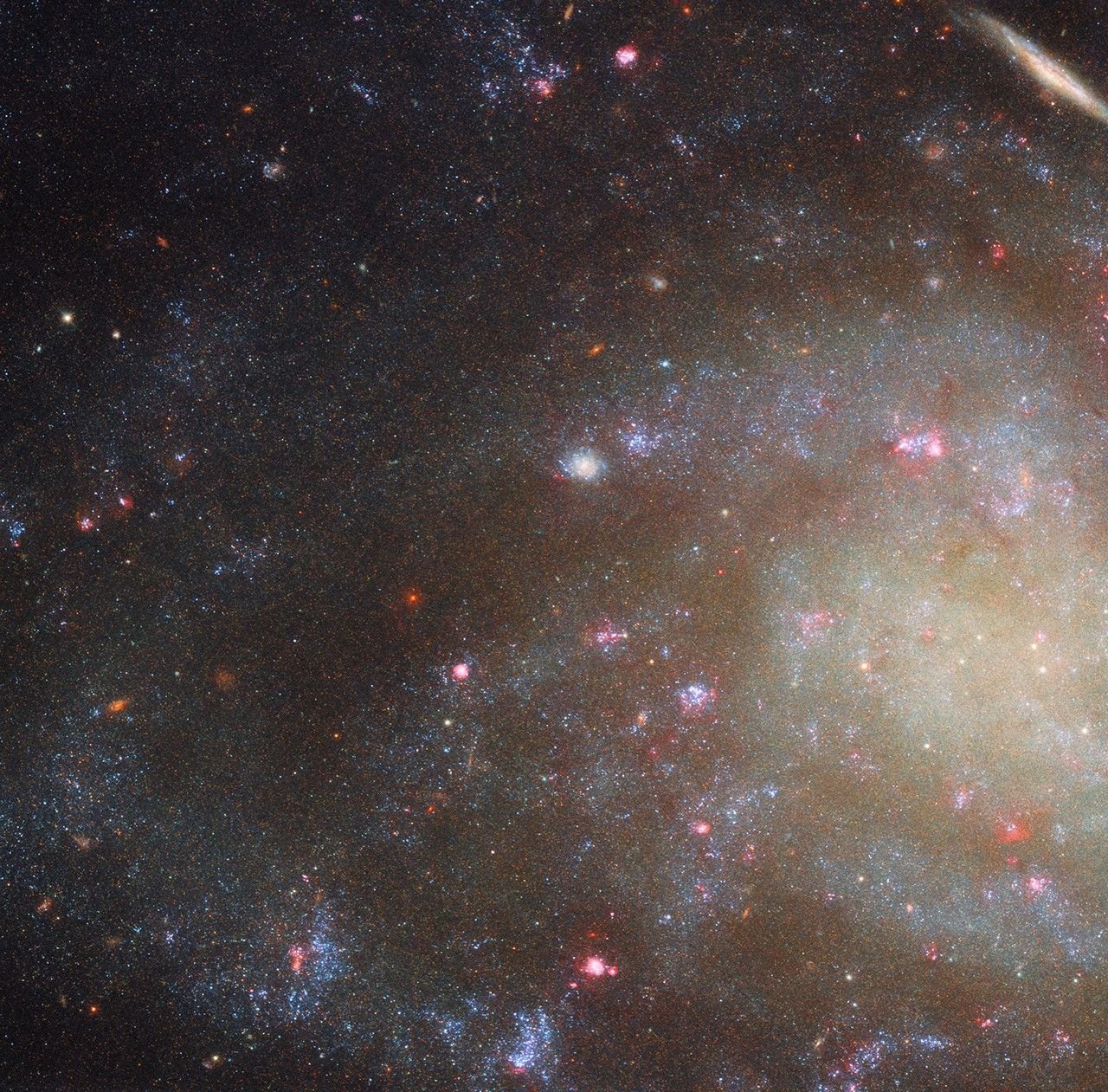
Observational Focus: Hubble’s image of galaxy NGC 45, located 22 million light-years away, captures its feathery spiral arms and features star-forming regions visible in vibrant H-alpha light.
-
Dual Data Collection: The portrait derives from two studies: one analyzing 50 nearby galaxies for star formation across multiple wavelengths, and another targeting specific H-alpha emissions from star-forming nebulae.
-
Unique Classification: NGC 45 is classified as a low surface brightness galaxy, appearing fainter than the night sky due to its sparse star population relative to its gas and dark matter content.
-
Significance of Study: Low surface brightness galaxies, making up 30-60% of all galaxies, are crucial for understanding galaxy formation and evolution, with Hubble’s sensitive instruments facilitating this vital research.
Hubble Examines Low Brightness, High Interest Galaxy
NASA and ESA’s Hubble Space Telescope recently captured stunning images of the galaxy NGC 45. This spiral galaxy lies about 22 million light-years away in the constellation Cetus. While it may look like a typical spiral galaxy, it belongs to a fascinating group known as low surface brightness galaxies.
Observations from Hubble reveal NGC 45’s feathery spiral arms and pink-red patches. These patches indicate areas where new stars are being born. Researchers used two different observing programs for this study. One program focused on 50 nearby galaxies, observing them in ultraviolet, visible, and near-infrared light. The second program zoomed in on specific wavelengths, particularly H-alpha light, which highlights vibrant star-forming regions.
Researchers find low surface brightness galaxies particularly intriguing. They contain fewer stars compared to their gas and dark matter. This faintness makes them hard to detect. Since the first discovery in 1986, scientists estimate that up to 60% of all galaxies might be low surface brightness types.
Understanding these galaxies is essential for comprehending galaxy formation and evolution. Hubble’s advanced technology plays a crucial role in these discoveries. By shedding light on hidden cosmic structures, scientists can learn more about the universe’s history and its future.
Such research not only expands our knowledge but also drives advancements in technology. Innovations developed for space observation often translate to improvements in various fields on Earth, enhancing our quality of life. Therefore, studying galaxies like NGC 45 contributes to both scientific understanding and technological progress.
Expand Your Tech Knowledge
Dive deeper into the world of Cryptocurrency and its impact on global finance.
Discover archived knowledge and digital history on the Internet Archive.
SciV1
