

Summary Points
-
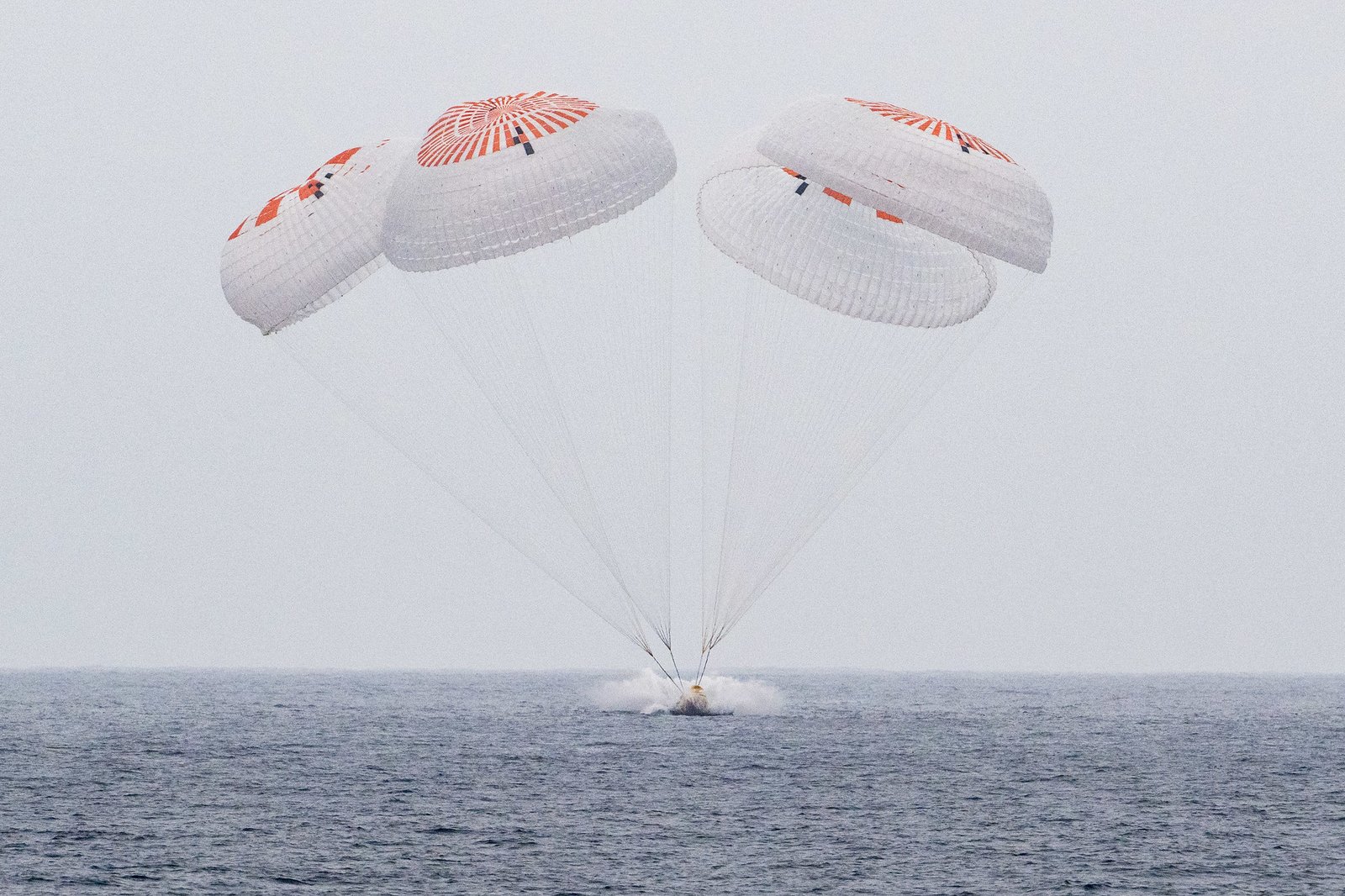
Successful Splashdown: NASA’s Crew-10 mission marked the first crewed splashdown in the Pacific Ocean, returning astronauts safely after completing 10th commercial crew rotation to the ISS.
-
Mission Highlights: Crew-10, which included astronauts McClain, Ayers, Onishi, and cosmonaut Peskov, contributed to scientific research, including studies on plant growth and human biology in microgravity.
-
Spacewalk Milestone: The mission featured a successful spacewalk by McClain and Ayers, which involved relocating a communications antenna and supporting ISS upgrades.
-
Future Exploration Goals: NASA’s Commercial Crew Program enhances reliable space access while preparing for future human exploration missions to the Moon and Mars alongside private industry partners like SpaceX.
NASA’s SpaceX Crew-10 Mission Returns, Splashes Down Off California
NASA’s SpaceX Crew-10 mission made a successful return to Earth, splashing down in the Pacific Ocean off California. The crew, which included NASA astronauts Anne McClain and Nichole Ayers, JAXA astronaut Takuya Onishi, and Roscosmos cosmonaut Kirill Peskov, landed at 11:33 a.m. EDT on Saturday.
Teams aboard SpaceX recovery vessels swiftly retrieved the spacecraft and crew, initiating their return journey to NASA’s Johnson Space Center in Houston. There, they will reunite with their families.
NASA’s acting administrator celebrated the crew’s return, stating, “Splashdown! Crew-10 is back on Earth from the International Space Station marking the completion of another successful flight.” This mission demonstrates NASA’s commitment to advancing human exploration of space.
The Crew-10 mission launched on March 14 at 7:03 p.m. from Kennedy Space Center in Florida. After a 29-hour journey, the crew’s spacecraft docked with the International Space Station on March 16. The team undocked on August 8 to begin their trip home.
During their time in space, Crew-10 traveled nearly 62.8 million miles and completed 2,368 orbits around Earth. For Ayers and Peskov, this flight marked their first space mission, while McClain and Onishi have flown before. McClain has now logged 352 days in space, and Onishi has a total of 263 days.
Crew-10 contributed significantly to scientific research and technology testing. They conducted experiments on plant growth, examined the effects of space radiation on DNA, and studied changes in human eye structure in microgravity. This research not only enhances our understanding but also prepares humanity for future missions to the Moon and Mars.
Additionally, McClain and Ayers completed a spacewalk on May 1, relocating a communications antenna and beginning preparations for a new solar array. This spacewalk was Ayers’ first and McClain’s third, contributing to essential upgrades for the International Space Station.
The return of Crew-10 paves the way for continued exploration. Following their mission, Crew-11 has already docked at the station for long-duration scientific efforts. By partnering with private companies like SpaceX, NASA’s Commercial Crew Program ensures reliable access to space, supporting various research initiatives.
As humanity looks to the stars, missions like Crew-10 are vital. They push technological advancements, promote scientific growth, and ultimately enrich our understanding of both space and ourselves.
Expand Your Tech Knowledge
Learn how the Internet of Things (IoT) is transforming everyday life.
Stay inspired by the vast knowledge available on Wikipedia.
SciV1
