

Summary Points
-
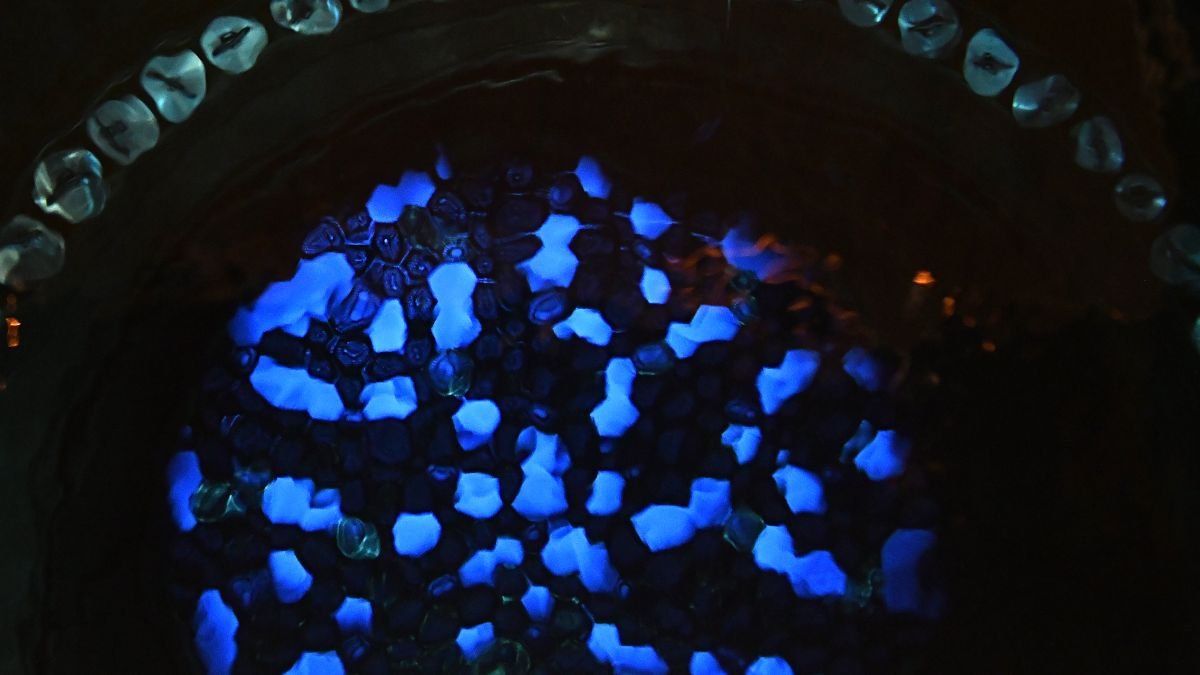
Cherenkov Radiation and Vacuum Decay: A breakthrough suggests that the eerie blue glow of Cherenkov radiation, typically seen in nuclear reactors, could indicate quantum instability and vacuum decay if detected in space.
-
Ghost Perturbations: Theoretical physicist Eugeny Babichev posits that Cherenkov radiation might be interpreted as arising from “ghost” perturbations—negative-energy disturbances—that indicate instabilities in the vacuum of space.
-
Implications for Gravity Theories: Detecting such radiation in a vacuum could challenge current understanding of spacetime, potentially revealing limits in existing theories of gravity and prompting a reevaluation of the vacuum as the universe’s lowest-energy state.
-
Future Research Directions: The study opens new avenues for exploring modified gravity theories and suggests investigating the dynamics of ghost instabilities in various gravitational contexts, laying groundwork for future discoveries.
Negative Energy ‘Ghosts’ in Space Could Reveal New Physics
Recent research suggests that the eerie blue glow known as Cherenkov radiation could offer insights into fundamental physics. The phenomenon occurs when a particle exceeds the speed of light in a medium, creating a ‘boom’ of light. This could indicate a kind of quantum instability that may lead to vacuum decay.
Theoretical physicist Eugeny Babichev from the University of Paris-Saclay proposes that if observers detect this glow in space, it might signify negative-energy ghost perturbations. This discovery could dramatically enhance our understanding of gravity. Currently, our theories about gravity are incomplete. The presence of this radiation would help scientists explore how spacetime behaves in extreme conditions.
Babichev’s paper claims that Cherenkov radiation and ghost instability share a common mechanism. “We can interpret Cherenkov radiation as instability with the creation of ghosts carrying negative energy,” he writes.
In physics, a “ghost” can refer to any non-physical factor that ensures mathematical consistency in particle theories. However, it can also mean a physical disturbance that indicates instability. Think of water ripples. Usually, creating ripples requires adding energy. But under specific conditions, disturbances can appear carrying negative energy without an external input, resembling spontaneous ripples.
On Earth, Cherenkov radiation appears when charged particles travel faster than light in water, resembling a sonic boom. However, according to current physics, nothing should exceed light speed in a vacuum. Babichev’s findings suggest that a ghost instability in empty space could mimic this effect.
Detecting Cherenkov radiation in the vacuum of space would challenge our understanding of the universe. It might mean the cosmic vacuum behaves like a structured medium, contrary to our existing beliefs. If the vacuum is not the lowest-energy state as we assume, researchers would need to rethink fundamental physics principles.
This fascinating research exists largely in theoretical discussions. Though Babichev’s paper does not offer a practical method for detection, it sets the stage for further exploration. “It would be interesting to study scenarios where such unstable configurations exist within altered gravity,” he notes, pointing to possible future research directions.
Understanding these ghostly disturbances could have broad implications, potentially influencing technology developments in various fields such as quantum computing or energy storage. Overall, Babichev’s theories encourage scientists to rethink essential elements of physics, potentially leading to groundbreaking advancements.
Discover More Technology Insights
Stay informed on the revolutionary breakthroughs in Quantum Computing research.
Discover archived knowledge and digital history on the Internet Archive.
QuantumV1
