

Summary Points
-
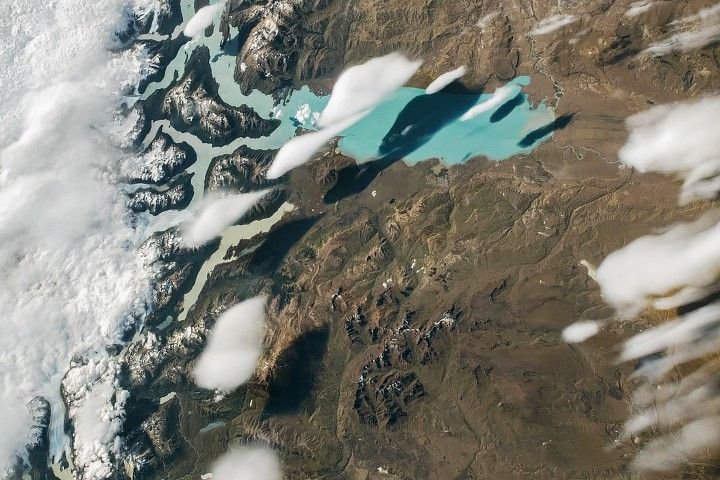
Lenticular Cloud Formation: NASA scientists identified the fish-shaped clouds over Lago Argentino as likely lenticular clouds, formed by mountain-induced lee waves and stable air conditions.
-
Environmental Influences: The region’s strong surface winds and glacial ice sublimation contributed to the clouds’ moisture, leading to distinctive high-altitude formations.
-
Cloud Appearance and Properties: Observations indicated cloud altitudes around 9,200 meters with temperatures near 220 K, supporting the classification as Cirrocumulus lenticularis.
-
Citizen Science Initiative: The GLOBE Clouds project invites public participation in cloud classification, enhancing NASA’s research through community contributions.
Clouds Swim Over Lago Argentino: A Spectacular Sight
On December 27, 2025, an astronaut aboard the International Space Station captured a stunning photograph of Lago Argentino in Patagonia. Above the glacial lake, fish-shaped clouds floated gracefully, stirring curiosity among scientists. They quickly began analyzing the image for clues about these captivating formations.
Experts suggest that these clouds resemble lenticular clouds, which typically develop near mountains. Maria Hakuba, a researcher from NASA’s Jet Propulsion Laboratory, noted, “The lens shape and smooth edges suggest these clouds are ice clouds at a high altitude.”
Lenticular clouds form when winds push moist air over geographic features like mountain ranges. As air rises, it cools, leading to condensation and cloud formation. Conversely, the air descends, warming and evaporating the cloud on the other side. This process creates unique, stationary clouds that often take smooth, lens-like shapes.
Hazem Mahmoud, from NASA’s Langley Research Center, provided further insights. He cited data indicating these clouds likely reached altitudes near 30,000 feet, with temperatures around -53 degrees Celsius. “The high altitude and cloud properties point toward Cirrocumulus lenticularis,” he explained.
Patagonia’s strong winds likely contributed to the cloud formation. These winds involve moisture from the glacial lakes, which rises, creating spectacular displays above the Andes. “Sublimation from glacial ice adds extra moisture,” Mahmoud added, underscoring the interplay between the environment and atmospheric processes.
Furthermore, Santiago Gassó from NASA’s Goddard Space Flight Center emphasized the significance of lenticular clouds in the region. These clouds often remain stationary due to mountain-induced turbulence and are famous for their mesmerizing shapes. “They don’t usually precipitate, as moisture tends to remain on the western side of the range,” he said.
Despite these insights, scientists face challenges in cloud classification from a single image. Without additional radar data, it’s tough to illustrate the clouds’ full vertical structure. Mahmoud remarked that distinguishing between lenticular and cumulus clouds requires more comprehensive analysis.
Interestingly, atmospheric scientists affectionately refer to certain cloud formations as “fish,” connecting this phenomenon to a broader classification. For those eager to learn more about clouds, the GLOBE Clouds project invites citizen scientists to participate in identifying different types. This initiative enables students and the public to engage with NASA’s research and explore the skies above.
The photograph taken during Expedition 74 not only presents an awe-inspiring view but also showcases the marvels of atmospheric science. This collaboration inspires further exploration and enhances our understanding of the environment, affecting both technological advancement and the quality of life for communities around the globe.
Stay Ahead with the Latest Tech Trends
Stay informed on the revolutionary breakthroughs in Quantum Computing research.
Stay inspired by the vast knowledge available on Wikipedia.
SciV1
