

Top Highlights
-
Novel Combination: MIT researchers have merged 2D magnets and moiré materials, predicting new phenomena that could significantly advance condensed matter physics and have applications in computer science.
-
Flat Band Creation: They theorize that a structure of two layers of a 2D magnet topped with a 2D semiconductor can create a flat band where electrons stand still, allowing for enhanced interactions crucial for exotic physics.
-
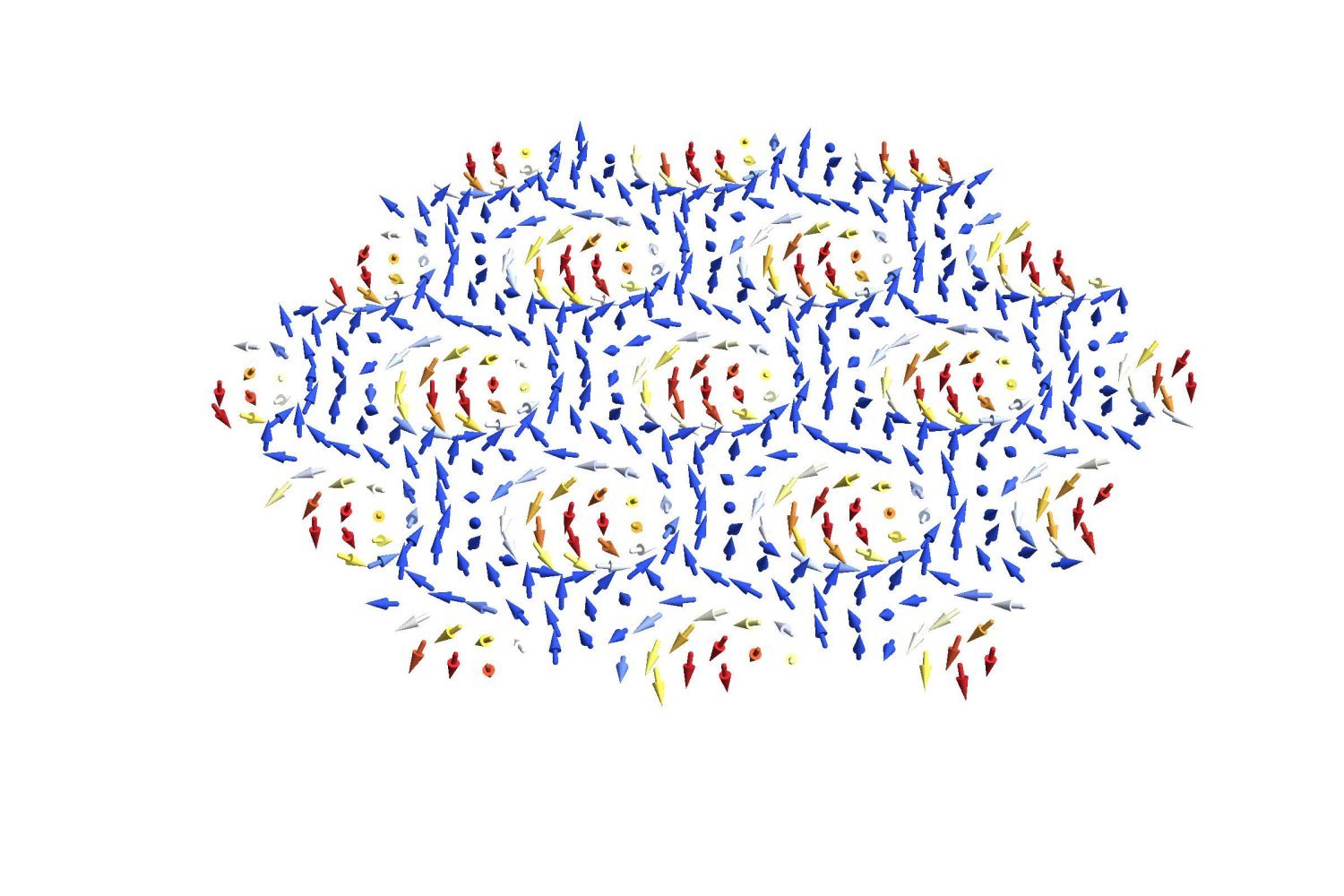
Skyrmion Integration: The team expects skyrmions—stable, knot-like spin structures—to endow semiconductor electrons with similar properties, facilitating the formation of the flat band and potentially robust applications in memory storage.
- Material Recommendations: Using density functional theory, researchers identified molybdenum disulfide and chromium tribromide as an optimal combination to achieve strong interactions between spins and electrons, opening pathways for experimental validation and innovative technologies.
MIT Physicists Predict Exotic New Phenomena and Provide Blueprint for Realization
MIT physicists recently unveiled exciting theories that could significantly impact technology, particularly in computer science. Their research fuses two separate realms in condensed matter physics, hinting at new phenomena that researchers are eager to observe experimentally.
The study focuses on 2D materials, which are composed of only a few atomic layers. This unique structure allows researchers to manipulate them like building blocks. “You can stack them and twist them to create various sandwich structures with unusual properties,” explained Nisarga Paul, a graduate student and co-author of the study.
This work zeroes in on two key areas: moiré materials and 2D magnets. Moiré materials, which include partnered sheets of graphene, have undergone major advancements in recent years. Meanwhile, the exploration of 2D magnets is gaining momentum. The question arises: What happens when these two fields converge?
The team predicts that a structure composed of two layers of a 2D magnet and a layer of a 2D semiconductor will create a flat band phenomenon. In this scenario, electrons in the semiconductor become stationary, allowing them to interact meaningfully. Paul emphasized this point, stating, “Getting electrons to stand still lets them really talk to each other.”
Central to this research is the concept of skyrmions—topological particles that involve the spin property of electrons. Skyrmions are resilient against deformation, making them promising candidates for future memory storage technologies. The team believes these skyrmions will influence the semiconductor electrons, granting them similar properties and stabilizing the flat band.
Moreover, the researchers identified optimal conditions for creating a viable magnet-semiconductor structure with a flat band. Using a technique called density functional theory, Yang Zhang determined that a combination of molybdenum disulfide over chromium tribromide offers the strongest electron interactions. This specific pairing boasts a crucial parameter, known as proximity exchange, that is significantly higher than other typical combinations.
Experts not involved in the study have shown enthusiasm for the potential impacts of this work. Xiaodong Xu from the University of Washington remarked on the innovative technique for engineering flat electronic bands. Inti Sodemann from the Max Planck Institute focused on the implications for topological quantum computing, asserting the research could pave the way for developing exotic states beneficial for future technologies.
This groundbreaking research highlights the thrilling prospects that arise from merging different fields in condensed matter physics. The team looks forward to partnering with experimentalists to bring their predictions to life, marking a significant step forward in technological innovation.
Expand Your Tech Knowledge
Explore the future of technology with our detailed insights on Artificial Intelligence.
Stay inspired by the vast knowledge available on Wikipedia.
QuantumV1
