

Quick Takeaways
-
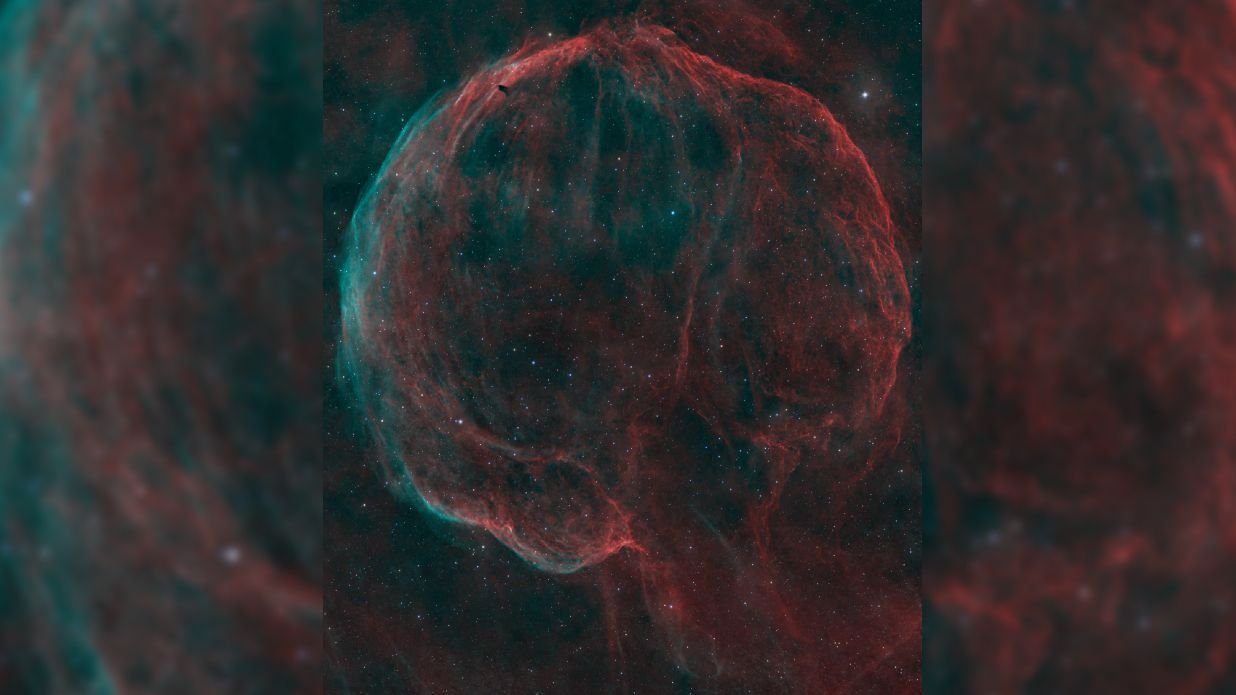
Kentucky astrophotographer David Joyce captured the stunning CTB 1 supernova remnant, also known as the Garlic Nebula, 9,132 light-years away in Cassiopeia, showcasing ancient light from a stellar explosion that occurred 10,000 years ago.
-
The nebula’s shape resembles both garlic and a human brain, and it has been observed in multiple wavelengths including radio, X-ray, and visible light, revealing its interaction with interstellar gas.
-
Joyce dedicated over 50 hours to capture the faint object from his suburban backyard using an 8-inch Schmidt-Cassegrain telescope and a ZWO camera, achieving a detailed image after years of planning.
-
His work highlights advancements in astrophotography tools, emphasizing the importance of equipment and ideal conditions for successful night sky imaging.
Cosmic ‘Brain’ Ponders the Cosmos in Stunning New Photo
A spectacular deep space image has surfaced, showcasing the Medulla Nebula. This vibrant spectacle is a supernova remnant named CTB 1, also called the Garlic Nebula. This moniker stems from its bulbous shape, which resembles both a garlic bulb and a human brain.
Thus, this nebula lies approximately 9,132 light-years from Earth, nestled within the Milky Way in the constellation Cassiopeia. Scientists believe it formed from the explosive death of a massive star about 10,000 years ago. As a result, this cosmic event not only created the nebula but also a superdense pulsar that NASA discovered in 2009. This pulsar races through space at 2.5 million miles per hour, continuously shedding light on the aftermath of stellar explosions.
Moreover, capturing this beautiful yet faint nebula posed challenges. The astrophotographer, operating from a light-polluted area, dedicated over 50 hours to obtain a clearer view. He utilized an 8-inch Schmidt-Cassegrain telescope and a specialized camera, conducting observations over seven nights. The artist transformed raw data into a stunning visual through advanced software, revealing intricate details of this celestial marvel.
The impact of such developments is significant. Technologies used in astrophotography often trickle down to other fields, improving imaging techniques in medicine and manufacturing. Additionally, these endeavors spark interest in science and technology among young people, inspiring the next generation to explore the cosmos.
As amateur astronomers observe the night sky, they can feel connected to universal wonders. Efforts to capture images like that of the Garlic Nebula help ignite a passion for exploration and discovery. Ultimately, this stunning cosmic photograph not only serves as art but also acts as a bridge between technology and human curiosity.
Stay Ahead with the Latest Tech Trends
Stay informed on the revolutionary breakthroughs in Quantum Computing research.
Stay inspired by the vast knowledge available on Wikipedia.
SciV1
