

Quick Takeaways
- Penn State researchers sought to confirm corona discharge in natural settings.
- They observed electrical bursts on trees during thunderstorms in North Carolina.
- Findings were published, marking the first natural documentation of corona discharges.
- The discovery highlights trees’ role in atmospheric chemistry and air quality.
A New Dawn for Atmospheric Science
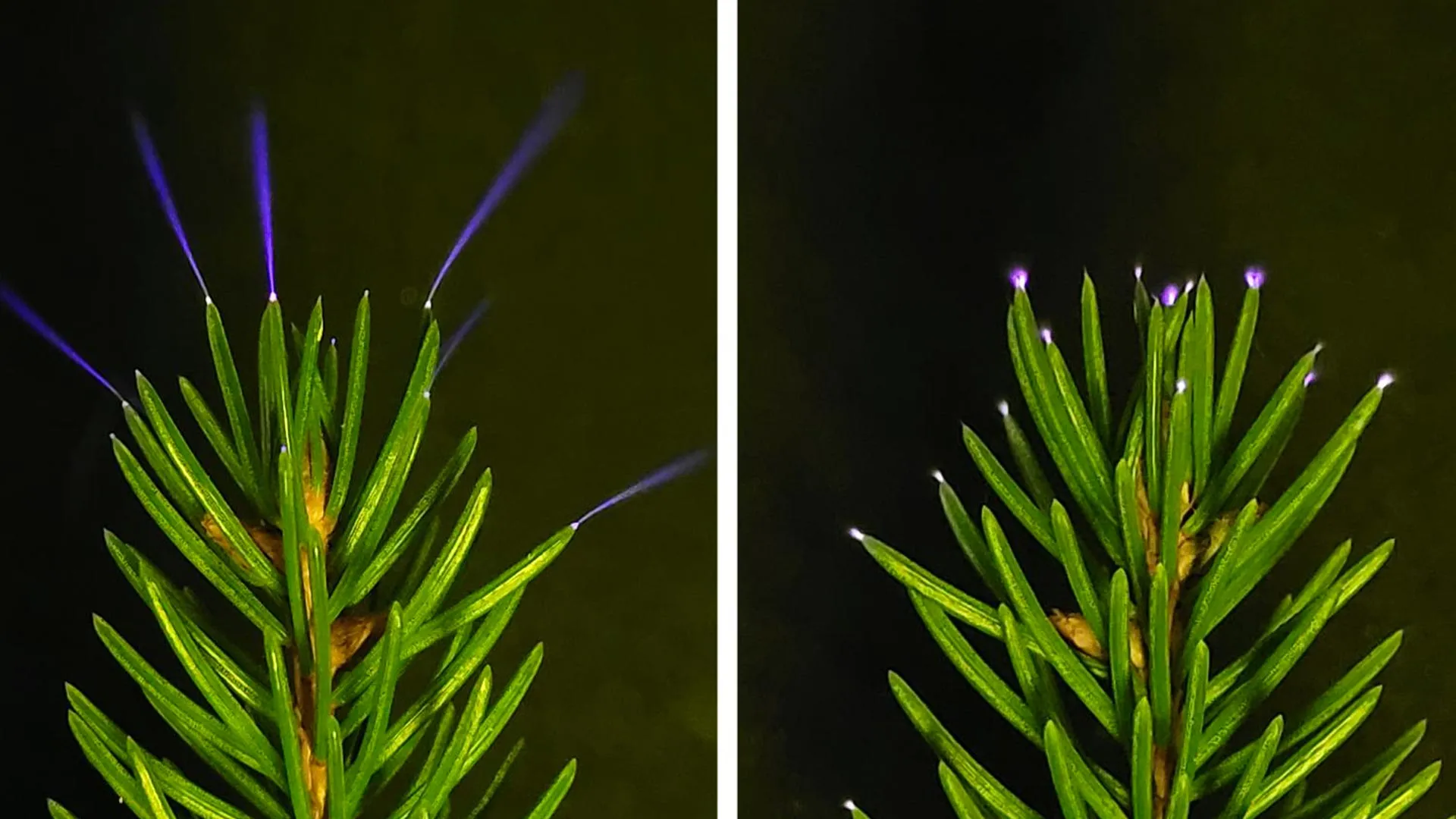
In June 2024, researchers from Penn State embarked on an ambitious quest. They aimed to capture a natural phenomenon known as corona discharge. This process causes tree leaves to emit faint electrical pulses, creating a subtle glow during thunderstorms. For over 70 years, scientists theorized that forests produce electrical activity during storms. Yet, they lacked direct evidence.
The team faced challenges during their journey along the East Coast. Florida’s summer thunderstorms often fizzled out, leaving the researchers empty-handed. Just as they prepared to return home, opportunity struck in North Carolina. They observed corona discharges on a sweetgum tree and a loblolly pine during a significant thunderstorm. This marked the first confirmed detection of corona discharges in the wild, a breakthrough in atmospheric science.
Implications for the Environment
The implications of these discoveries stretch beyond scientific curiosity. Corona discharges arise from strong electrical imbalances during storms. Thunderclouds generate negative charges, which attract positive charges from the ground. This upward movement of positive charge concentrates at the tips of tree leaves, creating an intense electric field that produces light.
Researchers emphasize the importance of hydroxyl, a substance formed from this process. Hydroxyl acts as a cleaning agent in the atmosphere, breaking down pollutants like methane. As trees emit compounds, they become part of this vital cycle of purification.
Despite confirming corona discharges, many questions linger. Do these electrical events harm trees, or do they provide benefits? Could trees have adapted to tolerate or leverage this phenomenon? The ongoing research aims to explore these interactions between trees and the atmosphere. This knowledge may reveal new avenues for understanding forest health and air quality.
Such discoveries illustrate the continuous nature of scientific exploration. Even in a world dominated by technology and data, nature still holds mysteries waiting to be unveiled. As researchers collaborate across disciplines, they push the envelope of what we understand about our environment. The glow of trees during storms may very well illuminate not just the forest canopy but also our understanding of ecological balance and atmospheric chemistry.
Expand Your Tech Knowledge
Stay informed on the revolutionary breakthroughs in Quantum Computing research.
Explore past and present digital transformations on the Internet Archive.
TechV1
