

Summary Points
- NASA and Boeing completed wind tunnel tests for an innovative aircraft design.
- The truss-braced wing aims to enhance fuel efficiency and reduce costs.
- Extensive studies are needed to redesign passenger jet aerodynamics revolutionarily.
- Testing contributed valuable data for future aircraft and cut fuel use.
Testing the Future of Aviation
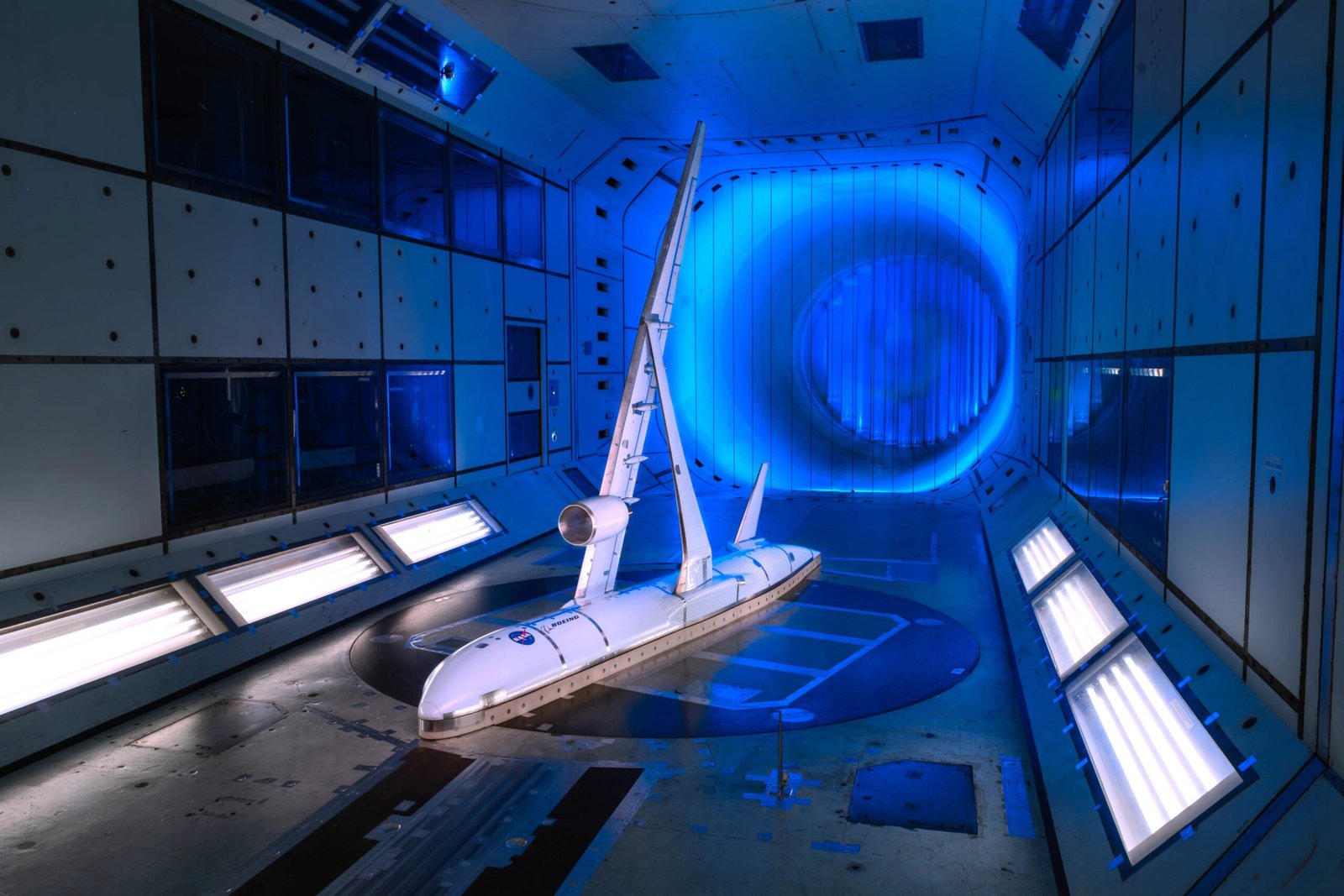
NASA and Boeing have taken a significant step toward revolutionizing aircraft design. They recently completed wind tunnel testing of a truss-braced wing configuration. This design features a long, thin wing supported by aerodynamically shaped structural elements. By improving aerodynamic efficiency, this innovative approach aims to lower fuel consumption and operational costs for future airliners.
The testing leveraged a semispan model—essentially half an aircraft—mounted in a state-of-the-art wind tunnel. This setup allows researchers to study how air flows around the wing and understand the forces acting on it during flight. By manually adjusting the model’s slats, flaps, and other control surfaces, the team could simulate takeoff and landing conditions, key phases for assessing lift capabilities.
The wind tunnel used for these tests, operated by QinetiQ in Farnborough, England, provided valuable insights. Its large size and pressurized conditions help predict airplane behavior more accurately during critical flight stages. Real-time data analysis ensured the model’s performance aligned with expectations, adding to the body of knowledge required for future designs.
The Path Forward for Truss-Braced Wings
The truss-braced wing concept is more than just a modification; it represents a significant shift in aircraft design. This reimagining of the passenger jet framework necessitates rigorous study and testing. NASA and Boeing’s work aligns with the Subsonic Ultra Green Aircraft Research (SUGAR) initiative—aimed at creating greener, more sustainable aviation.
Their collaboration exemplifies how NASA acts as a catalyst for innovative technology with real-world applications. The transonic truss-braced wing has roots in aeronautics research supported by NASA. Engineers from both organizations are steadily moving this design from concept to practical application. This effort is part of NASA’s Advanced Air Vehicles Program and the Subsonic Flight Demonstrator project within the Integrated Aviation Systems Program.
While researchers continue to analyze data, initial results indicate promising advancements. Their findings contribute to ongoing efforts to make flying more efficient, thereby reducing the industry’s environmental footprint. Testing will continue at multiple NASA facilities to build a comprehensive understanding of this advanced airframe concept, marking a significant milestone in the evolution of aviation technology.
Expand Your Tech Knowledge
Learn how the Internet of Things (IoT) is transforming everyday life.
Discover archived knowledge and digital history on the Internet Archive.
Space
