

Summary Points
- Smell influences daily experience, detecting hazards and enhancing memory and emotion.
- Harvard scientists created the first detailed map of nasal smell receptors.
- Neurons are organized in horizontal stripes, challenging previous assumptions.
- This research could lead to new treatments for loss of smell.
The Significance of a Hidden Smell Map
Smell shapes how we experience the world every day. It helps us detect hazards, adds depth to flavor, and connects strongly to memory and emotion. Despite its importance, scientists have struggled to understand how this sense works at a biological level. “Olfaction is super-mysterious,” says Sandeep Datta, a neurobiology professor at Harvard Medical School. Olfaction stands apart from vision, hearing, and touch, where scientists have already mapped sensory receptors.
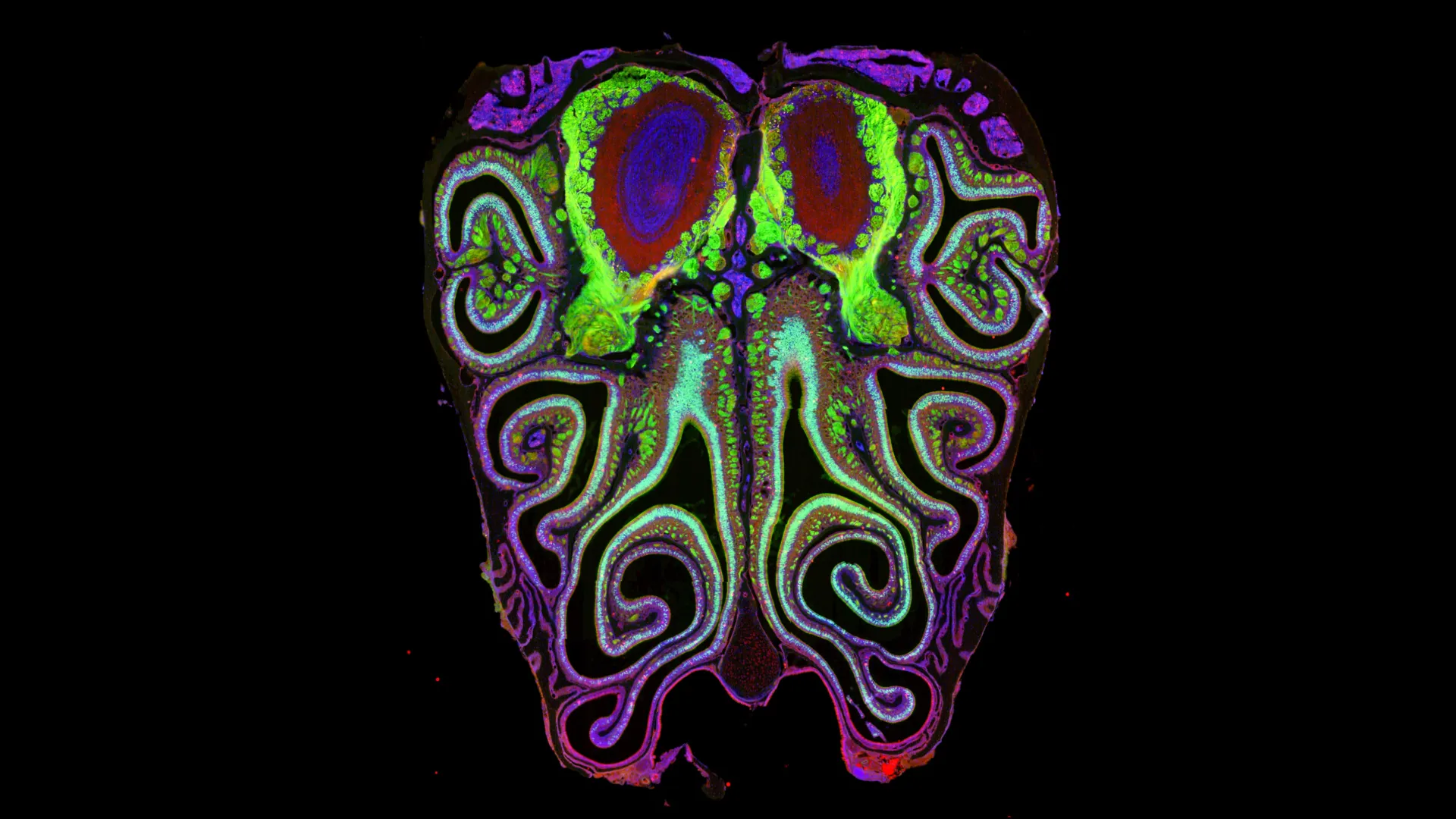
Recent research from Datta and his team has unveiled a detailed map of smell receptors in the noses of mice. Unlike earlier beliefs that suggested a random distribution of these receptors, researchers found a highly organized structure. Neurons form horizontal bands running from the top of the nose to the bottom. This striking organization brings order to a system that previously appeared chaotic. The layout corresponds with maps in the olfactory bulb of the brain, providing fresh insight into how scent information travels from the nose to the brain.
Understanding this map marks a significant step in the long search to decode the sense of smell. Scientists have recognized the complexity of olfactory neurons, which number around 20 million in mice. Each neuron expresses one of over a thousand receptor types, unlike human color vision, which relies on just three receptor types. For decades, researchers have attempted to discern patterns among these receptors, often concluding they were arranged randomly. New genetic tools enabled Datta’s team to analyze 5.5 million neurons across more than 300 mice. Their groundwork produced a consistent pattern among the neurons, resembling maps of smell information in the brain.
The Practical Implications of Smell Research
Beyond enhancing our understanding of biology, this research holds practical implications. Loss of smell, a condition affecting safety and well-being, currently lacks effective treatments. Datta emphasizes, “We cannot fix smell without understanding how it works on a basic level.” The team’s next steps involve examining the specific order of receptor stripes and whether similar organization exists in humans. This foundational knowledge could direct new treatments, including stem cell therapies or brain-computer interfaces, focused on restoring the sense of smell.
The profound effects of smell on human health range from nutrition to mental well-being. Restoring this sense isn’t merely a matter of pleasure or safety; it’s about holistic psychological health. As researchers lay the groundwork for more effective treatments, they recognize that understanding this hidden map in our noses is crucial for progress. The intricate biology of olfaction finally deserves the attention it has long lacked, paving the way for innovative solutions that can benefit countless lives.
Discover More Technology Insights
Dive deeper into the world of Cryptocurrency and its impact on global finance.
Stay inspired by the vast knowledge available on Wikipedia.
TechV1
