

Top Highlights
- Researchers developed a compact ultrafast laser on a photonic chip.
- The new laser matches traditional systems in performance and efficiency.
- It uses a unique Mamyshev oscillator design, overlooked in photonics.
- This innovation could make ultrafast lasers cheaper and more accessible.
Revolutionizing Ultrafast Laser Technology
For decades, ultrafast lasers have played a crucial role in various fields, from manufacturing to medicine. These powerful tools produce exceedingly short light pulses, lasting just a few hundred femtoseconds. Their applications include precision eye surgeries and the development of optical frequency combs—technologies that have earned Nobel Prizes for their transformative impact on scientific measurement. However, these lasers typically occupy large optical tables and come with hefty price tags. Now, scientists have made a breakthrough that could change this landscape forever.
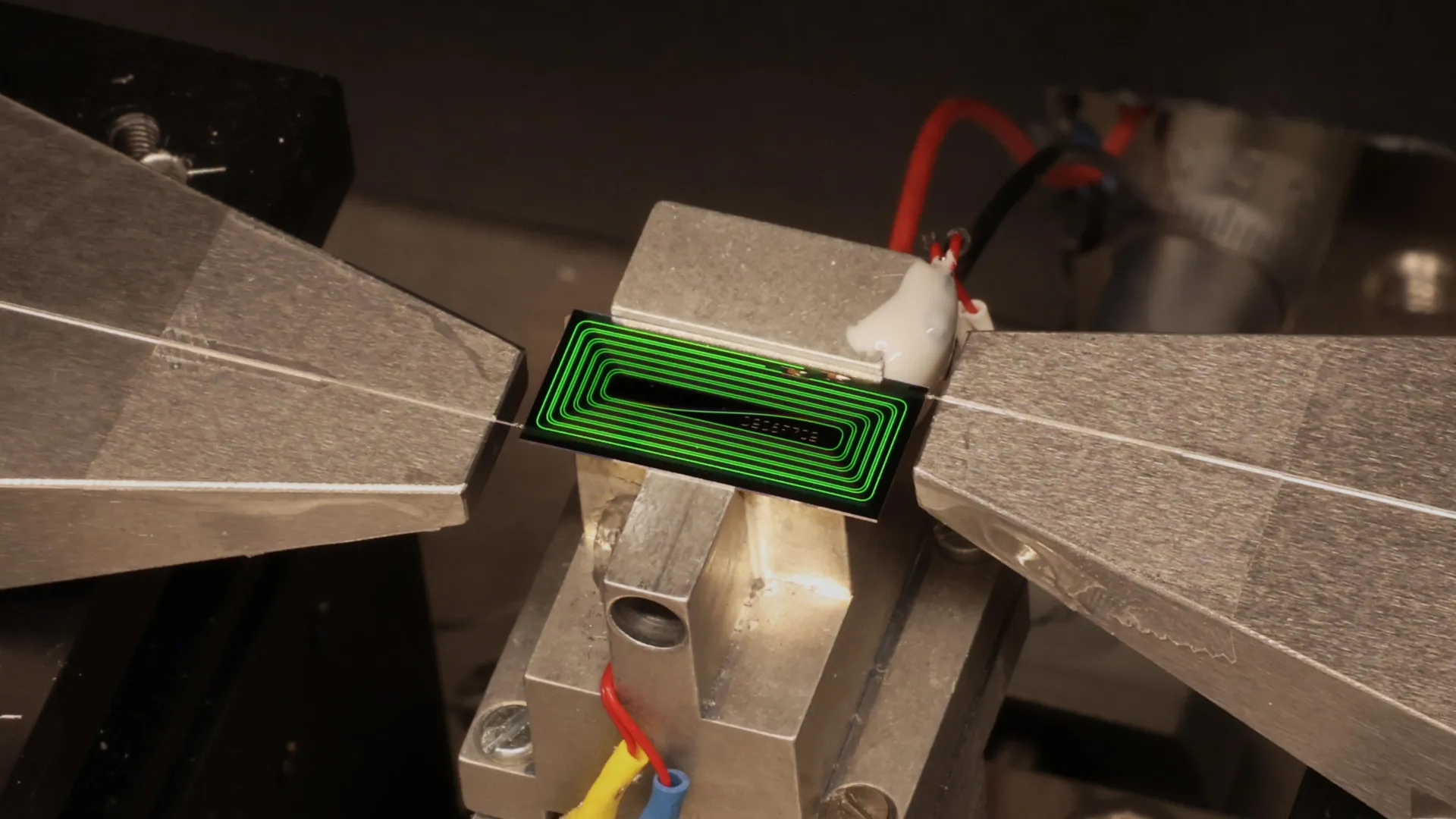
Researchers from the École Polytechnique Fédérale de Lausanne (EPFL) have developed the first integrated ultrafast laser on a chip that performs similarly to traditional tabletop systems. This compact device generates pulse energies of 1.05 nanojoules and durations as short as 147 femtoseconds. With a footprint comparable to that of a match head, it opens up numerous avenues for practical use. By harnessing photonic chips—integrated circuits that manipulate light—researchers have crafted a tool that shatters the conventional barriers imposed by size and cost.
Portability and Broader Applications
The new design leverages a Mamyshev oscillator, a configuration previously overlooked in integrated photonics. This oscillator uses a nonlinear waveguide to broaden laser pulses into multiple colors. As a result, only the strongest pulses circulate within the laser cavity, while weaker ones get filtered out. This unique architecture minimizes instability, a common challenge in other laser designs.
The implications are significant. Manufacturing photonic chips operates at wafer scale, allowing mass production of thousands of laser cavities simultaneously. This scalability could drastically reduce costs. With kilowatt-level peak powers, these compact lasers can tackle demanding applications, from environmental monitoring to medical diagnostics.
Imagine portable devices capable of real-time pollution detection or hidden defect identification in crucial materials. The potential goes beyond immediate applications. Compact optical atomic clocks, essential for navigation systems, could become a reality, ensuring precision in future technologies.
This innovation doesn’t come without challenges. The transition from traditional large systems to chip-based solutions requires time and investment in infrastructure. However, the benefits—reduced costs, increased accessibility, and enhanced capabilities—paint an optimistic picture for the future.
Continue Your Tech Journey
Explore the future of technology with our detailed insights on Artificial Intelligence.
Explore past and present digital transformations on the Internet Archive.
TechV1
