

Summary Points
- NASA’s ERNEST rover demonstrates advanced robotic autonomy in extreme terrain navigation.
- The prototype successfully traveled 16 miles with minimal human intervention.
- ERNEST’s technology aims to support future lunar and Mars exploration missions.
- Enhanced mobility features allow the rover to tackle challenging landscapes efficiently.
NASA’s ERNEST: A Leap in Rover Technology
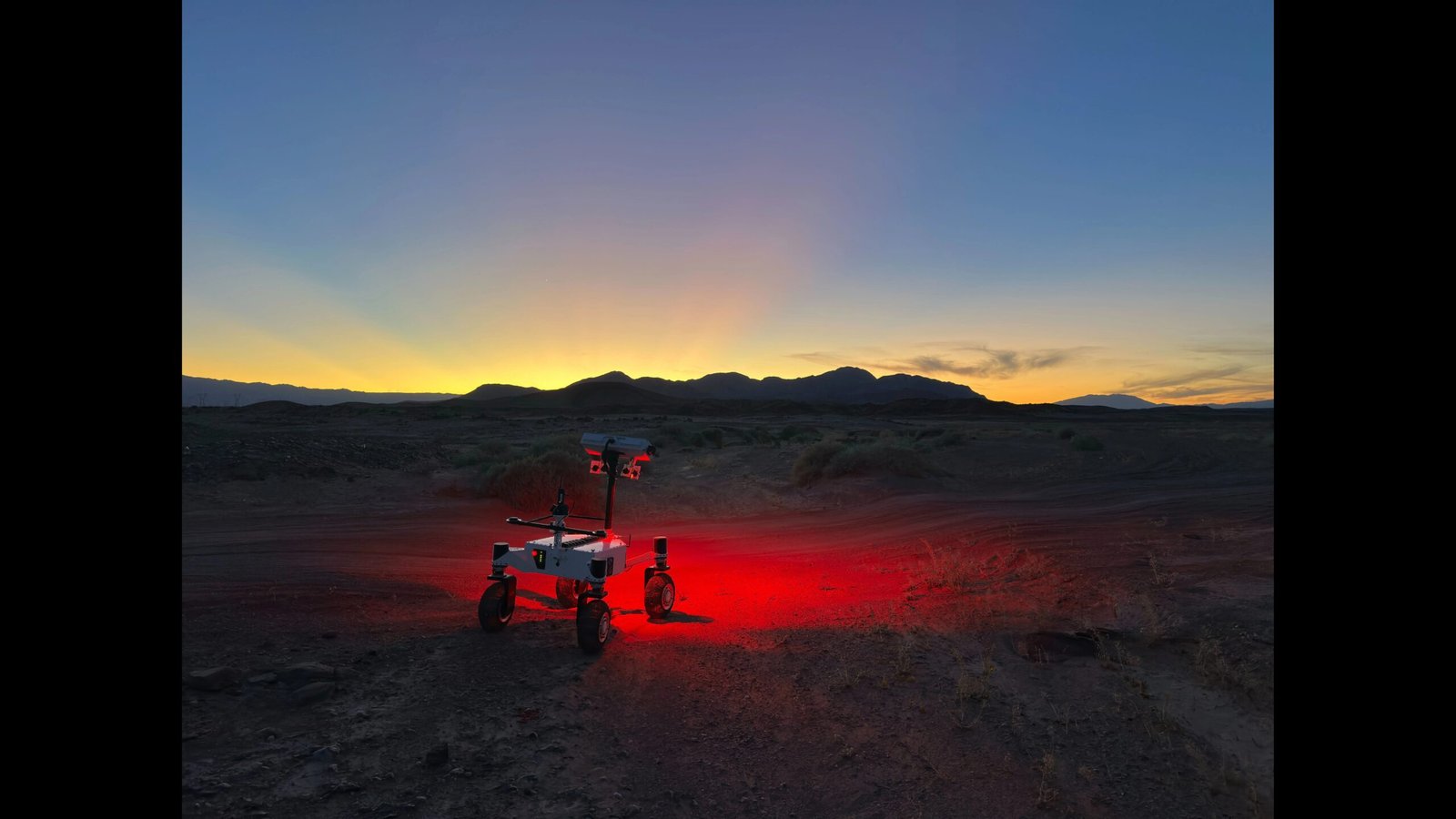
On a rugged stretch of the Colorado Desert, NASA has taken significant strides in rover technology with a prototype called ERNEST (Exploration Rover for Navigating Extreme Sloped Terrain). This compact, four-wheeled rover recently journeyed 16 miles in 37 hours with minimal human intervention. Developed at NASA’s Jet Propulsion Laboratory (JPL) in California, ERNEST is designed to enhance robotic autonomy and navigate challenging terrains, making it a crucial element for future lunar and Martian explorations.
ERNEST measures 4 feet in length and incorporates innovative features that allow it to lift each wheel to overcome obstacles. This capability vastly outperforms current Mars rovers, such as Curiosity and Perseverance. With improved decision-making abilities, ERNEST could be instrumental in missions targeting areas of Mars and the Moon that are currently deemed inaccessible.
The recent testing aimed to push the boundaries of robotic mobility. Unlike its predecessors, ERNEST can achieve higher speeds and cover greater distances. It traveled at speeds up to 0.6 mph, showcasing its potential for long-range missions. “You could do a science road trip across the Moon or Mars with this vehicle,” stated James Keane, a planetary scientist at JPL. This prospect opens new avenues for exploration and scientific inquiry.
Autonomous Navigation and Adaptive Technologies
The mobility advancements seen in ERNEST stem from a focus on mechanical and autonomy technologies. The rover employs an active suspension system that redistributes weight among its wheels, allowing it to adapt to a variety of terrains. The design builds upon the rocker-bogie suspension system proven successful in past Mars rovers but incorporates new research on mobility and terrain interaction.
Moreover, ERNEST utilizes artificial intelligence to enhance its autonomous capabilities. The project is employing reinforcement learning to train the rover to navigate independently. A high-fidelity virtual testing environment mimics physical terrains, allowing ERNEST to learn how to tackle obstacles without human input. The application of AI could prove transformative, enabling future rovers to independently navigate complex landscapes on the Moon and Mars.
The adaptability of ERNEST highlights its potential for future missions. By integrating intelligent navigation with active suspension capabilities, the rover could efficiently map out paths, circumvent hazards, and effectively conduct scientific investigations. With ongoing support from NASA’s Mars Exploration Program and JPL’s research initiatives, ERNEST may set the stage for unprecedented exploration efforts in space.
Expand Your Tech Knowledge
Learn how the Internet of Things (IoT) is transforming everyday life.
Discover archived knowledge and digital history on the Internet Archive.
Space
