

Essential Insights
- NASA celebrates the 250th anniversary of the U.S. with a Hubble image.
- NGC 6426 is one of Milky Way’s oldest globular clusters, about 13 billion years old.
- The image represents blue stars as hotter and red stars as cooler.
- Hubble’s study of globular clusters enhances our understanding of galaxy evolution.
A Stellar Celebration of 250 Years of Exploration
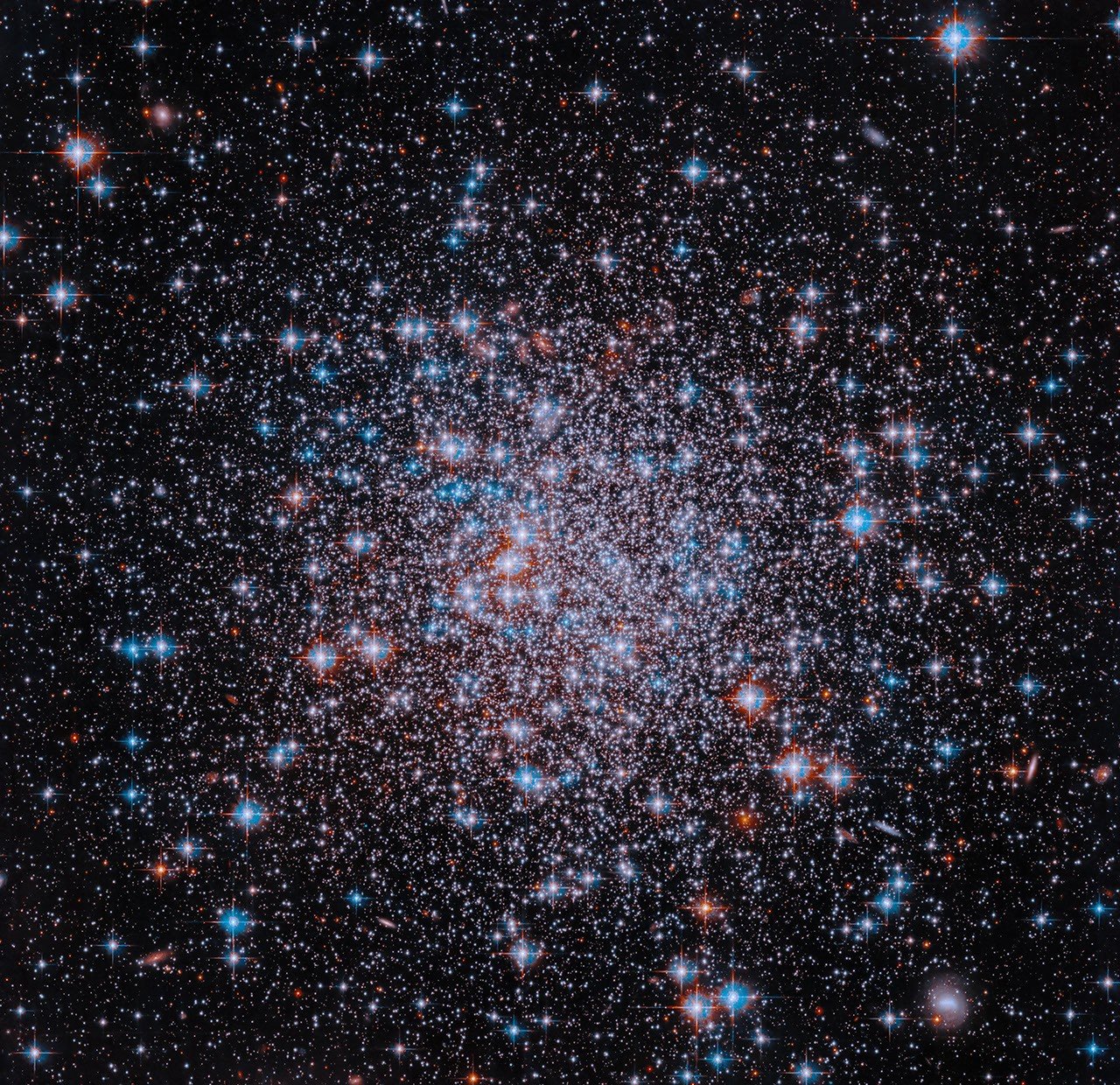
Red, white, and blue stars glitter like sparkler fireworks in a new image from NASA’s Hubble Space Telescope. Released in honor of the United States’ 250th anniversary, this stunning photograph exemplifies America’s ongoing legacy of scientific exploration.
The focus of this remarkable image is globular cluster NGC 6426, a spherical collection of stars located in the outer halo of our Milky Way galaxy. Bound together by gravity, NGC 6426 is one of about 150 known globular clusters within our galaxy. These clusters generally form from the same collapsing cloud of gas, leading to similarities in the ages of their stars. Approximately 13 billion years old, NGC 6426 stands out as one of the Milky Way’s oldest stellar groups, nearly as ancient as the universe itself, which is estimated to be 13.7 billion years old.
Colors in Hubble’s images serve as a visual cue to the stars’ temperatures. Blue stars represent shorter wavelengths of visible light and are significantly hotter. In contrast, the red stars indicate longer wavelengths, including some near-infrared light, marking them as cooler. The interplay of these colors provides a vivid portrayal of the star cluster’s composition.
The Legacy of Stars and Chemical Evolution
The stars in NGC 6426 exhibit low metallicity, meaning they contain fewer elements heavier than hydrogen and helium. This characteristic mirrors conditions from the early universe, where hydrogen and helium predominated. At that time, heavier elements began forming through nuclear fusion in massive stars.
Recent research has uncovered evidence for two chemically distinct populations of stars within NGC 6426. This suggests that slightly younger, more metallic stars have been enriched by materials ejected from the explosive deaths of earlier stars in the cluster. Supernovae, powerful explosions from massive stars, release heavy elements into space, facilitating the birth of new stars and planets.
Hubble captured this image while studying globular clusters in the Milky Way’s halo. The objective is to determine their ages and contribute to our understanding of the galaxy’s formation and evolution. Over 30 years in orbit, Hubble has reshaped our perspective on the universe. Its findings are augmented by missions like the infrared-sensitive James Webb Space Telescope and the upcoming Nancy Grace Roman Space Telescope, set to launch later this summer.
Explore More
Continue Your Tech Journey
Dive deeper into the world of Cryptocurrency and its impact on global finance.
Stay inspired by the vast knowledge available on Wikipedia.
Space
