
Close Menu
    Facebook X (Twitter) Instagram
    Sunday, October 25
    Top Stories:
    • AI Automation: Managing Digital Workers
    • Recordanelles: Single-Cell Transcriptome Recording in Human Cells
    • China’s Humanoid Robots Target South Korea’s Physical AI Boom
    Facebook X (Twitter) Instagram Pinterest Vimeo
    IO Tribune
    • Home
    • AI
    • Tech
      • Gadgets
      • Fashion Tech
    • Crypto
    • Smart Cities
      • IOT
    • Science
      • Space
      • Quantum
    • OPED
    IO Tribune
    Home » Decoding Math’s Mystical Langlands Program
    Quantum

    Decoding Math’s Mystical Langlands Program

    Staff ReporterBy Staff ReporterSeptember 10, 2026No Comments3 Mins Read
    Share Facebook Twitter Pinterest LinkedIn Tumblr Reddit Telegram Email
    Share
    Facebook Twitter LinkedIn Pinterest Email

    Essential Insights

    1. Langlands program links number theory, geometry, and symmetry through deep correspondences.
    2. Galois symmetries influence modular forms, revealing the pattern behind equations’ solutions.
    3. Wiles proved Fermat’s Last Theorem via Langlands’ ideas, uniting different mathematical worlds.
    4. Physicists see Langlands duality as fundamental, hinting at a deeper, unified mathematical reality.

    Unraveling the Mystery of the Langlands Program

    The Langlands program is a huge idea in mathematics. It tries to connect different fields that seem very different. At its core, it links number theory, the study of numbers, with harmonic analysis, the study of waves and patterns. But the connection is deep and hidden. It’s like a secret code that explains how numbers, shapes, and symmetries relate.

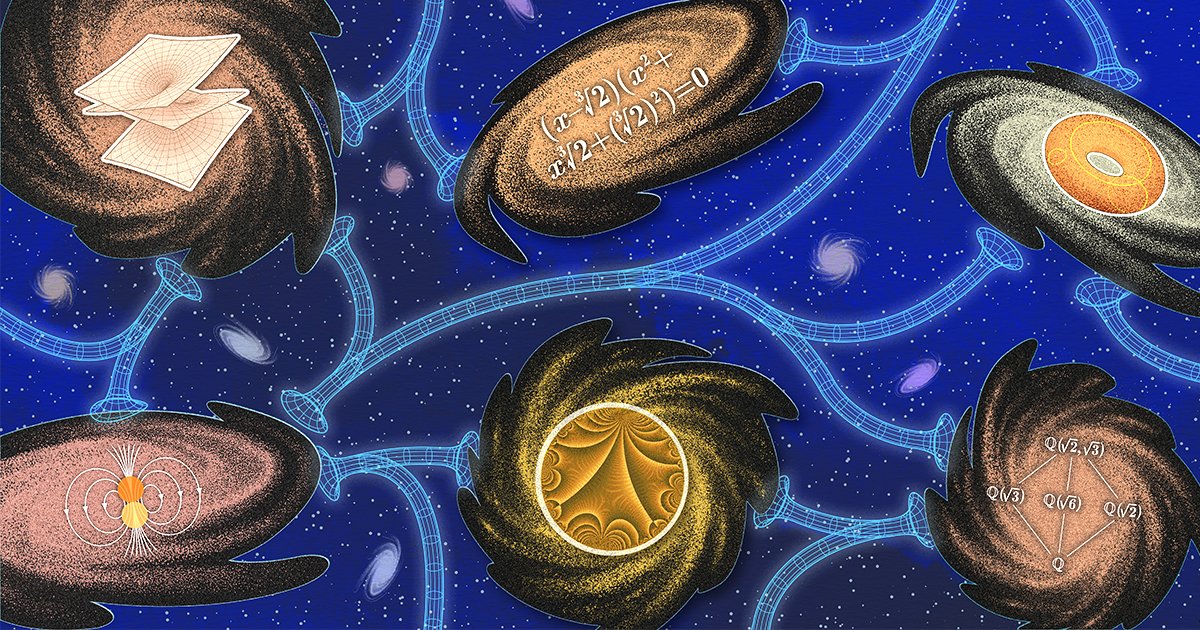
    One way to see this is through number equations called polynomials. For example, solving the equation ( x^3 – 2 = 0 ) modulo some prime number shows patterns that match what a modular form—a special type of math function—predicts. These solutions have symmetries that are linked to algebraic structures called Galois groups. How solutions change when you multiply or transform them reveals a hidden pattern. This pattern is what mathematicians call a “correspondence” between different mathematical objects. It’s as if the solutions are actions in a distant galaxy, and the form’s coefficients are snapshots of those actions. These mysterious relations aren’t random; they are connected through what’s called Galois symmetries. They paint a complex, swirling picture of the universe of math.

    The Langlands program suggests that, beneath the surface, many seemingly unrelated objects are actually part of a bigger system. It’s like discovering that different language dialects are variations of a single core language. Historically, this idea helped prove famous theorems. For example, in 1994, mathematician Andrew Wiles used a Langlands-like correspondence to prove Fermat’s Last Theorem, a problem that puzzled mathematicians for 357 years. Wiles showed that certain elliptic curves could not exist, thanks to the connections the Langlands program predicts. These connections are also seen in physics, where dualities—like electric and magnetic fields—show how two different descriptions can really be the same thing. Physicists believe that the Langlands program could be pointing toward a hidden, unified structure in both math and the universe. Many experts think the program might reveal the true roots of how math connects across different areas, though the full picture remains a mystery.

    Continue Your Tech Journey

    Explore the future of technology with our detailed insights on Artificial Intelligence.

    Access comprehensive resources on technology by visiting Wikipedia.

    QuantumV1

    HPC Quantum VT1
    Share. Facebook Twitter Pinterest LinkedIn Tumblr Email
    Previous ArticleTelit Cinterion Launches Edge AI SDK for 4G/5G Modules
    Next Article Breaking Symmetry to Boost Neural Network Performance
    Avatar photo
    Staff Reporter
    • Website

    John Marcelli is a staff writer for IO Tribune, with a passion for exploring and writing about the ever-evolving world of technology. From emerging trends to in-depth reviews of the latest gadgets, John stays at the forefront of innovation, delivering engaging content that informs and inspires readers. When he's not writing, he enjoys experimenting with new tech tools and diving into the digital landscape.

    Related Posts

    Tech

    AI Automation: Managing Digital Workers

    October 25, 2026
    Science

    Recordanelles: Single-Cell Transcriptome Recording in Human Cells

    October 25, 2026
    AI

    Why AI Agents Keep Answering After Tools Fail

    October 25, 2026
    Add A Comment

    Comments are closed.

    Must Read

    AI Automation: Managing Digital Workers

    October 25, 2026

    Recordanelles: Single-Cell Transcriptome Recording in Human Cells

    October 25, 2026

    Why AI Agents Keep Answering After Tools Fail

    October 25, 2026

    Why Most of the World’s Rivers Defy Prediction Models

    October 25, 2026

    Earbuds vs. Headphones: Why Are Earbuds Cheaper?

    October 25, 2026
    Categories
    • AI
    • Crypto
    • Fashion Tech
    • Gadgets
    • IOT
    • OPED
    • Quantum
    • Science
    • Smart Cities
    • Space
    • Tech
    Most Popular

    Unbeatable Deal: Apple Watch Series 10 Hits Lowest Price Ever!

    November 13, 2025

    Unlocking the Mystery: Why Gold Stays Brilliant Forever

    July 12, 2026

    Cellphone Bans Fail to Boost Student Test Scores

    May 4, 2026
    Our Picks

    Unlocking Time’s Quantum Secrets with Atomic Clocks

    April 21, 2026

    ChatGPT Mania: Goblins in US, Steady in China

    May 7, 2026

    Handheld Xbox Delayed: What to Expect

    May 31, 2025
    Categories
    • AI
    • Crypto
    • Fashion Tech
    • Gadgets
    • IOT
    • OPED
    • Quantum
    • Science
    • Smart Cities
    • Space
    • Tech
    • Privacy Policy
    • Disclaimer
    • Terms and Conditions
    • About Us
    • Contact us
    Copyright © 2025 Iotribune.comAll Rights Reserved.

    Type above and press Enter to search. Press Esc to cancel.